GPT-6.1 Terra Hands-On: Blazing Fast, but Outperformed by DeepSeek?

GPT-6.1 Terra completes front-end tasks extremely fast, but falls short of the meticulous DeepSeek in quality.
OpenAI's mid-tier model GPT-6.1 Terra prioritizes speed: in a Bilibili creator's test, it completed all four front-end tasks in under 5 minutes, while DeepSeek V4.1 Flash's fastest single task took 1 hour 16 minutes — over 7.5 hours for all four. Terra's speed comes from short time to first token, fewer output tokens (10K–20K per task vs. DeepSeek's 280K–370K), and automatic sub-task parallelism. Despite being 7–8x more expensive per unit, Terra's total cost was 40% lower due to smaller output. In quality, DeepSeek clearly completed more: the panda platformer had three levels and score cards, Minecraft had trees, flowers, clouds, and 39 self-adjustments, and the 3D racing game had a countdown and drift scores; Terra's output was playable but rough. Official data and third-party reviews also show Terra approaches Soul in computer operation, but trails by over 100 points on GDPVal real-world tasks — front-end code generation is not its strength.
1. The Contrast Between Speed and Quality
OpenAI's newly released GPT-6.1 Terra is all about speed. In a hands-on test by a Bilibili creator, it delivered a playable 3D racing game in just over 3 minutes, while DeepSeekAd took nearly two hours. But behind the speed, the results leave something to be desired. This comparison test reveals the gap between the model's positioning and the real-world experience.
2. Model Positioning and Official Data
GPT-6.1 Terra is the mid-tier model in the GPT-6 family, priced at $1 per million input tokens and $5 per million output tokens — half the cost of 6.1 Soul and one-tenth of Astra. Its official positioning covers three things: reading images, operating computers, and writing. On benchmarks, it scores 57.6% on Agent's Last Exam, 15 points higher than the previous generation; 74.2% on OS World 2.1 for computer operation, surpassing the previous generation's best; and Terminal Bench 4.0 jumps from 21.5% to 50.3%. However, OpenAI also acknowledges that the most complex coding tasks are still best left to Soul and Astra.
In independent evaluations by third-party Artificial Analysis, Terra scores 48 on the composite intelligence index, 4 points below 6.1 Soul, but costs less than one-third of the previous generation per question. On the "no hallucination" metric, the rate of guessing on questions it doesn't know dropped from 88% to 38%. Yet on GDPVal real-world work tasks, it trails Soul and Astra by over 100 points — the official claim of "on par with Astra" was not fully reproduced.
Agent's Last Exam is a benchmark suite for AI Agents, specifically assessing a model's ability to autonomously plan and execute in real, open-ended tasks — not just answering questions, but calling tools, reading files, retrieving information, and making decisions across multi-step operations. It is regarded as a high-difficulty comprehensive exam for "Agent capability," where a higher score indicates the model can independently complete complex workflows. Terra's 57.6% on this benchmark, 15 points above the previous generation, reflects an improvement in "getting things done" rather than pure knowledge Q&A.
OS World is a benchmark environment for evaluating a model's ability to operate a graphical user interface (GUI), with tasks including clicking menus, filling out forms, and switching between applications, simulating a real person completing operations on a desktop system. Version 2.1 of this benchmark increases task complexity and interface diversity, so a score of 74.2% means the model is approaching the practical threshold for "using a computer like a human."
Terminal Bench focuses on task execution in command-line environments, assessing whether a model can write and run scripts in a terminal, troubleshoot errors, and complete file and system operations — a benchmark measuring "coding + ops" practical capability. Terra's jump from 21.5% to 50.3% shows significant progress in unattended command-line scenarios.
GDPVal is an evaluation standard based on real economic work output, directly scoring actual job tasks (such as document writing, data processing, and code delivery), closer to "can it really create value." Terra trails Soul and Astra by over 100 points here, which explains why the official claim of "on par with Astra" was not fully reproduced in independent evaluations — good benchmark scores don't necessarily mean equivalent real-world work output.
3. Head-to-Head Test Against DeepSeek
The creator compared GPT-6.1 Terra (Codex desktop version, Ultra thinking intensity) and DeepSeek V4.1 Flash 1017 (off-peak pricing, Max thinking intensity) on the same computer. The four tasks covered a 2D mini-game, a web-based Minecraft, a 3D racing game, and an SVG animation.
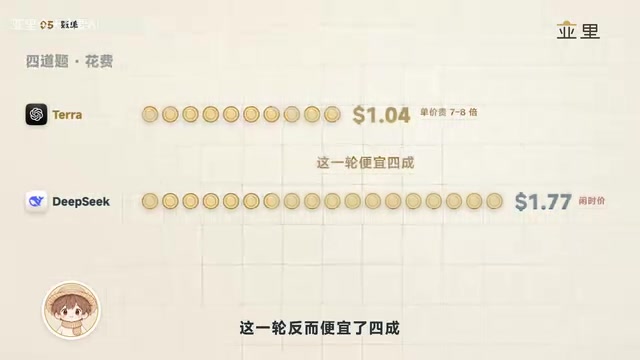
In terms of time, Terra completed all four tasks in under 5 minutes, while DeepSeek's fastest single task took 1 hour and 16 minutes — over 7.5 hours for all four. In terms of cost, DeepSeek at off-peak pricing still cost $1.77, while Terra totaled $1.07 — Terra, despite being seven to eight times more expensive per unit, was actually 40% cheaper overall. The reason: DeepSeek output 280,000 to 370,000 tokens per task, while Terra used only 10,000 to 20,000, with file sizes an order of magnitude smaller.
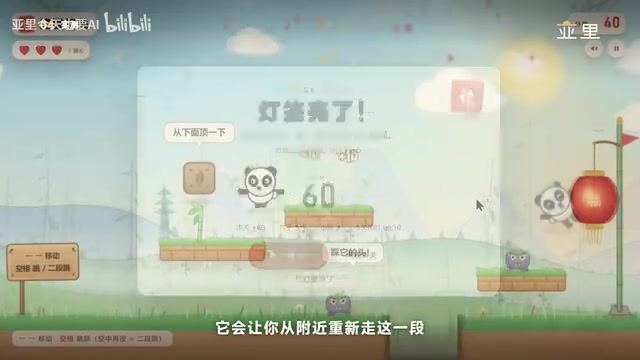
But in terms of quality, DeepSeek's completion level was clearly higher. In the panda platformer, DeepSeek built three levels with bubble hints,结算卡 (score cards), and mini-storylines, with more natural controls; Terra had only one level that could be finished in十几 seconds. In the web-based Minecraft, Terra's screen shook violently, the map was tiny, and the inventory was just flat blocks; DeepSeek had trees, flowers, oceans, and clouds, a much larger map, and even took and adjusted 39 screenshots on its own. The 3D racing comparison was even more stark: Terra's car was slow and could drive off the track, with a lap time of 15 seconds; DeepSeek had a countdown, drift scores, and complete track logic, with stunning visuals.
4. The Secret to Speed: Less Thinking, Less Waiting
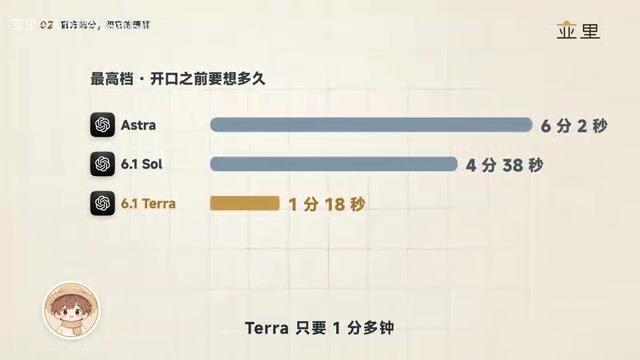
Terra's speed comes mainly from "thinking less and waiting less." Third-party data shows Terra outputs 91 tokens per second, faster than 6.1 Soul's 74 and Astra's 66, but slower than the previous generation 5.6 Terra's 135. The biggest change is in time to first token (TTFT): at the highest tier, Soul thinks for over 4 minutes and Astra for 6 minutes, while Terra takes just over 1 minute; at the medium tier, it starts answering in 1.5 seconds. Combined with fewer images and fewer steps, overall completion is much faster. However, some tests found that at the highest tier, Terra thinks too much and is actually slightly slower than Soul.
DeepSeek's slowness comes from "writing more and testing more." In the Minecraft task, for example, it took 196 steps in total, with only 45 minutes of actual token generation — over 130 tokens per second is actually not slow. What took the most time was the wait before each step — it carried the code and screenshots for each step in the conversation, which grew longer and longer, eventually reaching 360,000 tokens, requiring a re-read before every step. Plus, the test environment lacked a sub-task plugin, so everything had to be done from scratch. On the Codex side, Terra automatically spawned two or three sub-tasks in parallel for each task.
Time to First Token (TTFT) refers to the wait time from sending a request to the model producing its first token, which directly determines how fast the user "feels" it is. Large models often perform a round of internal reasoning before giving an answer (especially at high thinking-intensity tiers); this thinking produces no visible output but lengthens TTFT. Terra compresses the highest-tier TTFT from Soul's 4+ minutes and Astra's 6 minutes down to just over 1 minute, and even 1.5 seconds at the medium tier — this is the main reason for the "perceived speed."
In contrast, tokens per second (TPS) measures how fast it "speaks." Terra's 91 TPS is higher than the two same-generation models but lower than the previous generation Terra's 135, indicating that its speed advantage is not in token emission rate but in shortening upfront thinking and reducing total output.
Sub-agent / task delegation is a scheduling mechanism in Agent frameworks: the main model breaks a large task into sub-tasks, dispatches them to parallel sub-agents for simultaneous execution, then aggregates the results. The Codex desktop version automatically spawns two or three sub-tasks in parallel for each task, significantly compressing overall time.
On the DeepSeek side, because the test environment lacked a sub-task plugin, it could only work serially from start to finish; more critically, there is the context accumulation problem — it kept the code and screenshots for each step in the conversation history, causing the context to grow longer and longer, eventually reaching 360,000 tokens, requiring a re-read of the entire history before each step, multiplying the wait time. This explains why its per-second token output is not slow (over 130 TPS) yet total time stretches to hours.
5. Is It Worth Using?
GPT-6.1 Terra is indeed cost-effective, and the speed that has long been criticized is finally up to par. Computer operation is its main focus — an OpenAI employee demonstrated filling out the same long web form: Terra took 53 seconds, while 6.1 Soul took over 3 minutes; in official OS World benchmarks, its accuracy is also similar to Soul. But for tasks like front-end code generation, the hands-on results are mediocre — it almost feels like an advertisement for DeepSeek.
What DeepSeek produces is indeed better, but you have to be patient. OpenAI's slogan for Terra is "Seize it, does it" — see it, do it. At least on the "fast" front, it truly delivers.

Related articles

Anthropic's IPO Crisis: Why $16.8B in Revenue Can't Buy a High Valuation
Anthropic posted $16.8B in Q3 revenue with 85% gross margin yet faces a cut to its IPO valuation. A deep dive into halved growth, the token price war, circular financing, and the clash between safety ideals and capital reality.

Anthropic Races Toward the Largest IPO in History: Can a $100 Billion Raise Ignite the AI Investment Boom?
Anthropic may file its prospectus as early as October 23, aiming to raise up to $100 billion at a valuation of up to $2 trillion, potentially the largest IPO ever. Q3 revenue hit $16.8 billion, up nearly 50% quarter over quarter, with adjusted profitability, but slowing growth has led some investors to cut valuation to $1.5 trillion. The IPO is a key test of whether the AI investment boom can continue.

Bessemer Partner on Anthropic IPO: The Public's First Direct Investment in AI Software
Bessemer partner Byron Theta on the Anthropic IPO: why it's called the moment everyone's been waiting for, the $650M four-round investment, the LP liquidity bind, and expectations of a 2027 IPO wave—plus open-source model pricing pressure, existential risk disclosures, and what the founders' 50.1% voting structure means for ordinary investors.