GPT-6.1 Terra Hands-On: One-Prompt Websites, and the Trade-Off Between Speed and Cost

Hands-on with GPT-6.1 Terra: one prompt can build a site, but commercial use still needs human review.
Via a YouTube creator's first-hand test, the article evaluates GPT-6.1 Terra's practical value. A single prompt generated an interactive North Star Coffee website prototype with menu, hours, location, and mobile nav, though commercial use still requires checking copy, links, and layout. OpenAI's computer use push and the Agents Last Exam score (57.6% vs 42.6%) show progress, but complex coding still belongs to Sol or Astra. Terra is faster and cheaper, yet results may need reruns, and quota burn was higher than expected—ultimately favoring Luna 6. The takeaway: allocate models by task; bills and rework matter more than benchmarks.
OpenAI used an animated globe to introduce GPT-6.1 Terra, but the question that really matters is simple: for an ordinary user who just wants to get the work done, what does this model actually deliver? A YouTube creator ran a direct test—giving Terra a single prompt to build a website for a fictional coffee shop from scratch—and put the whole process and his impressions into a video.
One-Prompt Website Build: The North Star Coffee Test
The test setup was concrete: a fictional neighborhood coffee shop, North Star Coffee, needed a welcome page, a menu with sample prices, opening hours, location info, and working mobile navigation. The creator gave a single prompt, and Terra completed the design, menu, and store information through ChatGPT Work Insights, generating an interactive preview page. The mobile menu was checked as well.

The creator's first impression: for a single prompt, this is a useful starting point, especially friendly to non-developers. But he also explicitly cautioned that copy, links, and layout still need to be checked and revised before any real commercial site. That judgment matters—the value of one-prompt website building isn't in delivering a finished product directly, but in compressing the time between an "idea" and "something you can see and click."
Computer Use and Benchmark Results
What OpenAI emphasized in this release is computer use: the model can observe on-screen content and interact with software, including clicking buttons, filling out forms, and pushing tasks forward across applications. You give it a goal, and it plans the steps itself to get there.
Supporting this is a benchmark called Agents Last Exam, which tests how agents perform on professional tasks. According to figures published by OpenAI, at medium reasoning effort, GPT-6.1 Terra scored 57.6%, while GPT-5.6 Terra scored 42.6%—a 15-percentage-point improvement.
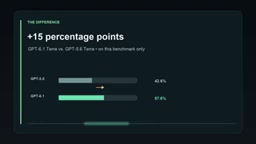
What needs to be clear is that this is an OpenAI-reported, global result, and it doesn't mean Terra is stronger in every scenario. OpenAI also states that for the most complex coding tasks, GPT-6.1 Sol or GPT-6 Astra remain the better choices.
Computer use is a core capability class for today's agent models: the model understands screen captures visually and outputs mouse clicks, keyboard input, scrolling, and other actions, completing tasks in a graphical interface the way a person would. Unlike calling an API or generating code, computer use doesn't require the target software to expose an interface, so it applies more broadly—but it's also more prone to errors from interface changes, pop-up interference, or rendering delays, and typically needs longer step planning and error-tolerance mechanisms. OpenAI making it a focus of this release means the model's capability boundary has extended from "generating content" to "operating software."
Agents Last Exam is an evaluation benchmark for agents. Its name echoes "Humanity's Last Exam," but it assesses agents' actual ability to complete professional, multi-step tasks rather than single-turn Q&A. Such benchmarks typically include cross-application operations, information retrieval and synthesis, and long-process planning, with scoring based on whether the final result is correctly delivered. Note that benchmark scores reflect average performance on a specific task set, and there's still a gap from the complexity and error-tolerance requirements of real workflows—vendor self-reported data especially should be viewed alongside third-party reproduction.
Third-Party Comparison: Fast and Cheap, but You May Need Several Runs
On X, Ruben Soto shared his early comparison of Sol and Claude Opus. In his test, Terra ran noticeably faster and cheaper, but he also noted that Terra's results "may need a few more runs." The creator's response was practical: speed is useful, but the result has to actually be deliverable.
This points to a common tension in today's agent models—speed and cost advantages often come with the need for human review and multiple iterations.
Real Usage Costs in Video Production
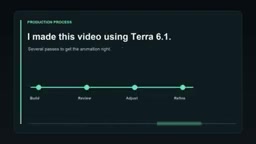
More informative than the benchmark scores is the creator's experience during video production. He used GPT-6.1 Terra to make this video, but it burned through usage quota far faster than expected. After one quota reset, he switched to Luna 6 at the extra high setting to finish the edit. By his account, Luna 6 at extra high performed better than Terra 6.1 at low reasoning effort, at much lower cost, and he plans to stick with that combination going forward.
Separately, the animation in the video took multiple iterations to get right; on similar projects, Claude Sonnet had given him better results. These are first-hand impressions from a single sample, but they reveal the real cost structure beyond official benchmarks.
Reasoning effort is an adjustable parameter offered by OpenAI models, typically graded as low, medium, high, extra high, and so on, determining how much internal reasoning computation the model performs before answering. Higher settings usually improve performance on complex tasks, but consume more tokens and usage quota and respond more slowly. The creator's mention of "Terra 6.1 at low reasoning effort" versus "Luna 6 at the extra high setting" is exactly a comparison of the trade-offs between effectiveness and cost across different model and reasoning-effort combinations.
Availability and Practical Judgment
According to OpenAI's release notes, Plus, Pro, Enterprise, and Edu users can access Terra in ChatGPT Work and Codex. For non-developers, one-prompt generation of an interactive prototype genuinely lowers the barrier to entry; but if the goal is a production environment, none of the human steps—content review, link checking, layout adjustment—can be skipped.
A more pragmatic strategy is to allocate models by task: hand complex coding to Sol or Astra, consider lower-cost settings for cost-sensitive tasks that need lots of iteration, and use Terra for scenarios where you need a quick prototype. Benchmark scores show the trend, but the bill and the number of reworks are what determine whether it's worth keeping in your workflow.

One-line Summary
Hands-on with GPT-6.1 Terra: one prompt can build a site, but commercial use still needs human review, and the cost structure remains to be seen.
Paragraph Summary
Through a YouTube creator's first-hand test, the article assesses the practical value of OpenAI GPT-6.1 Terra for ordinary users. In the test, a single prompt generated an interactive website prototype for the fictional coffee shop North Star Coffee, including menu, opening hours, location, and mobile navigation—but copy, links, and layout still need checking before commercial use. OpenAI's highlighted computer use capability and the Agents Last Exam benchmark (57.6% vs. 42.6%) show progress, though the company acknowledges that the most complex coding tasks should still go to Sol or Astra. Third-party comparisons show Terra is faster and cheaper, but results may need several runs; the creator's quota consumption during the video project far exceeded expectations, and he ultimately switched to Luna 6. The conclusion: allocate models by task—the bill and rework count matter more than benchmark scores in deciding its value.
Related articles

Last Week Tonight Exposé: The Dangerous Ties Between Politicians and White Supremacy
Last Week Tonight investigates Georgia Senate candidate Mike Collins and Florida candidate Marshall Rawson, exposing their multiple ties to white supremacists and the Republican Party's silent response.
AI Buzz Weekly: GPT-6.5 Leak, New Claude Model, and MiniMax's Cost-Effectiveness
This week's AI buzz roundup: suspected GPT-6.5 leak, Microsoft configs showing GPT-6.1 Tera, Anthropic's new model that can identify entire classes of bugs, disappointing early Gemini 4 Carbon results, and MiniMax M3.1 Flash beating Claude Opus 5 and GPT-5.6 Sol in benchmarks at extremely low cost.

AI Briefing: Gemini 4 Carbon Released, Ant Open-Sources Ling-3.1
AI Briefing: Google releases Gemini 4 Carbon qubit model, claiming to surpass Opus 5.5 with half-price tokens; Ant open-sources Ling-3.1-1019 for real-task Personal Agents; domestic AI drug discovery succeeds in 18 of 19 projects, hitting all 6 GPCR targets; zero-revenue company valued at $20B raises another $1B; Sichuan convenience store robot sales fail.