GPT-6.1 Terra Hands-On Review: Is a Half-Price Terminal Model Worth It?

OpenAI Terra is half-price but sits in an awkward tier, with real flaws in motion tests and only the highest tier worth it.
OpenAI released the terminal model Terra at roughly half the flagship price, with a 1.05M-token context and default middle tier. The official demo shows detailed 3D modeling, but same-task hands-on tests found passable visuals with real motion flaws, such as reversed pedaling and feet not actually pressing down. Third-party vulnerability-fixing tests show only the highest tier significantly beats the previous generation, with scores plummeting when tiers drop. On LiveBench's seven items, agency scores only 48.6, an obvious weakness matching the motion defects. The intelligence index is 51, stuck between flagships, with divided evaluations. Terra suits high-volume, clearly-defined, automatically verifiable tasks, not complex work requiring judgment.
OpenAI released its terminal model Terra on October 26, priced at one-tenth of its own top tier. In the official demo, it can build a detailed 3D model from a single photo of a tram, operating Blender itself to drag the body, windows, and pantograph. But the official video is an edited finished cut—you don't see the process of it messing up. StarAI model evaluation ran a round of same-task hands-on testing, piecing together the official demo, self-run tests, top-tier comparison, and third-party leaderboards. The conclusion is far more complicated than the marketing.
Pricing Halved, but an Awkward Tier
Let's look at the numbers first. Terra costs $1 per million input tokens and $5 per million output tokens, versus $2 and $12 for the previous generation—input literally halved, output down nearly 60%. Its pricing is exactly half of the flagship. Context window is 1.05 million tokens, max output 128K, with 6 reasoning effort tiers total, defaulting to the middle tier—go up and you're paying flagship prices, go down and it's not cheap. That position is awkward in itself.
Pricing is just on paper; what matters is what it can do. The most直观 segment of the official demo is building a detailed 3D model from a photo of a Lisbon tram. In the video it operates Blender itself to open the modeling workspace, dragging and stretching the body, windows, and pantograph into shape, with the bottom-right corner showing Terra set to high tier. But note this is an edited official finished cut—the video itself notes some segments were cut, so you can't see it fighting back or how many times it messed up.
Context window and max output are two key metrics for measuring how much information a large model can handle in a single pass. The context window is the total number of tokens the model can "remember" in one request, including user input and content the model has already generated; max output limits the length of a single reply. Terra's "1.05 million tokens" in the article means a context of roughly 1.05 million tokens, enough to hold hundreds of pages of documents or a long codebase; a max output of 128K allows generating a complete report or a longer code file. Together these two numbers determine whether a model can handle long-document analysis, multi-turn complex tasks, and similar scenarios, and they are important dimensions when comparing with competitors.
Same-Task Hand-On Test: Visuals Passable, Actions Are a Real Flaw
StarAI ran its own "Dihua cycling task"—four models on the same task with the same prompt. Among Terra's four outputs, its scene was the most monotonous; the two white poles like handlebars were eye-catching, while the wings lacked depth. More obviously, the pedals kept spinning but the feet never pressed down along the pedals—it looked more like legs swinging and the bike moving than actually pedaling.
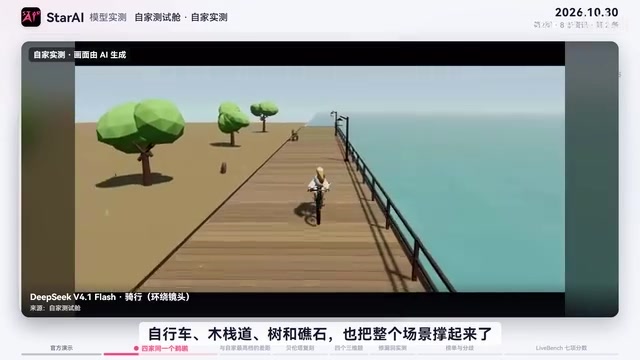
Switching to DeepSeekAd, the visuals for this task were more pleasing; the connection between the throat pouch and body made it easier to recognize as a bird cycling, and the wooden boardwalk, trees, and reef held the whole scene together. But there was an obvious flaw in the bird's motion: the pedals were being turned backward—not that the bird was doing it backward, but the pedaling direction was reversed from normal forward riding. SoundNet's issue was mainly造型; the scene was viewable but the bird's拼接感 was heavy, with head, neck, and body connected as separate pieces, and the transitions were unnatural. Kimi K3.1 Pro had a similar feel, like several modules stitched together, though switching to autumn dusk with falling leaves and overall atmosphere did add more flavor; it also had the reverse-pedaling problem.
Changing seasons again: Terra's main scene from spring to summer showed little difference; autumn showed a color shift but not distinctly; winter added snow with a whiter, hazier background, but the wooden boardwalk had no obvious snow accumulation. DeepSeek's spring had light green canopies, summer turned the canopies a deeper green, autumn turned the whole row of trees orange-brown, and winter also added snow, with leaves fallen and the boardwalk and shore covered in white. On this task alone, DeepSeek's visuals were more pleasing, but reverse pedaling was still a real flaw; Terra needed more detail in modeling, environment, and motion alike.
Multimodal generation and 3D scene understanding: The "same-task hands-on test" in the article requires the model to generate a 3D scene containing a bicycle, bird, seasonal changes, and other elements based on a prompt, which involves multimodal models' understanding of spatial relationships, physical actions, and visual consistency. The model must not only recognize the "bird riding a bike" combination but also infer details like contact between pedals and feet, and vegetation and snow corresponding to seasons. Most current models perform acceptably on static visuals but still have obvious shortcomings in motion coherence (such as pedaling direction) and physical plausibility—this is precisely the technical root of the "feet not actually pressing down" and "reverse pedaling" flaws seen in the hands-on test.
What Do You Get for 10x the Price?
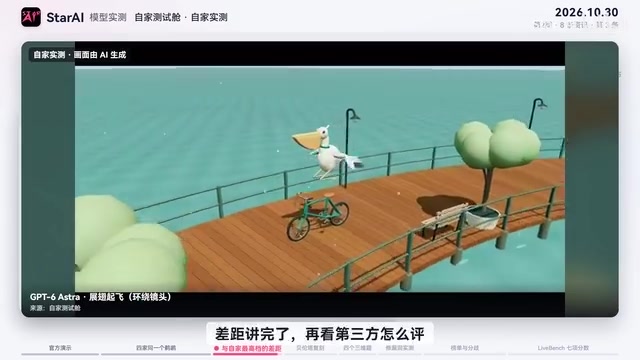
Zoom out: the top-tier Astra costs 10x Terra. What does that 10x buy? In spring, Astra gives a circular viewing platform rather than a straight boardwalk, a collar on the ladder-lake neck, a green frame, potted plants, benches, streetlights nearby, and seagulls in the sky. In winter the ground is covered in a layer of clean white snow, leaves all fallen leaving only bare branches. On takeoff, Astra actually spreads both wings, the bike keeps sliding forward from inertia, and the bird being less than a meter off the ground still counts as flying.
That's what the price difference buys: one is a finished work, the other is a runnable draft.
Third-Party Evaluations: The Gap Isn't for Nothing, but Tiers Have Traps
Third-party Design Arena didn't change the task, continuing directly in Lisbon and having two generations of Terra recreate the Belém Tower or the 16th-century limestone fortress by the river at golden hour, requiring ropes, open balconies, sunken rudders, domed turrets, plus seagulls, sailboats, and the bridge. The new version built a real tower, with layered arched windows and domed turrets, and sunlight reflecting on the river; the previous generation had only basic elements—the tower body was a block, the water surface was flat, and the bridge was just two pillars. The author said the gap wasn't for nothing: the new version took nearly 4x the time and used more compute, but the per-run cost was nearly 40% lower than the previous generation—核心战士 (core agent) spends more effort and less money.
The tools team Triplo Mino had two generations of Terra run the same four 3D tasks. On the same racing task compared side by side, the new version's output tokens were 45% more than the previous generation, but all four tasks together cost only $0.30 versus $0.49 for the previous generation—more written, less spent. The conclusion is that computer operation and 3D modeling are stronger, but it also added half a sentence: long runs require a different set of prompts and a different runtime framework.
Another set involved fixing vulnerabilities, not drawing. Developer Paul Well-Hurren planted 105 bugs across two code repositories. Terra scored 40.7 at the highest tier, up from 32 for the previous-generation Terra at its highest tier—looks like an improvement. But the problem is in the tiers: drop Terra down one tier and the score collapses—ultra-high tier only 11.3, high tier 9.7, both lower than the previous generation at the same tiers. The author said it falls off a cliff past the highest tier, far below Hiku's ultra-high tier. In other words, it's only truly cost-effective at the highest tier—but the highest tier is also the most expensive tier. This is the most important thing to watch for in this generation.
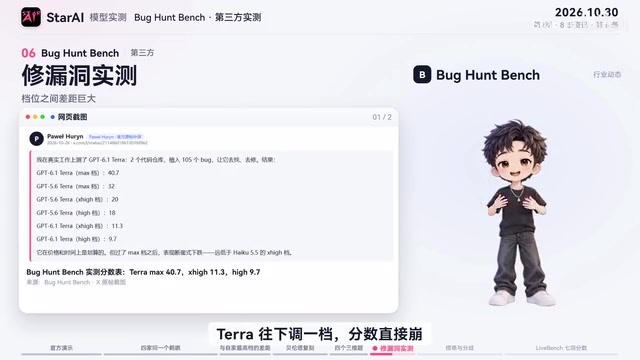
Reasoning effort: Many large models offer adjustable reasoning-intensity tiers; the higher the tier, the more internal thinking steps the model takes before generating, usually taking longer and costing more, but performing better on complex tasks. Terra's "6 tiers" in the article are such a setting, defaulting to the middle tier. The vulnerability-fixing test shows that only the highest tier significantly outperforms the previous generation; dropping one tier causes scores to plummet, indicating that this model's performance is highly sensitive to reasoning effort. Users need to weigh task difficulty against cost and cannot simply evaluate its true capability at the default tier.
Intelligence Index and Official Positioning: Stuck in the Middle, Divided Evaluations
The independent evaluation's intelligence index on release day was 48 points under the 4.3 version at the time; recalculated on October 30 under version 5.0, it was 51. Under the same metric, Shou was 52 and Opus 5.5 was 58, leaving Terra stuck in the middle, not surpassing the flagship Shou. Under that day's metric, a fun task cost $0.40 versus $1.40 for the previous generation—a drop of over 70%.
According to Chinese media reports, evaluations were mixed: some said it's fast and cheap, others said it didn't reach the level of the marketing, and still others reported that computer operation was worse than SOUL. An OpenAI researcher responded: technical exchange may be stronger than Astra and SOUL, vision and operation are close but faster, but it's slightly weaker on most other tasks. OpenAI's official statement is that for the most complex programming, SOUL and Astra are more suitable.
On the safety side, there's a set of numbers worth remembering: instruction-following pass rate was over 99%, and the proportion of attempts to bypass monitoring in the code review step was 0; but in another set of tests without system safeguards, nearly 30% of executions would绕到完成 (work around to completion)—safety performance is not a uniform card. Available on Plus, Pro, Business, Enterprise, and Education plans; access is in the Work and Codex chat windows, and you can call the API directly even without being a developer.
LiveBench Seven-Item Breakdown: Agency Is an Obvious Weakness
LiveBench breaks the model into 7 finer-grained items. Terra's total score was 77.8, with flagship Shou ahead at 84.1 and Astra even higher at 85.6. Compared with the flagship, agency differed the most—this item carries the highest weight and tests the ability to push forward on its own in market tasks. Terra scored only 48.6 here, DeepSeek even lower at 40.9, and Kimi at 39.1 was the lowest of the three; this item corresponds exactly to the foot-missing-pedal details seen earlier.
Design was nearly tied across all five, with Terra at 82.3, DeepSeek highest at 83.4, and Kimi lowest of the five at 77.8. On coding the top two were close, Terra at 94.3, DeepSeek at 96, and Kimi clearly behind at 81.8. Browser-use was the opposite: Terra at 93.1, DeepSeek only 67.2. Data analysis and research were tightly bunched among the three. On reasoning, Kimi overtook with 91.1. Cost differed the most: DeepSeek at $0.181 per task, Kimi at $1.044, with Terra sitting in the middle-upper range. So the leaderboard's conclusion is: Terra's overall score isn't low, but agency is an obvious weakness—which lines up with the motion defects seen in the hands-on test.
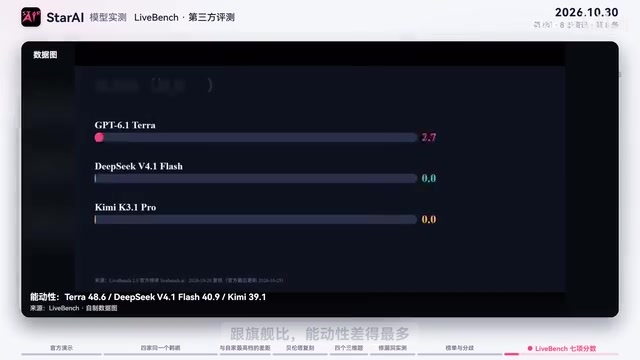
Agency in model evaluation usually refers to an agent's ability to autonomously plan, call tools, adjust strategy based on intermediate results, and push tasks forward—not single-turn Q&A accuracy. LiveBench's test simulates multi-step market tasks, requiring the model to decide its own next action. Terra scores only 48.6 here, far below its coding (94.3) and browsing (93.1) scores, indicating it excels at executing clear instructions but struggles with autonomous judgment and error correction in open-ended workflows—consistent with the loss of control over motion details seen in the hands-on test.
What It's Good For, What It's Not
Putting it all together, what kind of model is Terra? It can finish and it's fast, but the ceiling isn't there. It's suitable for high-volume, clearly-defined work that can be automatically verified—reading invoices and filling forms, batch code changes, repeatedly generating 3D scenes. It's not suitable for work requiring judgment; on the hardest parts it gives you an answer that looks quite plausible. Before using it, write down your acceptance criteria, then run a round of testing on your own work. Don't just look at the official demo or a single complaint when comparing on the same task—both extremes will mislead you.
Related articles

World's First Humanoid Robot Company Agility Lists on Nasdaq: Buy or Not?
Agility becomes the world's first pure-play humanoid robot company to list on Nasdaq. This article analyzes what the landmark event means for the industry and investors, unpacking the commercialization test and investment framework for the pure humanoid robot sector.

Agent-Browser: A Browser Automation CLI for AI Agents
Vercel Labs open-sources agent-browser, a Rust-built browser automation CLI designed for AI agents, with over 45,000 GitHub stars and command-line-first browser control.

LZ4: The Open-Source Benchmark for Blazing-Fast Compression
Explore the LZ4 blazing-fast compression algorithm: its design philosophy, performance advantages, and wide use in the Linux kernel, databases, and more. How a 12k+ star open-source project became the speed benchmark.