GPT-6.1 Terra Launches at Rock-Bottom Price: Do Flagship Work for a Tenth of the Cost

GPT-6.1 Terra matches flagship Agent delivery at one-tenth the price, but intelligence ceiling and total cost still involve trade-offs.
OpenAI's GPT-6.1 Terra is priced at one-tenth of flagship GPT-6 Astra yet matches it on professional Agent task tests, runs three times faster, cuts low-effort hallucination errors from 53.6% to 16.7%, and doubles terminal coding ability. But its third-party intelligence index is only 48, trailing Kimi K3.1 Pro and its own flagship, and complex software engineering still needs Astra; some tasks take longer and use more tokens, so what's cheap is the unit price, not the total cost. OpenAI now has an Astra/Soul/Terra product line, and industry competition is shifting from benchmark scores to per-task cost and delivery efficiency. The article advises Plus/Pro users to migrate high-frequency repetitive tasks, developers to route models by difficulty, and observers to wait for the price war.
OpenAI's newly released GPT-6.1 Terra has shaken up the Agent market with a set of sharply contrasting numbers: its API price has been slashed to one-tenth that of the flagship GPT-6 Astra, yet it matches the flagship's performance on multiple Agent task tests. Is this new product—officially positioned as a "worker model"—a heaven-sent tool for bringing Agents to scale, or just a new round of cost games? This article combines the hands-on analysis of Bilibili creator "A Bao" with official data to break down its real capability boundaries.
1. What Terra Is: Aimed at "Execution," Not "Intelligence"
Terra's positioning is very clear—it doesn't aim to be the intelligence ceiling, but instead packages three things together: "can understand images, can operate a computer, and is cheap enough." Official demo scenarios include reading architectural blueprints and generating 3D models, inspecting animated films frame by frame, creating time-coded records for repair teams, and reading invoices to automatically enter them into financial systems. These repetitive professional tasks that used to require flagship models are exactly Terra's main focus.
Price is the core weapon: standard API input at $1 and output at $5 per million tokens, directly halved compared with the previous generation 5.6 Terra and just one-tenth of GPT-6 Astra. The pricing logic points in one clear direction—if Agents are to be rolled out at scale, being smart alone isn't enough; it must be cheap enough that enterprises are willing to deploy in volume.
"Reasoning effort" is a key parameter for understanding the data in this article. In the o series and subsequent reasoning models (such as the generation to which this round's Terra/Astra belong), users can explicitly specify how long an internal chain of thought the model should perform before answering, usually divided into low, medium, and high levels. The higher the effort, the more tokens and time the model spends, but the higher the accuracy and stability; the lower the effort, the faster and cheaper the output, but the more prone it is to errors or hallucinations. This is exactly the background for statements in the original text such as "matches the flagship's highest tier at medium reasoning effort" and "error rate drops to 4.3% with reasoning maxed out"—the same model is almost two different products at different effort levels, and reasoning effort tiers must be aligned before comparing benchmark scores, otherwise the numbers are not comparable.
2. Hard Metrics: Agent Tasks Match the Flagship, Speed Is the Highlight
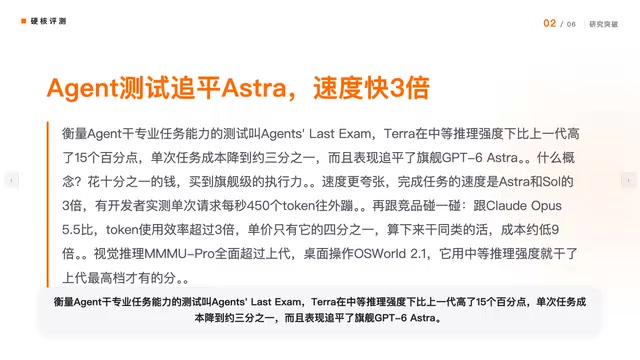
According to test data cited by Bilibili creator A Bao, on Agent's Last Exam, which measures professional Agent task capability, Terra at medium reasoning effort is 15 percentage points higher than the previous generation, with per-task cost reduced to about one-third, matching the flagship GPT-6 Astra. Buying flagship-level execution at one-tenth the unit price is the core signal conveyed by this set of data.
Speed is even more prominent: it completes tasks three times faster than Astra and Soul, and developers have measured a single request reaching 450 tokens per second. Compared with competitor Claude Opus 5.5, token usage efficiency is more than three times higher and the unit price is only one-quarter, making the cost of completing similar tasks about nine times lower. Visual reasoning on MMMU Pro comprehensively surpasses the previous generation, and on desktop operation OS World 2.1 it reaches the previous generation's highest-tier score at medium reasoning effort.
Agent's Last Exam is a high-difficulty evaluation set aimed at AI Agent capabilities. Unlike HLE (Humanity's Last Exam), which tests single-turn knowledge Q&A, it focuses more on end-to-end professional task delivery: the model needs to autonomously call tools, read multimodal materials, complete multi-step operations, and produce a final artifact. MMMU Pro mentioned in the article is an upgraded version of the multimodal visual understanding benchmark, covering professional scenarios such as charts, blueprints, and scientific images; OS World 2.1 evaluates the completion rate of models directly operating a desktop environment (clicking, typing, switching between applications). Together, these three types of metrics point to "whether the work can be finished," not "whether the answer is known," which is also why this article emphasizes that what Terra matches is delivery tests, not the intelligence ceiling.
3. Two Easily Overlooked Enterprise-Grade Improvements
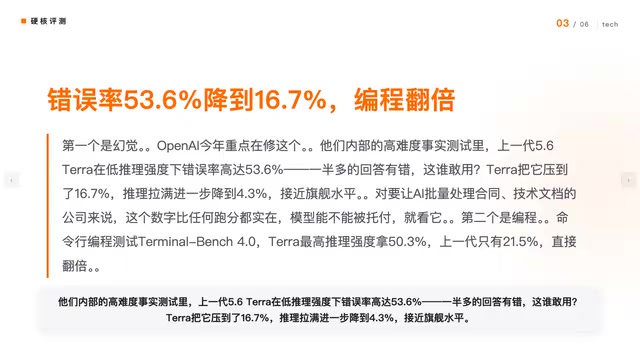
For enterprise deployment, hallucination and coding capability are more critical than benchmark scores. OpenAI's internal high-difficulty factual tests show that the previous generation 5.6 Terra had an error rate as high as 53.6% at low reasoning effort, with more than half of answers having problems; Terra brings this number down to 16.7%, and further to 4.3% with reasoning maxed out, approaching flagship level. For companies that need to process contracts and technical documents in bulk, this reduction is more convincing than any benchmark score.
Coding capability has likewise doubled: on the terminal command-line coding test Terminal Bench 4.0, Terra scores 50.3% at the highest reasoning effort, while the previous generation scored only 21.5%; on the scientific coding test Terminal Bench Science it even surpasses the higher-positioned Soul, and is less than 5 percentage points behind Claude Opus 5.5, while the estimated cost is less than one-fifth of the latter.
Terminal Bench is a benchmark that evaluates a model's ability to complete command-line operation tasks in a real terminal environment, covering scenarios such as file processing, Git operations, script debugging, and system configuration; its Science variant replaces the tasks with scientific research workflows such as data cleaning, experiment script writing, and result reproduction. The difference between this type of benchmark and ordinary code generation tests is that it requires the model to execute commands itself, read errors, and iteratively correct them, which is closer to a real coding Agent workflow. Enterprises are sensitive to these two scores because command-line and scripting capabilities directly determine whether an Agent can independently complete operations, batch processing, and automated pipeline tasks—and this is precisely the most core deployment scenario for a "worker model."
4. A Bucket of Cold Water: What It Matches Is Delivery Tests, Not the Intelligence Ceiling
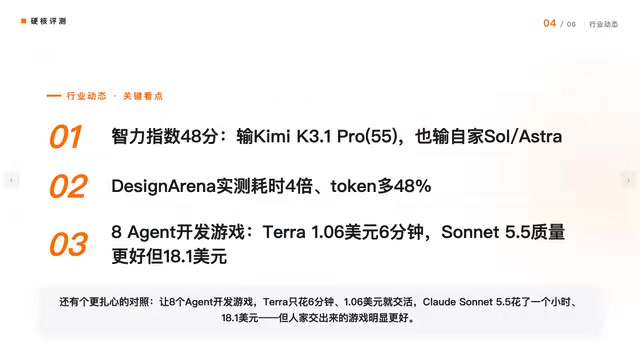
It is essential to distinguish what Terra is matching. What it matches is Agent task delivery tests, not the model's intelligence ceiling. On third-party intelligence indices it scores only 48, losing to Kimi K3.1 Pro's 55 and also trailing its own Soul and Astra. OpenAI itself admits that the most complex software engineering and deep research still require the flagship.
There are costs in actual experience. One evaluation organization had Terra recreate "the sunset over the towers of Lisben," and the generated image was indeed more refined, but it took four times as long as the previous generation and consumed 48% more tokens—what's cheap is the unit price, not the total. An even more striking comparison is having 8 Agents develop a game: Terra delivered in just 6 minutes at a cost of $1.06, while Claude Sonnet 5.5 took an hour and $18.1, but the latter's final product was clearly better. Cheap and good-to-use still require trade-offs.
On the safety side, Terra reaches the Critical risk level for cyberattack capability in OpenAI's own framework, inheriting the flagship's protection conclusions. It is a good sharp knife, but not an all-purpose one.
"A cheap unit price does not mean low total cost" is the most easily overlooked point when evaluating Agent models. Large models are billed by input and output token counts, while Agent tasks often require multiple rounds of tool calls, long context, and repeated retries, so a single task may consume dozens of times more tokens than an ordinary conversation. If a model tends toward lengthy reasoning or repeated trial and error, even if the unit price per million tokens is only one-tenth of the flagship, the total spend may still exceed it. The original text's statement that "what's cheap is the unit price, not the total" and the example of the recreation test consuming 48% more tokens illustrate exactly this: when selecting a model, base decisions on the total cost per task and the first-pass success rate, not just the API list price.
5. Industry Interpretation: What's Compared Is Not Benchmark Scores, but Per-Item Cost
According to Bilibili creator A Bao's analysis, OpenAI's product line division this year is already clear: Astra pursues the intelligence ceiling, Soul emphasizes comprehensive capability, and Terra focuses on efficient execution—similar to cloud computing vendors' high-, mid-, and low-tier strategy. The judging standard is also changing—the industry is not comparing Benchmark scores, but how much money and time it takes to finish the same job and whether delivery can be stable.
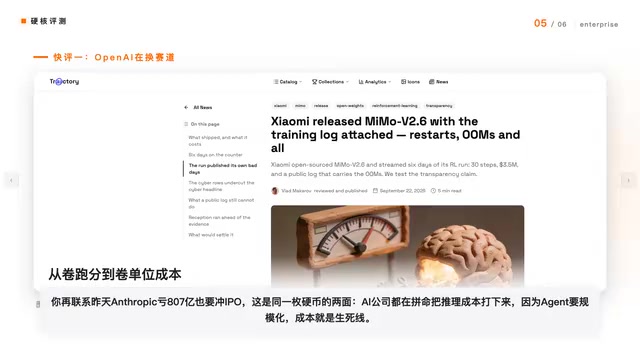
This judgment echoes the news that Anthropic is still pushing for an IPO despite an 80.7 billion loss: AI companies are all desperately driving down inference costs, because once Agents scale, cost becomes a matter of life and death. Price cuts are not charity, but the entry ticket to win enterprise orders.
6. Practical Advice for Three Types of Users
For ChatGPT Plus and Pro users, Terra is available now in ChatGPT Work and Codex, and the same quota can accomplish twice as much work as the previous generation. It is recommended to first migrate high-frequency repetitive tasks such as bulk document reading, spreadsheet organizing, and script writing, and the quota will immediately become more durable.
For API developers, the model name is GPT-6.1 Terra. The focus should be on driving down the per-item cost of Agent tasks, and batch tasks can be switched over directly; but there is no need to force savings on high-difficulty tasks—use Astra when Astra is needed, since the cost of one rework is often greater.
For those waiting on the sidelines, the price war has only just begun. Kimi K3.1 Pro's intelligence index is still 7 points higher, its weights will be open-sourced on November 4, and domestic models' prices will only get more aggressive. At this stage, the wait-and-see crowd is not at a disadvantage.
The flagship is responsible for accumulating experience, and the worker model is responsible for turning that experience into daily routine. When the cost of matching the flagship goes from one dollar to one dime, what really changes is not the benchmark score, but the speed at which AI enters ordinary work.
One-line Summary
GPT-6.1 Terra matches flagship Agent delivery capability at one-tenth the price, but there are still trade-offs in intelligence ceiling and total cost.
Paragraph Summary
OpenAI's GPT-6.1 Terra is priced at just one-tenth of the flagship GPT-6 Astra, yet matches the flagship on professional Agent task tests, runs three times faster, cuts hallucination error rates at low reasoning effort from 53.6% to 16.7%, and doubles terminal coding capability. However, its third-party intelligence index is only 48, trailing Kimi K3.1 Pro and its own flagship, and complex software engineering still requires Astra; some tasks take longer and consume more total tokens, showing that what's cheap is the unit price rather than the total cost. OpenAI thereby forms a high-, mid-, and low-tier product line of Astra, Soul, and Terra, and the industry's competitive focus is shifting from benchmark scores to per-task cost and delivery efficiency. The article suggests Plus/Pro users migrate high-frequency repetitive tasks, developers route models by difficulty, and wait-and-see observers hold off for the price war.
Related articles

GPT-6 Astra's Weight-Reading Trick: Only for Small Networks, Practical Value Comes from Writing Code
GPT-6 Astra can read network weights directly, but without tools it is limited to small networks of ~170K weights. Fixing QUEN 3.5 0.8b's reasoning loop required Python and 50 batches; game identification took nearly an hour. This article maps the capability's boundaries and two security reminders.

GPT-6 Astra Rewrites Qwen Weights: 7.9% to 48.1% — Did It Learn Math or Just Learn to Stop?
MIT researchers used GPT-6 Astra to edit Qwen's weights directly, raising math scores from 7.9% to 48.1% with no training. But reproductions show the gain mainly comes from fixing loops and teaching the model to stop, not new math ability.

Can Qwen 3.8 27B Really Read Neural Network Weights? A 16GB Hands-On Test
MIT claims LLMs can directly read neural network weights. We tested Qwen 3.8 27B on a 16GB GPU: the signal is real, but "native reading" is false.