GPT-6 Astra's Weight-Reading Trick: Only for Small Networks, Practical Value Comes from Writing Code

GPT-6 Astra can read weights of small ~170K-parameter networks tool-free, but real models need code assistance; weight editing remains limited to small models and tiny edit proportions.
Based on Hacker News discussion and developer experiments, this article reconstructs the boundaries of GPT-6 Astra's ability to understand and edit models by reading network weights. Pure tool-free weight reading covers only small networks of about 170,000 parameters; in the QUEN 3.5 0.8b fix, Astra wrote Python code and ran up to 50 batches of practice problems, raising math solve rates from about 1/13 to nearly half via tiny weight edits. Simon Willison's laptop test showed QUEN 3.8.27b identified Pac-Man, Pong, and Breakout from weights alone, each taking nearly an hour, and missed Freeway. The article also covers a 1995 desktop running Stockfish—showing software improvements often matter more than hardware—and warns that the Codex training data toggle may not truly be off and that the Postman desktop app installs plugins into Codex and Claude Code. The conclusion: weight reading is a window into interpretability research, not a one-click editing technique for large models.
Introduction: When a Model Learns to "Read" Its Own Weights
On Tuesday, a Hacker News headline discussed a topic that sounds straight out of science fiction: over what range can GPT-6 Astra actually edit a network by reading its weights? A paper titled Sparks of Weights-Based Programming had Astra inspect the raw numerical values of a network directly—without any tools—and state what it was trained to do. The premise is compelling, but where are the real boundaries? Drawing on the Hacker News discussion, developer experiments, and notes from paper curator Matthew Hannibal, this article reconstructs the true scope and limitations of this capability.
Model weights are the set of all learnable parameters in a neural network, typically stored as multidimensional tensors. For a language model, weights include embedding matrices, projection matrices in attention layers, and connection weights in feedforward networks, with counts ranging from millions to hundreds of billions. "Reading weights" means the model directly parses the statistical features and structural patterns of these values—without running a forward pass or calling external tools—to infer what task the network was trained for. This capability differs from traditional interpretability methods (such as probe classifiers or attention visualization) because it requires the model to develop a kind of "metacognition" about the weights themselves: an understanding of the mapping between numerical distributions and function.
Tool-Free Weight Reading: Upper Limit Around 170,000 Weights
Matthew Hannibal (author of Spacey), who curated the paper, categorized the experiments. The purest "tool-free" setting—relying solely on weight values without calling external tools—covers only small networks, with an upper limit of about 170,000 weights. This means Astra's ability to directly "read" weights remains at toy scale and cannot yet handle real language models.
The tests with genuine practical value all involve having Astra write Python code to assist with analysis and editing. In other words, Astra's strength is not "pure looking" but "looking + writing code to verify."
Core Case: Fixing the QUEN Reasoning Loop
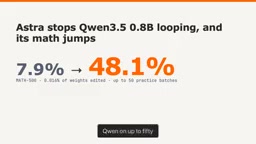
The paper's headline result is a fix for QUEN 3.5 0.8b. This model had fallen into a reasoning loop and could not escape. Astra edited only a tiny fraction of the weights, raising the model's math problem-solving rate from roughly 1 correct out of every 13 problems to nearly half.
Achieving this was not easy: Astra wrote code and ran QUEN on up to 50 batches of practice problems. Hannibal notes that the tool-free setting covers only what "a human machine learning engineer could do by hand." 3.13, who works on interpretability research, estimates that doing the same work manually would take 4 to 8 hours.
Interestingly, this fix targeted a small 0.8b model, and the proportion of weights edited was extremely small. This suggests that the feasibility of weight reading and editing drops rapidly as network size grows.
Reasoning loops refer to the phenomenon where a language model repeatedly enters the same line of thought while generating an answer and cannot converge on a final result. Common symptoms include: repeatedly outputting the same reasoning steps, oscillating endlessly among multiple candidate answers, or repeatedly verifying an already-solved problem. Causes are usually related to pattern biases in training data, decoding strategies (such as too low a temperature), or local optima in the model's internal representations. In the QUEN 3.5 0.8b case, Astra broke the loop by editing a very small proportion of weights—essentially locating and correcting, in parameter space, the specific connection patterns that caused the repetitive behavior. This is an application of weight editing, which differs from fine-tuning in that it does not rely on gradient descent but directly modifies parameter values.
Developer Experiment: A "Guess the Game" Test on a Laptop
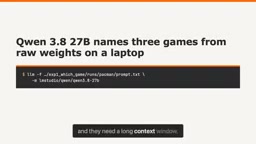
Simon Willison ran a publicly reproducible test. He fed the game prompts from the paper to QUEN 3.8.27b (a 17GB model) running in LM Studio on a laptop. The prompts are on GitHub and require a fairly long context window.
The result was interesting: starting from weights alone, QUEN correctly identified Pac-Man, Pong, and Breakout, each taking nearly an hour, but missed Freeway. Willison believes a patient person with pen and paper could do the same. This shows that the model can indeed extract abstract information related to the training task from weights, but it is slow and has limited accuracy.
LM Studio is a desktop application that supports running open-source large language models locally, offering a graphical interface and a local server compatible with the OpenAI API. Users can download quantized models in GGUF format and run inference offline on consumer hardware (such as a laptop). Willison's test used a 17GB QUEN 3.8.27b model, requiring substantial memory and a long context window. The significance of this setup is that it proves weight-reading experiments do not depend on cloud compute or proprietary tools—ordinary developers can reproduce them, lowering the barrier to research in this field.
Another Reference Point: Running Stockfish on a 1995 Desktop
The discussion also included a seemingly unrelated but highly instructive project: Nicholas Carlini ported Stockfish to a 1995 machine with a 200MHz Pentium Pro and 64MB of RAM. After tuning for that chip, its playing strength far exceeded Kasparov's, with a win rate likely above 90%. This means a desktop from that era could beat the chess champion without Deep Blue's custom chips, and most subsequent progress came from better software. The machine is online and available for actual play. Club-level player K2052 reported finding a line that beats it.
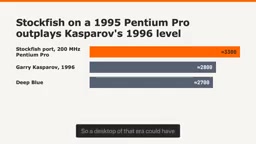
This case reminds us that algorithmic and software improvements are often more critical than throwing more hardware at a problem. By analogy to weight reading, Astra's "write code" assistance may be more promising than pure weight reading.
Two Security Reminders: The Training Data Toggle and the Postman Plugin
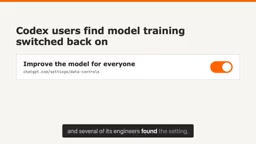
The Hacker News discussion also surfaced two practical issues. First, if you have ever turned off training data sharing in Codex chat, be sure to confirm it is still off. One company required all employees to disable data sharing to protect code, but multiple engineers found that Codex was actually still enabled. Chris Kenan requested disabling training twice, was approved both times, and then found it turned back on. OpenAI's privacy portal has a second toggle controlling the same thing. In a later update, the setting benefited everyone—but was then re-enabled in ChatGPT's data controls.
Second, the Postman desktop app installs plugins into Codex and Claude Code when opened by a logged-in user, and the Postman CLI does the same. IndicaVa discovered a startup hook that tells Codex to load the Postman skill before any non-trivial API task, and the installer code also attempts to approve that hook on its own. Another user saw the same installation on a new version. If you need an API client this week, the poster suggests Bruno, because it stores requests as plain files in a Git repository.
The training data sharing toggle is a privacy control offered by AI service providers that lets users decide whether their conversations are used to improve models. For OpenAI, for example, this setting is spread across multiple entry points: ChatGPT's data controls panel, API organization privacy settings, and separate toggles for specific products like Codex. Due to legacy history and product-line fragmentation, the same intent may correspond to multiple non-synchronized toggles, so that after a user turns it off in one interface, another entry point remains on. This "toggle fragmentation" is a common risk in privacy compliance—especially when a company requires all employees to disable data sharing, every relevant entry point must be checked individually.
Conclusion: Weight Reading Is a Research Window, Not a General-Purpose Editing Technique
Drawing on multiple sources, GPT-6 Astra's weight-reading capability shows verifiable performance on small networks, but once scaled to real language models, it must rely on writing code and batch experiments. The QUEN fix demonstrates potential while also exposing the cost: small models, small edit proportions, and hours of effort. For practitioners, the more pragmatic path is to treat weight reading as a window into interpretability research rather than as magic for one-click modification of large models.
Related articles

Qwen 3.8 Beats Opus at Coding—But Can Your Mac Run It?
Open-source Qwen 3.8 beats Opus 4.6 at coding at just 18GB, but how much Mac memory do you need? 24GB crashes; 32GB is the sweet spot. Full config guide inside.

Claude Code + Agent: Building a Fully Automated AI Testing Loop
Bilibili course breakdown: how test developers can use Claude Code terminal-based Agents to build a fully automated AI testing loop. Compares permission boundaries of terminal vs. device Agents, explains why enterprise projects choose Claude Code over Open Claude-type tools, and outlines the Node.js environment setup and DeepSeek model integration path.

Working with AI Agents Requires Nerves of Steel
The more autonomous AI agents become, the heavier the user's psychological burden. Drawing from a Hacker News discussion, this article analyzes black-box anxiety, behavior drift, and monitoring fatigue in agent collaboration, and offers practical approaches like sandbox isolation, permission control, and task granularity management to reduce cognitive load.