GPT-6.2 Appears in API Docs, Gemini 4 Carbon Goes Live

Dense model iteration and an active open-source ecosystem, with efficiency and cost as the new battleground.
This AI morning report shows leading labs and the open-source community advancing in parallel: OpenAI's docs mention GPT-6.2 for the first time, Google opens Gemini 4 Carbon and a multi-agent collaboration preview, and Anthropic offers a quota reset and MCP Apps connector upgrade. On the open-source side, MiniMax, Ant Lingbo, NVIDIA, and Zyphra released image, tactile, video regeneration, and voice cloning models. Efficiency and cost are the new focus, and Claude Fable 5.2 reportedly solved two open problems in black hole physics.
Today's Overview: Dense Model Iteration, Active Open-Source Ecosystem
This round of AI product updates centers on two main threads: next-generation models and agent capabilities from leading labs are moving from preview to availability, while the open-source side continues to lower deployment barriers across image, tactile, and speech modalities. According to a roundup from Bilibili's AI Morning Report, OpenAI, Google, Anthropic, and Meta all made new moves, while open-source projects from MiniMax, Ant Lingbo, NVIDIA, and Zyphra advanced in parallel.
Leading Models: New Versions Surface and Productization Advances
GPT-6.2 Appears for the First Time in Official API Docs
OpenAI's official API documentation explicitly mentions GPT-6.2 for the first time. The docs warn that when replaying compressed context with custom instructions, 6.2 and later models may lose subsequent reasoning content — this is a compatibility note, not a performance claim. The same source also mentions that GPT-6.2 Astra may be coming.
Compressed context replay refers to the system compressing early content into a summary when conversation history exceeds the model's context window, so it can be replayed in subsequent requests. The compatibility issue mentioned in OpenAI's docs is that when a compressed summary carries custom instructions (such as system prompts or role settings), GPT-6.2 and later models may fail to correctly preserve the reasoning chain following the summary, resulting in incomplete output. This suggests developers designing long-conversation applications should place key instructions before the compression boundary, or avoid attaching new custom instructions when replaying summaries.
Gemini 4 Carbon Lands in AntiGravity
Google has opened Gemini 4 Carbon to Google AI Ultra users in AntiGravity, along with a multi-agent collaboration preview: multiple agents can write code, test, and review changes in parallel, with Carbon handling complex planning and verification while lightweight models handle routine tasks — the feature is rolling out gradually. Meanwhile, Google Cloud launched a Gemini program for healthcare aimed at integrating clinical data and automating workflows, with the goal of reducing administrative burnout.
Claude Quota Reset and Connector Upgrade
On Anthropic's side, Cloud paid users can claim a one-time free full quota reset covering all models and the 5-hour and weekly usage limits. The company says recent issues caused quota consumption to exceed expectations, and the earlier Fable-specific reset did not resolve all cases; users must manually claim it before a specified time via the usage page in settings or a dedicated page.
Claude's interactive connectors have also been upgraded: users can open the full interface of third-party apps like Adobe and Notion directly in the chat window and collaborate with Claude in real time to edit documents, edit images, or process PDFs, with changes displayed in sync and available for user review. The new feature is built on MCP Apps and is rolling out to all plans on web and desktop.

The morning report also mentioned a screenshot of official developer documentation showing an OpenAI UI field, which was joked about as the two labs "innovating together." The field belongs to OpenAI's MCP extension interface for declaring app entry points and is not itself evidence of plagiarism.
MCP Apps is an application extension specification for the Model Context Protocol (MCP). MCP was proposed by Anthropic to provide AI assistants with a standardized way to connect to external tools and data sources. MCP Apps further defines how app entry points are declared, enabling Claude to embed the full interface of third-party apps (such as Adobe and Notion) directly within the chat window with bidirectional real-time sync. This differs from simple API calls — it deeply integrates app UI with AI interaction, letting users complete document editing, image processing, and other tasks without leaving the conversation while retaining a human review step.
OpenAI's Commercialization Moves
OpenAI launched a beta of the ChatGPT merchant platform, where merchants can manage profiles, create dedicated AI assistants to interact with users, update product prices and inventory, and view brand mention counts and website clicks, while users can inquire about and compare products. It is initially open to eligible US e-commerce and online service businesses. According to The Information, OpenAI has told investors that Q3 revenue was about $10 billion, up nearly 50% from the previous quarter. In addition, OpenAI acquired AI travel platform Odyssey, which was founded less than a year ago; its founder Francis Davison will join OpenAI to focus on the future of travel.
Open-Source Side: Image, Tactile, Speech, and Video All Blooming
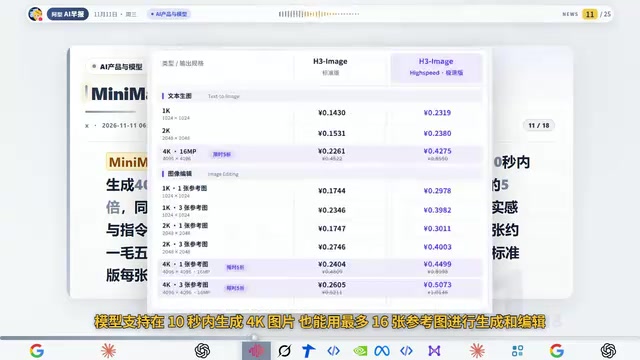
MiniMax released and open-weighted the H3-Image model, which supports generating 4K images in under 10 seconds and can also generate and edit using up to 16 reference images. The company claims speeds up to 5x that of mainstream models; at launch pricing, standard 2K text-to-image costs about 0.15 yuan per image, and standard 4K text-to-image is about 0.23 yuan per image at 50% off in the first week.
Ant Lingbo open-sourced the tactile foundation model LingBot Touch, which can unify different types of tactile signals into general-purpose tactile tokens, supporting cross-sensor, dexterous-hand, and task transfer. In tests, VLA success rate rose from 45.60% to 72.5%; the model was pretrained on 4,983 hours of real tactile data, and the Tiny and Small versions are already open-sourced on Hugging Face under Apache 2.0.
NVIDIA open-sourced a video regeneration model that first generates a 768P video draft, then regenerates it to 2K or even 4K in just 3-4 steps; compared with ordinary super-resolution, it better preserves faces, lip movements, text, and scene structure. Zyphra open-sourced the voice cloning model Zonus 3 Mini, with 800 million total parameters and 100 million activated per run, 57 ms first-audio latency, and real-time operation on-device or even in the browser under Apache 2.0; developers who tested it report natural sound and high fidelity.
Tactile foundation models are general-purpose models pretrained on large-scale multi-sensor tactile data that can unify tactile signals of different physical forms (such as piezoresistive, capacitive, and optical) into token representations, thereby supporting transfer across sensors, dexterous hands, and tasks. Ant Lingbo's open-source LingBot Touch is one such model, pretrained on 4,983 hours of real tactile signals. The value of such models lies in solving the fragmentation problem of tactile hardware: developers no longer need to train policies separately for each sensor type and can directly reuse a unified representation, significantly lowering the barrier to dexterous robotic manipulation.
Competitive Landscape: Efficiency and Cost Become the New Battleground
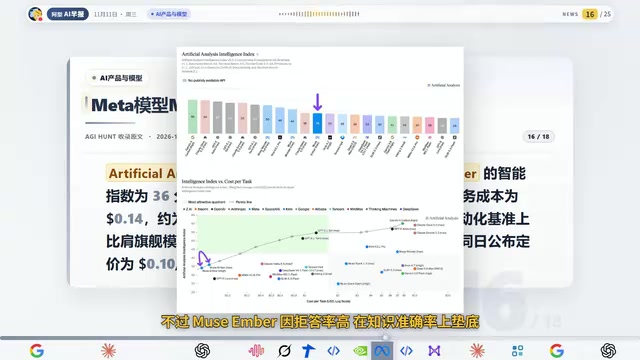
Artificial Analysis evaluations show that Meta's Muse Ember has an intelligence index of 36, on par with Claude Haiku 5.5's Max mode, at about one-third the per-task cost; however, Muse Ember ranks last on knowledge accuracy due to a high hallucination rate, while matching flagship models on automation benchmarks.
Another set of data from Semi-Analysis is more intriguing: Claude Fable 5.2 scored 21.8% on materials science tasks, close to GPT-6 Astra's 21.6%, but cost $78.73 per task — 89% more than the latter and about 7.5x that of Gemini 4 Carbon. The firm attributes Fable's lower token efficiency to its more persistent task processing and frequent spawning of sub-agents.

Musk revealed that Grok 4.8 has completed pretraining and is entering the reinforcement learning phase, with plans to open it to some GrokBot users this week. xAI rewrote its reinforcement learning and reasoning systems from scratch, and its supervised fine-tuning data also underwent large-scale cleanup — work that extended the development cycle. He admitted the new version has not yet met expectations, but the underlying foundation is now right.
Token efficiency measures the ratio of tokens consumed to task quality when a model completes a specific task. In agent scenarios, models may repeatedly plan, spawn sub-agents, or perform multiple rounds of self-verification, causing token consumption to surge. Semi-Analysis notes that Claude Fable 5.2's per-task cost is significantly higher than peers, partly because it tends toward more persistent processing and frequent spawning of sub-agents, lowering token efficiency. This metric is becoming key to evaluating the real-world deployment economics of models, especially for enterprise users with large-scale automation tasks.
Research and Safety: AI Starts Tackling Hard Problems
Anthropic announced that Claude Fable 5.2 solved two open problems in black hole theoretical physics: one is the RAW and small-universe Hawking-Page phase transition calculation proposed in 2003, and the other is the exact limit of the simplest version of Modular Bootstrapping proposed 15 years ago. Both results have been written up as preprints and labeled as primarily AI-generated, though how much the AI completed autonomously awaits official details.
Geodesic released the molecular structure prediction model Nova Atom Lite, which can predict the structure and assembly of proteins, nucleic acids, and binding molecules. On the official FoldBench antibody and antigen benchmark, it scores about 79% under the specified scoring standard versus AlphaFold 3's 48%; the model was developed by a team of about 15 people.
Google DeepMind released the multi-agent formal verification framework AlphaProof Code, which in about 4 weeks verified the real production code of the Signal cryptographic protocol at the machine-code level; Gemini-driven agents generated about 6 million lines of proofs, of which about 1% were human-reviewed, and the paper and proof code are public and machine-checkable. In the same period, DeepMind released the MKA benchmark on Hugging Face, covering 10 professional domains including surveying, architectural design, and engineering, requiring agents to read blueprints and other materials, synthesize multiple files, and call tools to deliver spreadsheets; the dataset is under Apache 2.0.
On the safety side, OpenAI announced it will host a cybersecurity-themed livestream to showcase its latest research and product progress, noting that frontier models can help find and fix important vulnerabilities in their own code and infrastructure. On education, a survey cited by OpenAI's education research report found that 79% of surveyed students have used AI to complete homework, but only 47% have received related guidance — usage far outpaces guidance. OpenAI is working with Estonia, Greece, Slovakia, and other countries to promote teacher AI training and AI literacy education.
Summary
Taken together, one clear trend emerges from today's news: competition in model capability is shifting from "can it do it" to "is it efficient and reliable." The compressed-context compatibility note, token efficiency and per-task cost, and multi-agent parallelism and verification are different sides of the same coin. The dense releases on the open-source side are bringing tactile, speech, and video — modalities that once had high barriers — more quickly into developers' toolboxes.
One-line Summary
Dense model iteration and an active open-source ecosystem, with efficiency and cost as the new battleground.
Paragraph Summary
This AI morning report shows leading labs and the open-source community advancing in parallel: OpenAI's docs mention GPT-6.2 for the first time and flag a compressed-context compatibility issue, Google opens Gemini 4 Carbon and a multi-agent collaboration preview, and Anthropic offers a quota reset and upgrades MCP Apps connectors. On the open-source side, MiniMax, Ant Lingbo, NVIDIA, and Zyphra released image, tactile, video regeneration, and voice cloning models respectively, greatly lowering the barrier to multimodal deployment. In the competitive landscape, efficiency and cost are the focus: Muse Ember matches Claude Haiku at one-third the cost, while Fable 5.2's per-task cost is 89% higher than peers. In research and safety, Claude Fable 5.2 reportedly solved two open problems in black hole physics, and DeepMind launched the formal verification framework AlphaProof Code.
Related articles

Prompt Engineering for Beginners: From Writing Prompts to Engineering Thinking
Starting from the essence and four functions of prompts, this article systematically explains the six-step process, four success criteria, learning value, and practical limitations of prompt engineering to help you build a complete understanding.

Anthropic Launches Nasdaq IPO: AI Giant's Listing and Risk Disclosures
Anthropic officially launches its Nasdaq IPO under ticker ANT, with market valuation expected to potentially exceed SpaceX's record. The prospectus devotes nearly 100 pages to AI risks, while first-half revenue grew over 14x but net losses widened sharply, reigniting the AI bubble debate.

Rust cURL Clone Uses 4,832 unsafe Blocks—Is the Memory Safety Myth Broken?
A Rust cURL clone uses 4,832 unsafe keywords, challenging Rust's memory safety narrative. We analyze what unsafe really means, compare Fil-C, and examine rewrite motives.