GPT-6.2 Astra and Sol Released: Performance Soars, Costs Plunge
OpenAI releases GPT-6.2 series Astra and Sol, as AI shifts toward agents that independently complete complex professional tasks.
OpenAI officially releases the GPT-6.2 series models, including the performance flagship Astra and the high cost-effectiveness version Sol. Astra scores 78.3% on Agent's Last Exam, up 5.2 percentage points from the previous generation at less than one-third the cost, with clear gains in professional work, CAD design, and scientific research workflows. Sol trails Astra by only 0.4 points on code tasks but costs far less, with no API price increase. The technical report also shows OpenAI rating model self-improvement as HIGH for the first time, as AI begins to participate in next-generation AI R&D. The article argues that capability gains and cost declines are accelerating simultaneously, and AI agent adoption may exceed expectations.
OpenAI has officially released the GPT-6.2 series models, comprising Astra, which focuses on top-tier performance, and Sol, which offers high cost-effectiveness. Judging from the official technical report and interpretations by Bilibili creators, the core signal of this upgrade is clear: AI is shifting from an assistant that "can chat and write code" toward an agent capable of independently completing complex professional tasks.
Astra: The Performance Flagship That Tackles the Hardest Problems
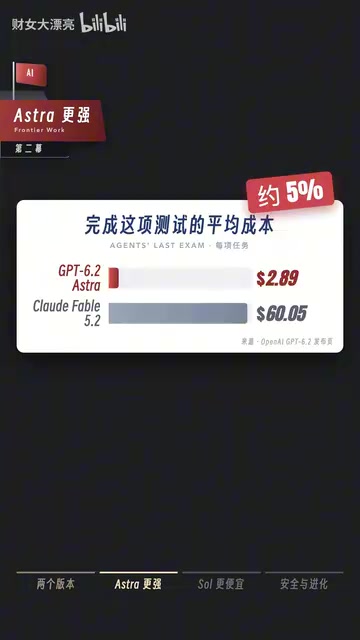
Astra is positioned to conquer highly difficult tasks. OpenAI designed a test called "Agent's Last Exam" specifically to evaluate AI's ability to independently complete multi-step, complex professional tasks. Astra scored 78.3%, a 5.2 percentage point improvement over the previous generation, while the average cost of completing tasks was less than one-third of the previous generation.
Compared with the competitor Anthropic's Claude Fable 5.2, Astra scores 5.5 percentage points higher, and the average cost of completing test tasks is only about 5% of the latter. According to analysis by a Bilibili creator, this is only the result of one specific test and does not mean all tasks are 95% cheaper, but it reflects a trend: while AI capabilities are improving, the cost of completing work is falling rapidly.
A Leap in Complex Professional Work Capabilities
In the past, asking AI to analyze a public company's financial reports allowed it to summarize data and organize viewpoints. But if required to compile all financial reports from the past five years, build a valuation model, and then produce a PPT for investors, while also handling Excel, checking calculation results, and adjusting formatting along the way, traditional models easily make mistakes. What Astra focuses on upgrading is precisely this type of complex work: in professional work tests it improved by 6.2 percentage points over the previous generation, output tokens decreased by 22%, and the generated slides, spreadsheets, and reports better match the actual usage habits of professionals.
Token consumption is one of the key metrics for evaluating the cost of using large models. Models are billed in tokens for both processing input and generating output, with output tokens being especially expensive. When completing the same type of task, a reduction in output tokens means the model expresses itself more concisely, takes fewer detours, and produces less useless content, directly lowering API call costs and shortening response times. Astra's 22% reduction in output tokens shows that it is more "targeted" when planning steps and generating results, which has significant cumulative economic meaning for long-process tasks that require repeated model calls (such as financial report analysis and report generation).
Breakthroughs in 3D Modeling and CAD Design
Astra's performance in visual and engineering domains is also noteworthy. OpenAI had it design a dynamic simulation of a car chassis: given the requirement to "simulate the movement of tires and suspension when a car drives on a mountain road," Astra could autonomously build a 3D model, write a Python program to calculate force relationships, and finally call Blender to turn the entire process into an animation. In tasks such as mechanical assembly, engine design, and even converting architectural photos into manufacturable lamp designs, Astra also demonstrated its capabilities. Its CAD design test score jumped directly from 62.6% in the previous generation to 82.5%, which means engineers doing product design may no longer need to do every step by hand.
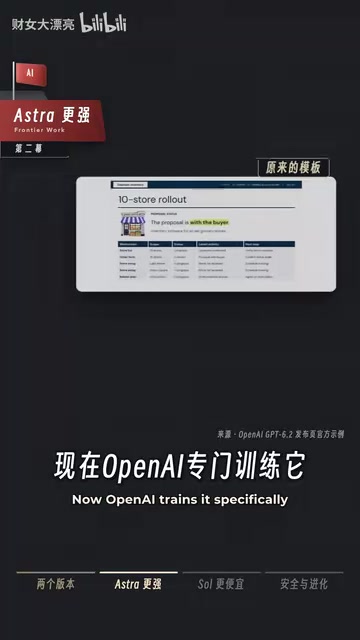
Agent's Last Exam is a benchmark designed by OpenAI to evaluate the capabilities of AI agents, with a name that parodies the "Last Exam" used by humans to test the breadth of expert knowledge. Unlike conventional question-answering evaluations, it does not merely look at whether the model can give the correct answer; it requires the model to autonomously plan, call tools, process intermediate files, and complete multi-step complex professional tasks without step-by-step human intervention. Such tests are closer to real work scenarios, so scores can reflect the model's ability to "work independently," not just its ability to "answer questions." Numbers such as 78.3% need to be understood within the difficulty distribution of that test; scores across tests or vendors cannot be directly compared horizontally.
CAD (Computer-Aided Design) is a core tool in engineering and manufacturing, traditionally relying on professionals to manually model, constrain dimensions, and repeatedly verify. Getting AI to complete CAD tasks is difficult not only because it must generate graphics, but also because it must understand geometric constraints, assembly relationships, and physical plausibility, and translate design intent into executable modeling steps. Astra's improvement in CAD tests from 62.6% to 82.5% means the model can more reliably convert natural language requirements into structured 3D design workflows and call tools such as Blender and Python to complete calculations and visualization. If such capabilities stabilize, they will change the way early-stage product design iterates.
Sol: The Cost-Effective Killer with Low Price and High Performance
Sol's performance is less dazzling than Astra's, but its impact on the entire AI industry may be greater—because it is cheap enough. In real code task tests, Astra scored 44.2 and Sol scored 43.8, a gap of only 0.4 points; but to complete the same test task, Astra spent an average of $5.97, while Sol needed only $1.29. At about one-fifth to one-fourth of the price, you get very close programming performance (the Bilibili creator's original wording mentioned "about 1% of the money," which in context should be understood as a perception of cost relative to the previous generation or under a specific comparison; the exact ratio should be based on official data, and no precise assertion is made here).
Sol's API unit price has not increased compared with the previous generation. For tech companies that call AI millions or even tens of millions of times a day, this is a very good deal.

Scientific Research, Safety, and Self-Improvement: Hidden Messages in the Technical Report
In addition to performance and price, there are several noteworthy signals in the technical report. Astra's scientific research capabilities have clearly improved, with its score in scientific research workflow tests rising from 68.1% to 77.1%; it can analyze scientific data more effectively and even help researchers discover problems in the AI training process. In cybersecurity, Astra's secure code development test score rose from 48.7% to 65.7%, and its security patch repair capability also improved markedly. In the future, AI can assist programmers more in checking vulnerabilities and fixing code. But conversely, hackers' ability to use AI to find vulnerabilities is also increasing, so OpenAI has set strict limits on high-risk cybersecurity features.

Most notably, for the first time OpenAI rated the AI self-improvement capability of a publicly released model as HIGH. This does not mean AI can already upgrade indefinitely without humans, but rather that, according to the official assessment, its help with AI research and development is already equivalent to giving researchers an additional excellent research engineer assistant. In the past, humans used AI to improve work efficiency; now, when researching the next generation of AI, increasingly powerful AI is also beginning to participate.
AI self-improvement refers to the model's ability to participate in improving AI systems themselves, such as assisting researchers in designing experiments, analyzing training logs, locating training anomalies, and generating or reviewing code. OpenAI's HIGH rating does not mean AI can autonomously upgrade indefinitely without humans, but rather that, according to the official assessment, the help it provides in the AI R&D process is already equivalent to an excellent research engineer assistant. The significance of this rating is that the iteration speed of AI R&D may accelerate due to AI's participation, while also raising higher requirements for controllability and oversight mechanisms.
Two Acceleration Processes Are Happening Simultaneously
Sol continues to lower usage costs, while Astra keeps raising the ceiling of capability. In the future, AI development may show two simultaneously accelerating processes: on one hand, stronger AI helps researchers develop the next generation of models; on the other hand, cheaper AI enters enterprises and takes on more work originally done by humans. According to the Bilibili creator, Sol has already launched in ChatGPT; whether the actual experience can truly rival competitors still needs to be verified by users themselves.
The core message of this release is not any single benchmark score, but that the scissors gap between cost and capability is rapidly widening—when the price of high-performance AI falls to a level where enterprises can deploy it at scale, the adoption speed of AI agents may exceed many people's expectations.
One-line Summary
OpenAI releases the GPT-6.2 series, Astra and Sol; AI is shifting toward agents capable of independently completing complex professional tasks.
Paragraph Summary
OpenAI has officially released the GPT-6.2 series models, including the performance flagship Astra and the high cost-effectiveness version Sol. Astra scored 78.3% on the Agent's Last Exam test, a 5.2 percentage point improvement over the previous generation, at less than one-third of the cost; it also showed significant gains in tests for professional work, CAD design, and scientific research workflows. Sol trails Astra by only 0.4 points on code tasks but costs far less than Astra, with no increase in API unit price. The technical report also shows that OpenAI rated the model's self-improvement capability as HIGH for the first time, with AI beginning to participate in next-generation AI R&D. The article argues that capability improvements and cost reductions are accelerating simultaneously, and the adoption of AI agents may exceed expectations.
Related articles
Did AI Really Solve a Black Hole Physics Problem? Anthropic's Claim Is Questionable
Anthropic says Claude Fabel 5.2 helped solve two black hole physics problems, but the announcement names no problems and shows no derivation. We break down the claim.

Building an AI Side Business from Scratch with Claude: 10 Monetization Paths Explained
Explaining 10 paths to build an AI side business from scratch with Claude alone: voice agents, digital products, data annotation, enterprise automation, and vertical industry tools, with a realistic assessment of barriers and feasibility for each.
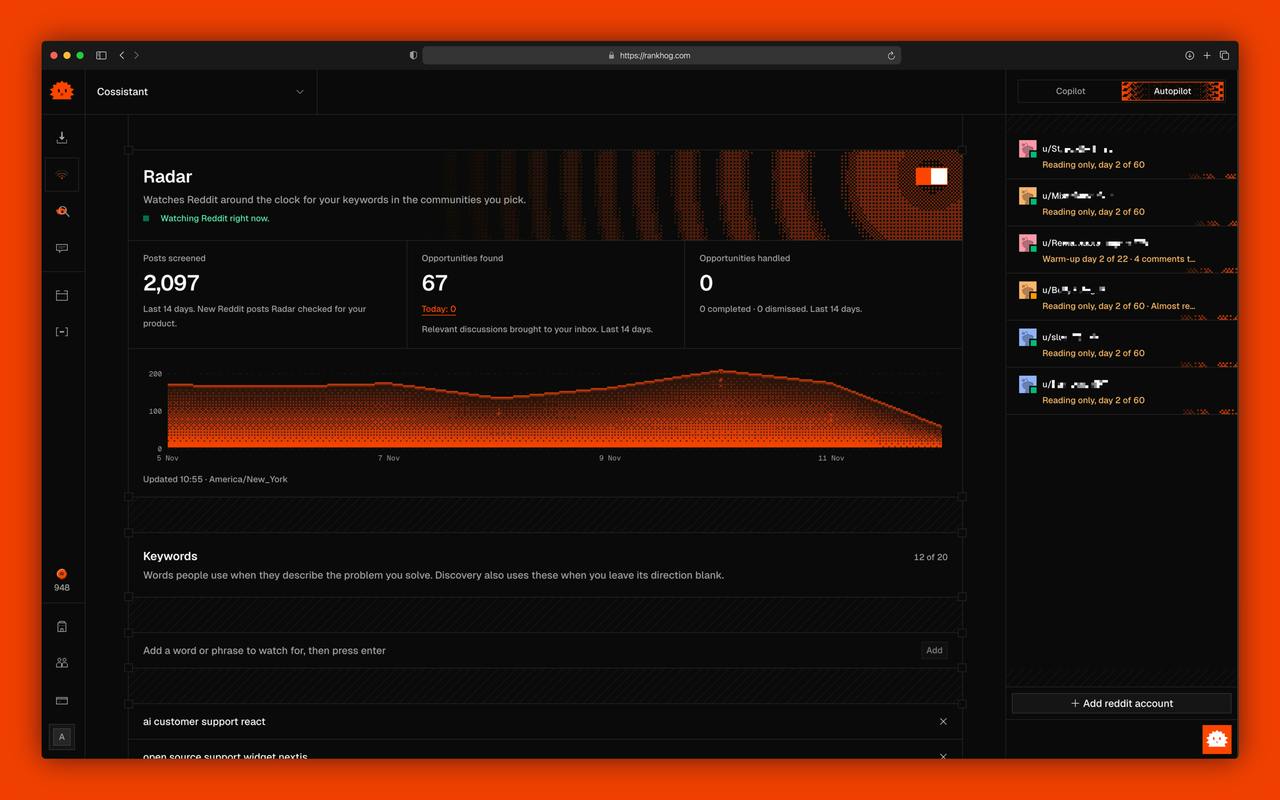
Rankhog: AI-Powered Reddit Lead Generation — Balancing Compliance and Efficiency
Rankhog is an AI tool that finds Reddit leads and generates replies, with manual approval or autopilot modes and MCP support for Claude, ChatGPT, and Cursor. We analyze how it works, MCP integration value, and community compliance risks.