GPT-6.2 Astra Leak, DeepSeek V4.1 Pro Exposed: Five Key Takeaways from the AI Daily

Model leak signals and quantized deployments advance in parallel, with breakthroughs across in-car systems, orchestration, embodied intelligence, and chip yields.
This issue of the AI Daily covers multiple developments including model leaks, quantized deployment, in-car implementation, model orchestration, embodied intelligence, and chip yields. A GPT-6.2 Astra migration record appeared in the OpenAI Codex repository, and the DeepSeek V4.1 Pro identifier surfaced in VersoFX source code—the community views these as pre-release signals, but there is no official confirmation. NVIDIA released the Kimi K3.1 Pro 4-bit quantized version, with 2.8T total parameters and 104B activated per token, now available on Hugging Face. Google Gemini lands on Apple CarPlay with cross-device conversation continuity. Anthropic launched Orchestrator and Self-hosted Cloud Managed Agents, and is testing dynamic API Effort level adjustment. On-device 100B-class open-source models H0-145B/H0-120B emerged, and Tsinghua and Berkeley open-sourced Uni-Robot Agent. SK Hynix HBM4 yield topped 70%, Microsoft open-sourced the Token Economizer plugin, and Cloud Fable 5.2 Max leads the intelligence leaderboard.
Today's Highlights: Model Leaks and Quantized Deployments Take Off Together
According to a roundup of AI daily news content on Bilibili, a model migration record for "GPT-6.2 Astra" has appeared in OpenAI's official Codex repository. The poster believes OpenAI wouldn't migrate a model in a public repository for no reason, and views this as the strongest signal that GPT-6.2 is about to be released. This discovery echoes developments on the DeepSeekAd side: developers found the "DeepSeek V4.1 Pro" identifier in the VersoFX source code, and the model directory in the same batch of code also showed DeepSeek V4.1 Flash. The UP host noted that V4.1 Flash was released months ago and the official confirmation of V4.1 Pro has yet to come; this code leak is seen as the first real signal of its upcoming launch. "Circumstantial evidence" such as model naming and repository migrations is becoming a common way for the community to predict release timelines, but its reliability is always questionable—migration records may simply reflect internal toolchain adjustments, and code identifiers may be pre-embedded placeholders.
Meanwhile, NVIDIA released a 4-bit quantized version of Kimi K3.1 Pro on Hugging Face. The material shows the model has 2.8T total parameters and 104B activated per token; the quantization is nearly lossless, and 4-bit quantization greatly reduces VRAM usage, making this trillion-parameter-class model easier to deploy locally. It is now available for download on Hugging Face. A trillion-parameter model entering local deployment in low-bit form means the usability of the open-weight ecosystem has taken another step forward.

4-bit quantization: Quantization refers to representing model weights and activations with lower bit widths (such as 4-bit integers) to reduce VRAM usage and computational overhead. 4-bit quantization typically combines group-wise quantization and calibration data to determine scaling factors, and can achieve nearly lossless results on trillion-parameter models. Kimi K3.1 Pro has 2.8T total parameters and 104B activated per token, belonging to a mixture-of-experts (MoE) architecture; after quantization, VRAM requirements drop substantially, making local deployment possible. However, low-bit quantization has specific requirements for inference frameworks, and under extreme compression, long-context or complex reasoning tasks may still suffer precision loss.
AI Developments: In-Car Systems, Orchestration, and Agent Hosting
Google announced that Gemini is officially coming to Apple CarPlay, rolling out gradually to iOS users worldwide starting today, covering all languages supported by Gemini Live. Once in the car, users can tap the Gemini icon on the car screen or sidebar to start a conversation, and can pick up from where they left off on their iPhone. This is another implementation case of large model assistants extending from phones to in-car scenarios, with cross-device context continuity becoming an experience highlight.
On the model orchestration front, Anthropic's Antigravity introduced Orchestrator, aimed at AI Ultra subscribers, allowing dynamic switching between model keys such as Carbon and Hydrogen within the same canvas without opening another canvas; the simultaneously launched Gemini 4 Hydrogen Orchestrator is provided as a model dropdown option. In the same period, Anthropic announced that Self-hosted Cloud Managed Agents has entered Private Beta, allowing developers to host agent frameworks, sandboxes, and domain canvas history in their own cloud or local environments, and to choose where Cloud requests are sent, completing agent orchestration and data management within their own infrastructure.
Anthropic also launched a Beta feature for the Cloud API: within the same conversation, the Effort level can be adjusted mid-way—switching intensity for a casual chat in the first half and complex analysis in the second half, without changing top-level configuration. The usage is to insert an empty System message in the message sequence and set the level with Output Configure Effort.

On the on-device front, a team released the first batch of on-device native 100B-class open-source models—H0-145B and H0-120B—free, offline, and capable of running cloud-level intelligence on a laptop. The material claims it beats Cloud Opus 4.6's 78.2% with 86.5% on Terminal Bench, requiring only 29G of memory.
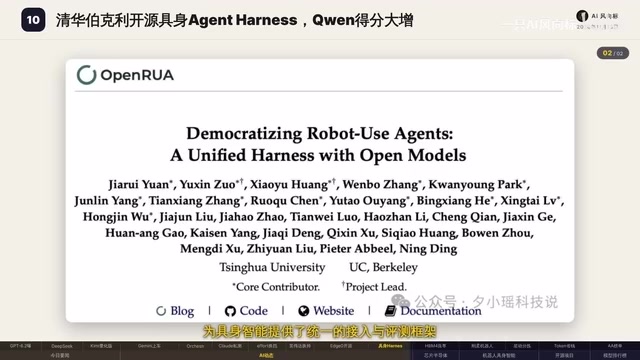
A team from Tsinghua University and UC Berkeley open-sourced a unified embodied intelligence Agent Harness, "Uni-Robot Agent," released as the paper Democratizing Robot Use Agents, with code, website, and documentation all open. The solution won first place at low cost, with zero-shot real-machine results surpassing the fine-tuned Pi 0.5, and provides a unified access and evaluation framework for embodied intelligence.
Model orchestration refers to dynamically selecting, switching, or combining multiple models (such as Carbon, Hydrogen, etc.) under a unified interface or API according to task requirements to complete complex workflows. An Orchestrator typically handles task decomposition, routing, and result aggregation, so users don't need to manually switch canvases or sessions. Anthropic's Antigravity introducing Orchestrator means subscribers can switch across model keys within the same canvas, reducing the engineering complexity of multi-model collaboration. The accompanying Self-hosted Cloud Managed Agents hosts the orchestration layer and sandbox on the user's own infrastructure, balancing flexibility and data sovereignty.
Chips and Embodied Intelligence: Yield Breakthroughs and Scale Implementation
According to ChosenBiz, the yield of SK Hynix's sixth-generation high-bandwidth memory HBM4 has exceeded 70%, and competition with Samsung and Micron will intensify. The material notes that HBM4 is harder to manufacture than previous products; with yield rising from 60% to 70%, the output of qualified products increases by about 16.7% for the same investment, though the official data has not yet been officially announced. Yield is the most practical cost variable in the HBM race, and percentage-point climbs directly affect supply cadence.
In the embodied intelligence segment, Microsoft Research Asia and Seoul National University proposed Comp VLA, which allows robots to adjust contact stiffness while planning motion. Traditional VLA models usually output only motion commands without considering external contact forces; a slight positional deviation may cause the robot to miss the object or apply excessive force. The new method lets robots yield naturally and adjust pre-contact resistance appropriately, like a person wiping a whiteboard, making contact operations more delicate and safer. Xingdong Jiyuan's self-developed embodied sorting robots have been deployed in more than ten logistics centers, with a sorting peak of 1,500 items per hour, showing that embodied intelligence is moving from demos to large-scale implementation.

HBM4 yield: High-bandwidth memory (HBM) vertically stacks DRAM chips through through-silicon vias (TSVs). HBM4 further increases the number of stacked layers and adopts more advanced processes, significantly raising manufacturing difficulty. Yield refers to the proportion of qualified chips to total wafers started; rising from 60% to 70% means the output of qualified products increases by about 16.7% for the same wafer input (70/60≈1.167). Yield ramping directly affects HBM supply cadence and unit cost, and is a key variable in the competition among SK Hynix, Samsung, and Micron. Official data has not yet been published, but media sources indicate that HBM4 yield has exceeded 70%, and competition will intensify.
Open-Source Tools and Model Rankings
Microsoft quietly open-sourced a Cloud Code productivity plugin called Token Economizer, specifically designed to help Agents reduce token consumption. The material says many users are running low on quota after switching to the Fable 5.2 model, and the official recommendation is to use Opus 5.5 for daily tasks; the plugin's approach is to summarize experience from canvases the Agent has run through, so that similar situations later require fewer detours—the more you use it, the more you save. It currently supports Cloud Code, Codex, GitHub Copilot CLI, and others.
On the model capability rankings, the top three on the intelligence leaderboard are Cloud Fable 5.2 Max in first place with 65 points, followed by Gemini 4 Carbon High with 60 points. In the open-source camp, Kimi K3.1 Pro ranks 11th with 46 points; domestic models Quan 3.8 Max scores 34, GLM 5.3 scores 32, and DeepSeek V4.1 Flash scores 33—all on the list but with a clear gap from the leaders.
Token Economizer is a token consumption optimization plugin for Agents. Its approach is to summarize experience from canvases (i.e., task trajectories) the Agent has executed, forming reusable patterns or caches, so that when identical or similar situations arise later, repeated reasoning and context injection are reduced, thereby lowering token consumption. It supports environments such as Cloud Code, Codex, and GitHub Copilot CLI, and is suitable for use when quota is tight. However, such plugins depend on the quality of historical trajectories, have limited savings for entirely new task types, and care should be taken that experience caches may introduce outdated or incorrect patterns.
Editor's Observations
This issue is information-dense, but most items are still at the "community discovery" stage: both GPT-6.2 Astra and DeepSeek V4.1 Pro come from identifiers in repositories or source code, without official confirmation, and readers should treat them as references for release cadence rather than conclusions. What is truly verifiable is NVIDIA's 4-bit quantized release and the SK Hynix yield report—the former is already available for download, while the latter is supported by media sources but official data is not yet out. For developers, low-bit local deployment of trillion-parameter models, dynamic adjustment of API effort levels, and token consumption optimization plugins are the three changes that can most directly land in workflows right now.
Related articles

Abnormal Error Rate Spike in Claude Mythos 5.2 and Fable 5.2
Claude Mythos 5.2 and Claude Fable 5.2 show an abnormal spike in request error rates, marked as investigating on the official status page. This article covers the incident overview, practical impact on developers, and recommended responses.

ReAct Runtime Context Trimming: Why Claude Code Acts at 70%
A deep dive into ReAct runtime context trimming: why Claude Code compresses at ~70% usage, why tool calls dominate, why messages must be dropped in pairs, and why codebases don't need RAG.

AI Agent vs LLM: How Cursor and Claude Code Actually Work
An in-depth analysis of the essential difference between AI Agents and LLMs: LLMs generate code suggestions, while Agents modify files and run tests via tool calls. Using a Spring Boot bug fix as an example, it breaks down the workflows, permission control, and verification mechanisms of Cursor and Claude Code.