GPT-6.2, Gemini 4 Carbon, and More Leak Together: What's Next in the AI Giants' New Race

Next-gen models from OpenAI, Anthropic, and Google leak en masse, with price-performance and monitorability as the new focus.
The article aggregates leaks compiled by a Bilibili tech creator: OpenAI's GPT-6.2 Beetlejuice is rumored to be based on the DuckTrio pretraining series and linked to Navier-Stokes progress and ~10 trillion parameters, with Sam Altman revealing internal models solved multiple scientific problems with over $100M in compute; Anthropic's Fable 5.5 shows autonomous creative detailing in SVG, Opus 5.5 is reportedly secretly routed, and a "self-evaluation" safety technique costs only ~2% extra compute; Google's Gemini 4 Carbon matches Opus 5.5 in completeness while being ~3x cheaper and ~2.5x faster. It also covers Qwen 4, Mistral Large 4, and AI-controlled surgical robots, noting the race has split into scientific discovery, safety monitorability, and price-performance.
Title
GPT-6.2, Gemini 4 Carbon, and More Leak Together: What's Next in the AI Giants' New Race
Meta Description
A roundup of AI frontier leaks shared by a Bilibili creator: OpenAI GPT-6.2 Beetlejuice, Anthropic Claude Fable 5.5 and Opus 6, Google Gemini 4 Carbon's test performance and pricing comparison, plus Qwen 4 and Mistral Large 4 developments.
Article Content
Leaks about frontier AI models have never come this thick and fast. According to information aggregated by a Bilibili tech creator from multiple sources, OpenAI, Anthropic, and Google were all reported to have next-generation model developments surface within nearly the same time window: early checkpoints of GPT-6.2 (codename Beetlejuice), Claude Fable 5.5 and Opus 6, and Gemini 4 Carbon appeared one after another in internal trackers and on the Arena testing platform. Most of these reports remain officially unconfirmed, but multiple threads corroborate one another, sketching out a fairly aggressive technical roadmap.
OpenAI: GPT-6.2 Beetlejuice and Scientific Discovery Ambitions
According to tracker Nath Daniel's observations, an internal tracker picked up a new model identifier codenamed Beetlejuice, reportedly based on the DuckTrio pretraining series. The naming scheme echoes the space-themed image models that have appeared in the Arena (Aurora, Shooting Star, Soul, Luna, Asha)—Beetlejuice itself is a red supergiant star.
More noteworthy are the rumors about capabilities. The model has been linked to progress on the Navier-Stokes problem, with speculation of roughly 10 trillion parameters. None of these claims have been officially confirmed, but the timing of the leaks is telling: November 1 coincides with the end date of OpenAI's 28-day challenge.
Information Sam Altman shared on a podcast offers indirect context for these rumors. He said OpenAI researchers had thrown the hardest problems of their careers at the new model, and it went on to solve problems across multiple scientific domains. According to his account, OpenAI has invested roughly $10 million in compute on Navier-Stokes research and over $100 million on other scientific discoveries. When asked whether it had discovered far more than the 700 mathematical proofs publicly shared, Altman responded "of course." This does not independently prove the equation has been solved, but it reveals the strength ceiling of unreleased models.
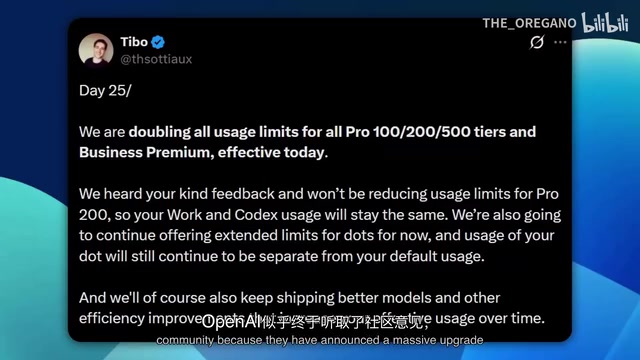
On the product side, OpenAI announced it is doubling usage allowances for all Pro tiers and business premium plans, and confirmed it will not reduce usage limits for Pro200 users, with Codex usage unchanged. But another thread warrants caution: a hidden disclaimer appeared in the ChatGPT web checkout flow stating that plan usage will share limits between ChatGPT and Codex, suggesting the product lines are moving toward integration.
The Navier-Stokes problem is a set of partial differential equations in fluid mechanics describing the motion of viscous fluids. The existence and smoothness of its solutions is one of the seven "Millennium Prize Problems" for which the Clay Mathematics Institute offered a million-dollar prize in 2000. In the three-dimensional case, whether the equations always admit a global smooth solution remains unproven. If an AI model truly made substantive progress on this problem, its significance would far exceed ordinary benchmark scores—it would mean the model possesses the ability to construct rigorous mathematical arguments, not merely pattern matching. This is why the related rumors, though unverified, have still drawn widespread attention.
Anthropic: Dual-Track Iteration and the Monitorability Challenge
Anthropic's leaks show a dual-track pattern. According to reports from DevMode Discord users, Claude Opus 5.5 is secretly routing some requests to a newer checkpoint, with output quality noticeably better than the current version; meanwhile a new Fable checkpoint has entered early testing. The community has also circulated a simple detection method: ask the model about an event at a specific point in time and judge from differences in the answer whether you've been routed to an experimental model.
From the showcased examples, the new Fable checkpoint performs notably well at SVG generation—fine feather separation, water reflections, sunset lighting—reportedly details the model added on its own without explicit prompting. In a PS5 SVG comparison test, Fable's texture and lighting details were clearly superior to Opus 5.5. This ability to "understand a scene and independently add creative details" may be the key that sets the Fable series apart from existing models.

On the safety side, Anthropic introduced a technique called "self-evaluation." After generating a response, the model uses the existing KV cache to perform a hidden safety assessment, requiring only about 10 additional tokens and under 2% extra inference compute for the whole process. According to official figures, when tested on Claude Fable 5, the system identified 78% of potentially harmful conversations and 94% of high-priority cases flagged by a stronger classifier, with a false positive rate of only 1%.
On the API side, the maximum request size for the message and token counting API was raised from 32MB to 128MB, and the resolution cap for a single image was raised from 2000 pixels to 3000 pixels—but the 128MB limit applies only to the first-party API, while third-party cloud platforms remain at 20-32MB.
The KV cache (Key-Value Cache) is a key mechanism in Transformer inference: as the model generates tokens one by one, it caches the key and value vectors from each layer's attention computation to avoid recomputing already-generated content. Anthropic's "self-evaluation" reuses exactly this cache—after normal response generation is complete, the model doesn't need to re-read the context and instead appends a very short evaluation reasoning step directly on top of its existing internal state, so the extra overhead is only about 10 tokens. This design embeds safety detection into the inference pipeline itself rather than relying on an external standalone classifier, which is the technical precondition that lets its cost drop below 2%.
Google: Carbon's Dual Advantage in Performance and Price
Google's Gemini 4 Carbon (tested in the Arena under the name Gemini4 Argantide) has the most solid test data of this round of leaks.
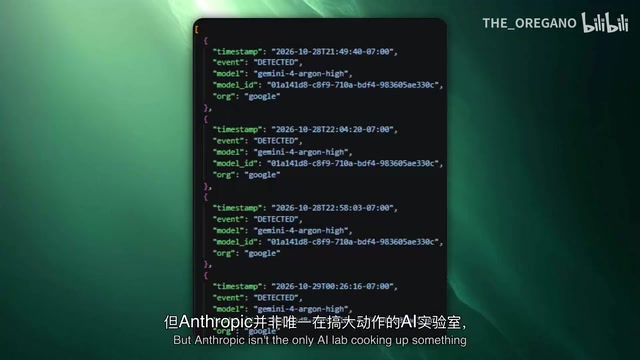
In an interactive rainbow jelly front-end comparison test, the two models were close in completeness, but Carbon took only 32 minutes and $4.30, while Opus 5.5 took 1 hour 20 minutes and cost $14. In an Iron Man helmet recreation task, Carbon generated over 2.1 million tokens, taking 43 minutes and costing $7. The black hole simulation task produced 3508 lines of code from a single prompt, all packed into one HTML file with zero external resources.
Across multiple tests, Carbon is about 3x cheaper and about 2.5x faster than Opus, while output quality is comparable or even slightly better in most scenarios. If this price-performance gap holds, it will have a substantive impact on developers' model choices. Google's old models' weak long-task tracking in coding and their cookie-cutter interface generation have reportedly improved markedly on Carbon.
Google also updated AI Studio's XR module during the same period, supporting one-sentence construction of interactive 3D and extended reality applications, including hand tracking, pinch gestures, and realistic physics. The Notebook team, meanwhile, made hundreds of textbooks freely available to students.

Arena (LMArena, formerly Chatbot Arena) is a crowdsourced model battle platform maintained by organizations such as LMSYS, where users blind-vote on answers from two anonymous models, and rankings are generated through an Elo-like scoring system. Because models compete under aliases, new models often appear on the Arena under codenames before their official release, which is why the platform has long been regarded as a "forward outpost" for model leaks. Gemini 4 Carbon being tested under the name "Gemini4 Argantide" in this article is an example of this mechanism—though alias battle data can only reflect relative preferences and cannot replace controlled engineering benchmarks.
Other Developments Worth Watching
The release window for Alibaba's Qwen 4 has been pointed to "next week"—a researcher gave this statement at an Amsterdam event, and code referencing six different models in the Qwen 4 series has already been merged in PRs, covering Max, Plus, Flash, a 27-billion-parameter local model, and an Omni 120-billion-parameter Think model. Mistral Large 4's full weights have been made available on Hugging Face, reportedly becoming the strongest open-weights fully Chinese agentic coding model.
The most controversial demo came from the biological experimentation domain: reports say someone used Claude Sonnet 5 to control a robotic surgical system to perform brain surgery on live mice, analyzing 19 treatment options, calculating injection parameters, controlling the surgical device, and checking the live camera 32 times throughout. One detail: both Opus 5 and Opus 5.5 refused to perform the task because it involved real biological experimentation, while Sonnet 5 continued under human supervision. The researchers believe this may be the first time an AI independently selected a treatment plan and injected it into a live mammalian brain, but the claim has not been fully verified.
Full weights (fully open weights) means that a model's complete weight files are made public at release, rather than only offering an API or partial access. The opposite of "open weights" is the closed-source API model. Mistral has long distinguished itself from OpenAI, Anthropic, and Google with an open-weights strategy; its models can be deployed locally and fine-tuned, making them notably attractive for privacy-sensitive or cost-constrained scenarios. "Agentic coding model" refers to models specifically optimized for agentic workflows such as multi-step tool calling, code execution, and autonomous error correction, where evaluation shifts from single-turn code generation to stability across long tasks.
The Main Threads of the Race
Looking at the three threads together, the focus of this round of competition has already diverged: OpenAI is betting on frontier scientific discovery and ultra-large-scale pretraining; Anthropic is strengthening monitorability and safety evaluation in addition to model capability iteration; and Google is using Carbon to lead on price-performance and rapidly roll out product integration. For developers, the most practically meaningful signal may be Carbon's price curve—if a model that's 3x cheaper and 2.5x faster really delivers output quality close to the flagship, the logic of model selection will be rewritten. And for the industry as a whole, the question raised by OpenAI's blog post on monitoring deserves long-term attention: as models become increasingly good at controlling what their visible reasoning process reveals, judging whether they are acting as intended is becoming ever harder.
One-line Summary
Next-generation models from OpenAI, Anthropic, and Google leak in quick succession, with price-performance and monitorability emerging as the new focal points of the race.
Paragraph Summary
The article aggregates leaks compiled by a Bilibili tech creator: OpenAI's GPT-6.2 Beetlejuice is rumored to be based on the DuckTrio pretraining series and linked to progress on the Navier-Stokes problem and speculation of roughly 10 trillion parameters, with Sam Altman revealing that internal models have solved multiple scientific problems with over $100 million in related compute investment; Anthropic's Fable 5.5 checkpoint shows the ability to autonomously add creative details in SVG generation, Opus 5.5 is reported to be secretly routing to a new checkpoint, and a "self-evaluation" safety technique consuming only about 2% extra compute has been introduced; Google's Gemini 4 Carbon matches Opus 5.5 in completeness across multiple tests while being about 3x cheaper and 2.5x faster. The article also mentions Qwen 4, Mistral Large 4, and AI-controlled surgical robots, noting that the race's focus has split into three main threads: scientific discovery, safety and monitorability, and price-performance.
Related articles

GPT-Image 2.6 Dual Release: A Double Upgrade in Speed and Precision
OpenAI releases GPT-Image 2.6 with Flare for faster generation and Sunburst for complex prompts and dense infographics. API adds markup editing, SVG, and GIF support.

Robert Caro: How to Get Insiders to Talk and Uncover the Hidden Logic of Johnson's Money Politics
Pulitzer winner Robert Caro shares how he interviewed John Connally, revealing how pressing on Johnson's funding annotations got insiders to explain political money logic.

Showing This Video to Someone in 2014: The Stunning Evolution of AI Video
From the viral Reddit post "Show this AI video to someone from 2014," we look back at a decade of AI video generation's leap from academic research to indistinguishable reality, analyzing the cognitive impact and trust challenges amid the flood of synthetic content.