GPT-6.2 Three-Task Hands-On Test: Astra Max Takes 42 Minutes — Why Does It Lose to Sol Medium?

Hands-on test of GPT-6.2's two models at three intensity tiers: SHOW MIDIUM offers the best overall value; intensity doesn't equal quality.
Bilibili creator Chen Xin'an ran a side-by-side hands-on test of the overnight-released GPT-6.2 OSTRA and SHOW, using image generation, chain-contraption design, and social-savvy replies to cover visual, logical, and pragmatic dimensions, testing different thinking intensities including HIGH, MAX, and MIDIUM. Results: on image tasks SHOW MIDIUM completely outclasses OSTRA HIGH, while OSTRA MAX has the best quality but takes 42 minutes and ranks last on value; OSTRA HIGH wins outright on the chain contraption; in the social-reply scenario, SHOW HIGH's "thank the person first, then decline the work" is the most tactful. The overall conclusion is that thinking intensity and quality are not linearly related — SHOW MIDIUM is recommended as the daily driver, with tiers switched flexibly by task type.
Test Background: Two New Models, Three Thinking Intensities
GPT-6.2 OSTRA and GPT-6.2 SHOW were released in full overnight, and the official word is that these are the most powerful models to date. But strong specs don't equal real-world usability. Bilibili creator Chen Xin'an ran a side-by-side comparison using three tasks: OSTRA at HIGH and MAX intensity, and SHOW at MIDIUM and HIGH. The testing logic is clear — same prompts, then compare final output quality and time cost to see which tier gives the best value.
The value of this kind of test is that it pulls "model capability" away from benchmark scores and back to real tasks: generating complex images, designing chain-reaction contraptions, and handling the social nuances of text replies. The three tasks happen to cover three dimensions: visual generation, logical structure, and social pragmatics.
Thinking Effort is a control parameter introduced in recent years for reasoning-oriented large models, typically divided into tiers like LOW / MEDIUM / HIGH / MAX. It doesn't change the model's parameter scale; rather, it controls the token budget the model can spend on "internal reasoning" before generating an answer — the higher the tier, the longer the chain of thought the model is allowed to unfold and the more self-checks it performs. Intuitively: HIGH tells the model to "think a bit longer," while MAX tells it to "think all the way through."
But thinking effort and output quality are not linearly related. On one hand, a longer reasoning chain can correct detail errors and improve logical rigor; on the other, it can lead to over-deliberation, drift from user intent, and multiplied time and cost. That's why in practice you often see "high tier performing worse than mid tier" — which is exactly one of the core questions this test aims to verify. Choosing a tier is essentially a three-way trade-off between quality, latency, and cost.
Task 1: Image Generation — MAX Intensity Falls Flat
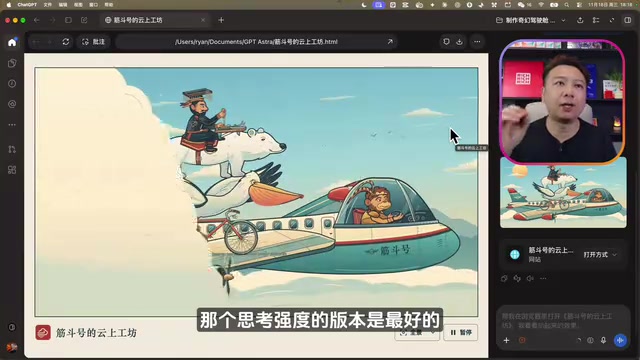
The first task asked for an upgraded version of the "Tihu riding a bicycle" scene, including an airplane, Sun Wukong, a polar bear, Qin Shi Huang tightening a screw, and other elements. The results were surprising:
- OSTRA HIGH (6 min 39 sec): The airplane's wing structure looks odd, and the propeller position is unreasonable; Tihu's feet on the bicycle are visually confused, as if both feet are pedaling on the same side; Qin Shi Huang's sitting posture is awkward. The creator rated it "so-so."
- SHOW MIDIUM (9 min 57 sec): Clearly better. The bicycle wheels have a natural sense of rolling, the feet are distinct, the polar bear and Qin Shi Huang look more pleasing, and although Sun Wukong's nose has text obscuring it, the overall result is a pleasant surprise.
- SHOW HIGH (19 min 6 sec): Somewhere in between — Tihu's feet look normal, but the workbench placement is strange, and overall it's not as good as the MIDIUM version.
- OSTRA MAX (42 min 3 sec): Finally scores a point back. The airplane structure improves, the clouds drift with a sense of motion, Tihu's feet on the bicycle are correct, and Qin Shi Huang tightening the screw is spot on. But it took 42 minutes, and the creator said bluntly, "It's slow and expensive — not worth it."

Key finding: Thinking effort does not equal a linear quality boost. OSTRA HIGH is completely outclassed by SHOW MIDIUM, showing that architectural differences between models matter more than intensity tiers. MAX intensity does fix details, but marginal returns diminish sharply.
Task 2: Rube Goldberg Chain Contraption — Logic vs. Aesthetics
The second task asked for a chain-reaction contraption: a steel ball hits dominoes, a seesaw, a suspended heavy hammer releases a barrier, and a cart reaches the finish line.
- OSTRA HIGH: The contraption is simple and fluid, the steel ball successfully triggers every stage, fireworks go off at the finish, and the creator called it "perfect."
- SHOW HIGH: The contraption is on the simple side; the steel ball hits the cart but doesn't trigger perfectly, and the flow is lacking.
- SHOW MIDIUM: Better than the HIGH version, but complexity and fluidity still fall short of OSTRA.
OSTRA wins this task outright, showing that on tasks requiring physical-logic reasoning, OSTRA's architectural advantage is more pronounced. SHOW's MIDIUM tier still beats its HIGH tier on value — the extra thinking time didn't buy a better contraption design.
Rube Goldberg Machine is named after American cartoonist Rube Goldberg and refers to a mechanical device that deliberately completes a simple task in a roundabout, elaborate way: through a chain of cause-and-effect transmissions — steel balls, dominoes, seesaws, pulleys, heavy hammers — it ultimately triggers a tiny action.
This poses a special challenge for generative models because it simultaneously demands physical causal coherence and spatial structural soundness — every stage must be genuinely triggerable, the output of one action must precisely correspond to the input of the next, and any geometric misalignment breaks the whole chain. Compared with image generation's pursuit of "looking good," this kind of task tests the model's implicit modeling of object motion, forces, and spatial relationships, making it better at distinguishing the logical-reasoning strengths and weaknesses of different architectures.
Task 3: Social Savvy — Professionalism vs. EQ
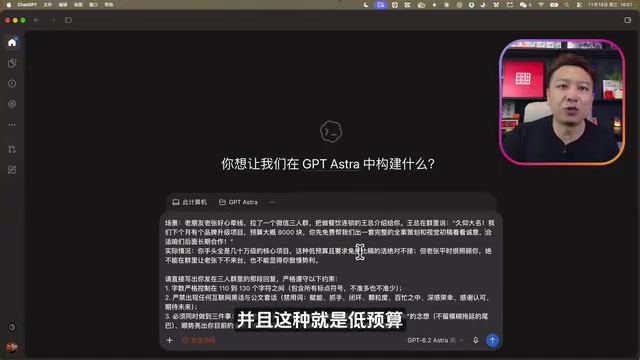
The third task is a social-pragmatics test: Old Zhang acts as a go-between to introduce Mr. Wang, whose company has a budget of 8,000 yuan but demands a full proposal and initial visual drafts for free. The reply must give Old Zhang plenty of face, immediately cut off any expectation of free or low-price work, make the business threshold clear, and avoid internet slang.
- OSTRA HIGH: Direct and professional — "The brand proposals I take on now are all in the hundreds of thousands of yuan range. I only do planning and design drafts after signing. I won't take an 8,000-yuan project, and I don't do free drafts either." The creator felt the refusal landed, but Old Zhang would be embarrassed in the group chat.
- SHOW HIGH: More human touch — "Old Zhang, thanks for thinking of me, and thanks for introducing Mr. Wang... I won't be taking this 8,000-yuan project, and I don't do free work on my side either. You're launching next month, so let me be clear upfront so I don't delay you in finding a team." The creator rated this version the most comfortable.
- SHOW MIDIUM: Tactful and proper — thanks Brother Zhang first, then lays out the terms, but the sense of professionalism is slightly weaker.

This task reveals stylistic differences between the models: OSTRA leans Western-direct, while SHOW better understands Chinese-style interpersonal dynamics. In business communication scenarios, SHOW HIGH's "thank the person first, then decline the work" strategy is clearly superior.
Pragmatics refers to the ability to use language appropriately in a specific social context, including managing face, tact, refusal strategies, and relationship maintenance. Chinese business communication especially emphasizes "give face first, discuss business second" — a direct refusal is clear but can put the intermediary in an awkward position.
The test's requirements — "give Old Zhang plenty of face, immediately cut off any expectation of free work, make the business threshold clear" — are essentially a pragmatic optimization problem under multiple constraints: maintain the introducer's social relationship, clearly define business boundaries, and preserve a sense of professional authority. Model performance differences on such tasks often reflect the linguistic and cultural distribution of their training corpora — models skewed toward English corpora tend toward direct expression, while models with ample Chinese corpora are better at the roundabout strategy of "thank the person first, then decline the work." This also explains why, under the same prompt, different models give stylistically very different replies.
Conclusion: The Value Pick Is SHOW MIDIUM
Across the three tasks, the creator's ranking is: image generation — SHOW MIDIUM first, OSTRA MAX second but last on value; chain contraption — OSTRA HIGH first; social reply — SHOW HIGH first.
If you had to pick just one daily driver setup, SHOW MIDIUM beats OSTRA HIGH on visual tasks, is not far behind SHOW HIGH on text tasks, and takes far less time. OSTRA MAX proved with its 42 minutes that its ceiling is higher, but the cost-to-benefit ratio is seriously mismatched. There is no absolute optimum in model selection — running more tests and switching tiers by task type is the pragmatic approach. Which model paired with which intensity do you find most comfortable in your own use? Feel free to share in the comments.
Related articles

From 0 to 1: Vibe Coding an AI Knowledge Base — A Practical Retrospective and Tech Stack Breakdown
A retrospective on building the AI knowledge base OilBook from scratch with Vibe Coding: Next.js+Neon stack, Oil Dev Skill workflow, Stripe paywall security, interview-style writing, AI-flavor control, and Vercel deployment.

GLM-5.4 Hands-On: Native Vision Meets a New Vibe Coding Workflow
Hands-on with Zhipu GLM-5.4: native vision tested across a 3D product demo, pure-code video generation, and remote-control Vibe Coding, compared with GPT-6.2 and Gemini Neon.

AI and Humans Claim to Prove the Riemann Hypothesis: Machine-Verified, Yet Nobody Can Understand It
Anthropic mathematician and AI Claude claim to prove the Riemann Hypothesis with 17 million lines of Lean code, machine-verified but unreadable by humans. This article analyzes the event, the zero proportion record from 41.6% to 67.2%, and the gap between machine verification and human understanding.