GPT-6.5 Leaks, Claude Fable 5.5, and Chinese Models in a Frenzy: This Week's AI Headlines

Dense AI signals this week: GPT-6.5 mystery, Anthropic's intent-understanding model, Gemini 4 Carbon's gap from rumors, and Chinese models' price offensive—all pointing to the eve of a dense release wave.
This week's AI news revolves around multiple threads about next-generation models. On OpenAI's side, the suspicious website opensi.lol showed a 6.5 reference and countdown, but archived history reveals it's an impersonation site; the more substantive signal is Microsoft's eval config replacing GPT-5.6 Turbo with GPT-6.1 Turbo. Anthropic was reported to have a new model that can identify entire classes of problems and proactively ask whether to handle them together, with intent understanding becoming the competitive focus. Google's Gemini 4 Carbon early checkpoints fell short of expectations on coding, so the "comparable to Opus" claim doesn't hold for now. On the Chinese side, MiniMax M3.1 Flash launched at extremely low prices with competitive agent performance, while Kimi K3.1, new GLM models, and DeepSeek 4.1 Flash also showed movement. NVIDIA achieved a 1.68x same-architecture speedup on Kimi K3 through roughly 12,000 lines of optimized kernels. Additionally, legacy code modernization and open source security scanning are seen as underrated directions.
This Week in AI: Leaks, Teasers, and the Eve of a Dense Release Wave
The AI news density this week has been remarkably high. From traces of OpenAI's next-generation model to release teasers from Anthropic and Google, and a string of new models from Chinese vendors, nearly every clue points to the same conclusion: a dense wave of model releases is approaching. According to The Information, we may be about to see a new Anthropic model, Google's Gemini 4 Carbon, and yet another new OpenAI model. This article pieces together the scattered signals to help you sort out what's solid and what's just speculation.
The GPT-6.5 Signal: A Suspicious Website and a Microsoft Code Change
The Countdown on opensi.lol
The first thing to spark discussion was a website called opensi.lol. Someone found a reference to 6.5 in the HTML source, next to a countdown pointing to 10 AM San Francisco time on November 1st. What's more, this timing coincides with the 28th day of a 28-day countdown, leading to speculation that OpenAI might close out this sprint with a heavyweight model.
But there are also facts that pour cold water on this: someone checked the site's history, and the September 23rd archive describes the domain as an independent OpenAI impersonation site for sale. So this clue is highly suspect and shouldn't be treated as solid evidence.
GPT-6.1 in Microsoft's PR
Compared to the mysterious website, Microsoft's changes are more worth pondering. Microsoft reportedly updated 18 different eval configurations, replacing references to GPT-5.6 Turbo with GPT-6.1 Turbo. This isn't a model name casually appearing on a webpage—it's a real code change in evaluation infrastructure, suggesting Microsoft may already be preparing to test or integrate the next-generation model.

Eval config refers to the infrastructure configuration files used by model vendors or cloud providers for automated benchmarking. It typically defines a set of task suites, scoring scripts, inference parameters, and the endpoint identifiers of the models under test. When a partner like Microsoft replaces model names in eval configurations, it means they have already conducted or are preparing to conduct standardized testing on unreleased models internally. Such changes appear in code repositories rather than marketing materials, making them more valuable as signals than webpage countdowns—because running benchmarks requires actual model access.
Anthropic's New Model: From Fixing Bugs to Reading Intent
In The Information's report, the Anthropic section carries the most information. According to an anonymous tester who tried the unreleased model, this new model (very likely Fable 5.5) doesn't just fix the bug you asked it to fix—it can identify the entire class of related problems and proactively ask whether you want those handled as well.
This capability matters a great deal for autonomous coding agents. The biggest shortcoming of current models is that you must explicitly tell them what to look for, what to fix, and what you ultimately want to achieve. A model that can read underlying intent and find problems you didn't even notice yourself is an assistant on another level. The report also mentions it's better at thinking outside the box rather than reciting conventional solutions. We already have models that execute instructions; coming up with creative solutions to unfamiliar problems remains the hard part.
Autonomous coding agent refers to an AI system that can autonomously plan, execute, and verify code changes, rather than just doing single-turn completions. Its core difference from traditional code assistants is the closed loop: the agent must locate files itself, run tests, read errors, and iterate on fixes. The bottleneck for such systems today isn't writing code itself, but how to infer the user's true goal when task boundaries are fuzzy. If a model can proactively expand the problem scope and seek confirmation, it essentially partially automates the most labor-intensive step—"requirement clarification." This is why "reading intent" in the report is seen as a generational difference.
Gemini 4 Carbon: The Gap Between Rumors and Real Testing
On Google's side, Business Insider previously reported that an internally tested Gemini 4 checkpoint codenamed Carbon had coding capabilities comparable to Claude Opus. But according to results from testing two different checkpoints (Carbon B and Carbon C), current performance is quite disappointing: it's not in the same league as Opus on coding tasks, and compared to Google's existing Gemini 4 Argon, there's barely any meaningful improvement—Carbon is slightly faster, but coding quality is even worse than Argon.
It should be noted that these are early checkpoints, and the final release will likely be much better. But the claim of "coding comparable to Opus" doesn't hold up at present, and Google still has catching up to do in this race.
The Dense Offensive from Chinese Models
MiniMax M3.1 Flash: A Combination Punch of Price and Performance
MiniMax M3.1 Flash has officially launched after ending its preview. The mysterious model SpaceMoney Alpha that flooded the leaderboards has been confirmed by the company as an early version of M3.1 Flash, which is said to have processed over 20 quintillion tokens.
The new version outputs over 200 tokens per second, nearly three times faster than the previous generation M3, at about 70% lower cost. On benchmarks, it scores at least 62.2 on Automation Bench, compared to Claude Opus's 50.3 and GPT-5.6 Soul's 45.8; on a certain coding benchmark it posted a score of 74, already on par with much more expensive models.
Price is its sharpest weapon: 15 cents per million input tokens, 60 cents per million output tokens, and as low as 1.5 cents per million input tokens on cache hits. By comparison, Claude Opus costs $5 per million input and $25 per million output. Open weights are set to be released on the 23rd, and the promotional free period is said to last until October 25th.

In initial hands-on experience, it's noticeably larger than M3, performing outstandingly on computer operation and 3D environment coding tasks, and beating the latest DeepSeekAd model on some coding tasks on the first try. In comparison tests like recreating trailers and web design, it completed tasks at extremely low cost—building a hardware launch landing page cost only 1 cent, versus $1.22 for Opus. Of course, this doesn't mean it's stronger; Opus's output quality is indeed much better, but using MiniMax to build a prototype and then polishing with a strong model is a pragmatic path. Across multiple benchmarks, it currently ranks 18th, which is quite astonishing for a Flash-tier model.
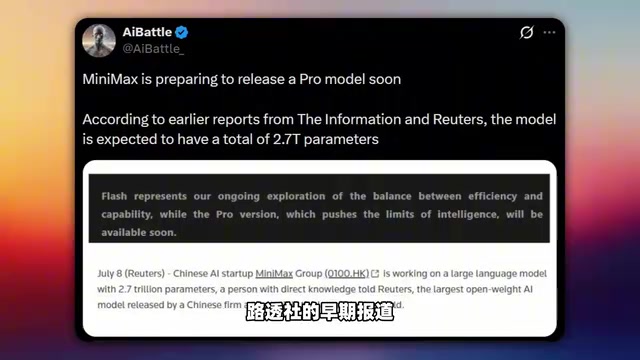
MiniMax is also preparing a stronger Pro version, which according to early reports from The Information and Reuters may have as many as 2.7 trillion parameters.
Open weights refers to publicly releasing parameter files after a model is trained, allowing others to download, self-host, and fine-tune, though not necessarily releasing training data or code. It differs from "open source": open weights typically grant only a usage license without providing a complete path to reproduce training. For vendors, open weights can both expand adoption through community ecosystems and monetize through hosted services and Pro versions; for users, it means avoiding API price fluctuations and data residency restrictions. MiniMax releasing open weights on a specific date in this article is a common rhythm that balances commercial API sales with community recruitment.
Kimi K3.1 and GLM's New Moves
Traces of Kimi K3.1 appeared in a PR that vanished after just 7 minutes, but the test data revealed details: a deployed instance hosted on DeepInfra, dated back to October 18th; the model uses the same tokenizer and chat format as Kimi K3, introduces four reasoning tiers—low, medium, high, and Max—with Max as the default, and supports image input. Kimi's early bird access is also about to open.
On Zhipu's side, the coding platform Zcode launched a workflow mode that can orchestrate multiple AI agents simultaneously, with a demo showing 10 sub-agents each working independently with real-time progress tracking. A research paper also revealed an internal multimodal model GLM Omni that can both understand and generate images, reportedly improving accuracy from 12.57 to 26.86 through better image-text alignment; GLM5.3 is said to have jumped from 4.6 to 28.3 on Terminal Bench through post-training alone, with no changes to the base architecture and no added parameters.
DeepSeek 4.1 Flash and NVIDIA's Inference Optimization
DeepSeek 4.1 Flash build 1017 is completely free in OpenCode. More notably, NVIDIA's optimization results: on the 2.8-trillion-parameter Kimi K3 model, it reportedly achieves 423 tokens per second for a single user, a 1.68x speedup on the same architecture. This comes from roughly 12,000 lines of highly optimized decoding kernel code written in QDSL, using Mega Current Fusion technology to drastically cut inference overhead—no model change, no GPU upgrade, nearly 70% faster through software alone.
Underrated Directions: Legacy Code Modernization and Open Source Security
OpenAI demonstrated its latest model's progress in understanding old languages like Cobol, Fortran, and even Visual Basic, helping developers migrate legacy codebases to modern tech stacks without breaking existing functionality. The dependence of banking systems, government infrastructure, and enterprise software on legacy languages far exceeds what most people imagine, and most of the people who wrote that code are no longer around, leaving business logic that no one can explain. This may be the most underrated use of AI coding agents.
Anthropic, meanwhile, launched the OSS Stanker program, using its strongest models to provide free regular security scans for critical open source projects, with each finding accompanied by proof of concept and suggested fix patches so maintainers can fix directly.

Cobol, Fortran, and Visual Basic were born in 1959, 1957, and 1991 respectively, and are still running in large quantities in core banking accounting, insurance claims, government benefit disbursement, and industrial control systems. The common dilemma of these systems is that business logic is implicitly embedded in tens of thousands of lines of procedural code, documentation is missing, and the original developers have mostly retired. The risk of migrating legacy code to modern tech stacks isn't in the rewrite itself, but in silently changing behavior during the rewrite. The value of AI agents is that they can summarize code intent segment by segment and generate comparison tests, turning "logic no one can explain" into verifiable specifications.
Robotics: DreamZero's Dream 1
DreamZero released the robotics foundation model Dream 1, with the goal of controlling robots it has never seen before, operating a dual-arm robot to complete tasks it was never explicitly trained on. Access is said to cost only $3 per hour, and the API is already open to developers. A foundation model that can adapt to different robots and tasks without extensive retraining is a prospect worth watching.
Summary
Putting this week's clues together: MiniMax M3.1 Flash has already landed with aggressively competitive pricing, Anthropic's new model's "intent understanding" capability is the key differentiator for next-generation competition, while GPT-6.5, Gemini 4 Carbon, Kimi K3.1, and new GLM models are all still on the way. The coming weeks are worth watching closely.
Related articles
 Tech Frontiers
Coldframe: A Honeypot Disguised as a Supermarket Freezer Controller
Coldframe is a honeypot disguised as Danfoss AK-SM 800A and Dixell XWEB freezer controllers, built as a single Python file that detects CVE-2025-41450 attempts and is identified as real devices on Shodan.
 Tech Frontiers
GRFNet: A Lightweight PyTorch Model Designed for Multichannel Time-Series Classification
GRFNet is a lightweight PyTorch model for multichannel time-series classification, originating from EEG decoding research. With only 3,847 parameters, it is based on the ROCKET architecture, combining random convolution kernels with learnable spatial filters, supports arbitrary input lengths, and will soon be evaluated on the PhysioNet dataset.
 Tech Frontiers
CUDA-Accelerated Rocket League Simulator: A Player-Made Hardcore Experiment
A Reddit post shows a "100% Accurate" Rocket League simulator accelerated with CUDA. We analyze its technical context, CUDA's value in game physics simulation, and the significance and limitations of such community projects.