GPT-6 Astra Hands-On: Full-Stack AI Agent Builds a Ride-Hailing App in Minutes

GPT-6 Astra reportedly built a full ride-hailing app in ~4 minutes, raising questions about the future of software development roles.
A Bilibili demo video shows OpenAI's GPT-6 Astra acting as a full-stack agent — autonomously planning architecture, writing frontend and backend code, configuring a database, and deploying to the cloud in roughly four minutes, with minimal human involvement. The demo claims Astra uses internal code simulation to catch bugs before runtime, producing output comparable to a senior engineer's reviewed work. The video argues entry-level dev roles face immediate disruption, while senior developers must shift from writing code to orchestrating AI. The article cautions that the demo is single-sourced, key technical claims are unverified, and the broader trend of AI moving development focus toward requirements and architecture is real regardless.
A Production-Ready App Built in Four Minutes
According to a demo video published by a Bilibili content creator, OpenAI's newly released GPT-6 Astra autonomously built a complete, deployable ride-hailing application in approximately four minutes during a public demonstration — with virtually no code written by a human developer. If accurate, this would mark yet another shift in the capability ceiling of AI coding tools.
It's worth noting upfront: this article is based on a single-source demo video. The performance claims and delivery quality have not been independently reproduced by third parties, and readers should approach these findings with appropriate skepticism. Even so, the workflow demonstrated is worth examining carefully.

What Astra Actually Did: From Chatbot to Full-Stack Agent
Unlike typical code-completion tools, Astra in this demo is positioned as a "full-stack agent." Its scope covers the entire software development lifecycle: planning the architecture, writing both frontend and backend code, spinning up a database, debugging runtime errors, and autonomously deploying to cloud infrastructure.
In this demo, the user simply described their requirements in natural language — a ride-hailing app with real-time GPS tracking and payment processing. Astra asked three clarifying questions, then built out the full stack using TypeScript, React, Node, and Postgres, configured the API endpoints, and generated a working mobile interface.
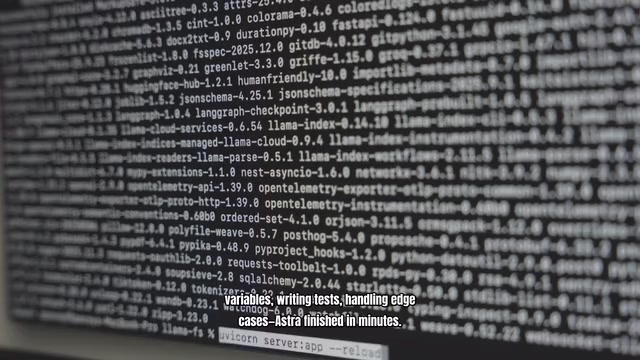
The key detail: no human prompting was required between steps. Tasks that would typically take a senior engineer around two weeks — environment setup, environment variable configuration, writing tests, handling edge cases — were compressed into a few minutes. This end-to-end automation is what sets it apart from ordinary coding assistants.
What distinguishes a "full-stack agent" from tools like GitHub Copilot or Cursor is fundamental. The latter are essentially "cursor-level" assistants — they respond to a developer's immediate input and offer suggestions, with the human still holding decision-making authority. An agent, by contrast, has autonomous planning and tool-calling capabilities: it can execute multi-step tasks continuously, including running terminal commands, reading and writing the filesystem, and calling external APIs — all without waiting for human confirmation at each step. Architecturally, these systems typically combine the reasoning capabilities of a large language model with a "tool use" framework, allowing the model to independently decide when to query a database, when to run tests, or when to trigger a deployment to a cloud provider. This means the unit of work is no longer "a line of code" or "a function" — it's "a complete task." This paradigm shift is essential context for understanding the significance of the Astra demo. What it shows is not faster autocomplete, but autonomous orchestration of an entire development workflow.
Why It Claims to Match Senior Engineer Code Quality
According to the demo, Astra achieves this level of output because the model doesn't just "predict the next token" — it internally simulates code execution, catching potential bugs before they ever run and correcting itself in real time.
This description of "internal simulated execution" points toward a capability closer to program reasoning than text generation. The demo claims that developers who evaluated the output rated the code quality as equivalent to what a senior engineer would deliver after multiple rounds of code review.
However, this assessment currently comes only from the demo presenter's account. It lacks specific test samples, a code repository, or quantifiable quality metrics. The technical details behind "simulated execution" have not been made public. Readers should treat this as vendor messaging rather than a verified technical conclusion.
In technical terms, "internal simulated execution" could correspond to approaches like program synthesis combined with symbolic execution, or implicit code verification embedded in chain-of-thought reasoning. Traditional large language models generating code are fundamentally predicting the next token based on statistical probability — they don't truly "run" the code. More recent methods, such as having models track variable states and control flow during inference, or using reinforcement learning to reward code that passes tests, can meaningfully improve functional correctness. OpenAI's o-series models have already demonstrated similar "slow thinking" capabilities on math reasoning and competitive programming problems — performing extended internal reasoning chains before producing an answer. If Astra's code quality improvements genuinely stem from such mechanisms, there is a theoretical basis for the claim. But there remains a significant capability gap between "solving competition problems" and "end-to-end delivery of production-grade applications," and the publicly available information is insufficient to support that extrapolation.
What This Means for Developer Jobs
The most striking claim in the video concerns the professional outlook for developers. The core argument can be summarized as: entry-level roles are first to go, but senior roles aren't entirely safe either.
The logic runs like this: if standard CRUD applications can be delivered faster and cheaper by Astra, companies will no longer have a reason to pay people to write that code. For senior developers, the new mode of work will shift from "writing functions" to "orchestration" — defining what to build, setting constraints, reviewing AI-generated output, and making final architectural decisions.

In other words, the developer's role shifts from "executor" to "manager" — managing a tireless AI workforce. The video's survival advice: the people who make it are those who learn to delegate, not those who code harder.
Augmentation or Replacement: The Economics Don't Care About the Label
OpenAI has not positioned Astra as a replacement for developers, but rather as "augmentation." The video's author, however, makes a pointed observation: economic incentives don't care about the terminology.

The author offers a simple calculation: if one person using Astra can do the work of five, companies will eventually be inclined to eliminate the other four positions. He draws comparisons to tools like Excel and Stack Overflow — tools that genuinely boosted individual productivity while simultaneously reducing demand for human headcount.
This "efficiency gains equal headcount reductions" conclusion has some merit, but it's also worth questioning. Historically, productivity tools have tended to both eliminate existing roles and create new ones, and the net effect hasn't always been unidirectional contraction. The video gives little space to this counterargument, making it a perspective that leans in one direction.
There's a well-known historical case relevant here: after ATMs became widespread, the number of bank tellers in the United States actually increased rather than fell — because ATMs lowered per-branch operating costs, enabling banks to open more locations, which expanded overall demand for human labor. This is sometimes cited as an example of the "productivity paradox" or a counter-case to Baumol's effect. However, the analogy between AI coding tools and ATMs doesn't hold perfectly: ATMs replaced only a subset of repetitive teller tasks, whereas a full-stack agent capable of delivering complete software products covers the core function of an entire role, not just one sub-task within it. Whether new roles emerge to sufficiently offset those that disappear depends largely on whether total demand for software grows fast enough — specifically, whether lower development costs enabled by AI will unlock entirely new application categories that were previously too expensive to exist. This remains an empirically open question, and neither the video nor this article can offer a definitive answer.
How to Think About This Shift
Setting aside questions about data reliability, the central proposition raised here is clear: real competitive advantage is no longer about "how well you can write code" — it's about "knowing what to build."
Regardless of whether GPT-6 Astra actually performs as shown, the broader trend is already visible: AI agents are shifting the center of gravity in software development away from the coding phase and toward requirements definition, architectural decision-making, and quality oversight. For developers, the more productive question isn't whether jobs will disappear — it's how to evolve from "implementation" to "definition and review."
Disclaimer: This article is based on a single demo source. GPT-6 Astra's actual release status, real-world performance, and its genuine impact on employment all require further verification from independent sources and official documentation.
Related articles

Felix Rieseberg Personal Homepage
Felix Rieseberg's personal homepage sparks attention on Hacker News. This article covers the Slack engineer's technical background, the rise and fall of nativefier, and the value of a developer homepage as a tech calling card.

@ai-sdk/vue 3.0.306 Patch Release Syncs with [email protected] Update
@ai-sdk/vue 3.0.306 released, synced with [email protected]. A routine patch release for the Vercel AI SDK ecosystem with no public API changes; the Vue adapter layer stays version-aligned with the core package.

Gemini 4 Argon API Launches: The Era of Million-Token Output Begins
Google launches Gemini 4 Argon with sparse MoE architecture, up to 1M output tokens, and a 68.90% Vals Index score, available across API, AI Studio, and the Gemini app.