GPT-6 Astra Plays World of Warcraft for the First Time: A New Frontier for AI Game Agents

The agent-wow project puts an LLM-driven AI agent into World of Warcraft, testing the boundaries of general-purpose AI in complex real-world environments.
The agent-wow project recently appeared on Hacker News, claiming to be the first attempt at using GPT-6 Astra to play World of Warcraft. The article traces the research lineage of using games to test AI agents — from AlphaGo to AlphaStar — and argues that MMORPGs pose far more comprehensive challenges than chess or MOBA games, due to their open worlds, multimodal inputs, real-time demands, and sparse feedback. Projects like this typically employ an "LLM as the brain" architecture inspired by Minecraft agents like Voyager. While "GPT-6 Astra" lacks official backing and the experiment reads more like an early proof of concept, the underlying technical capabilities — multimodal perception, long-horizon planning, self-correction — have implications well beyond gaming, from office automation to robotics.
An Experiment Worth Watching: AI Takes On World of Warcraft
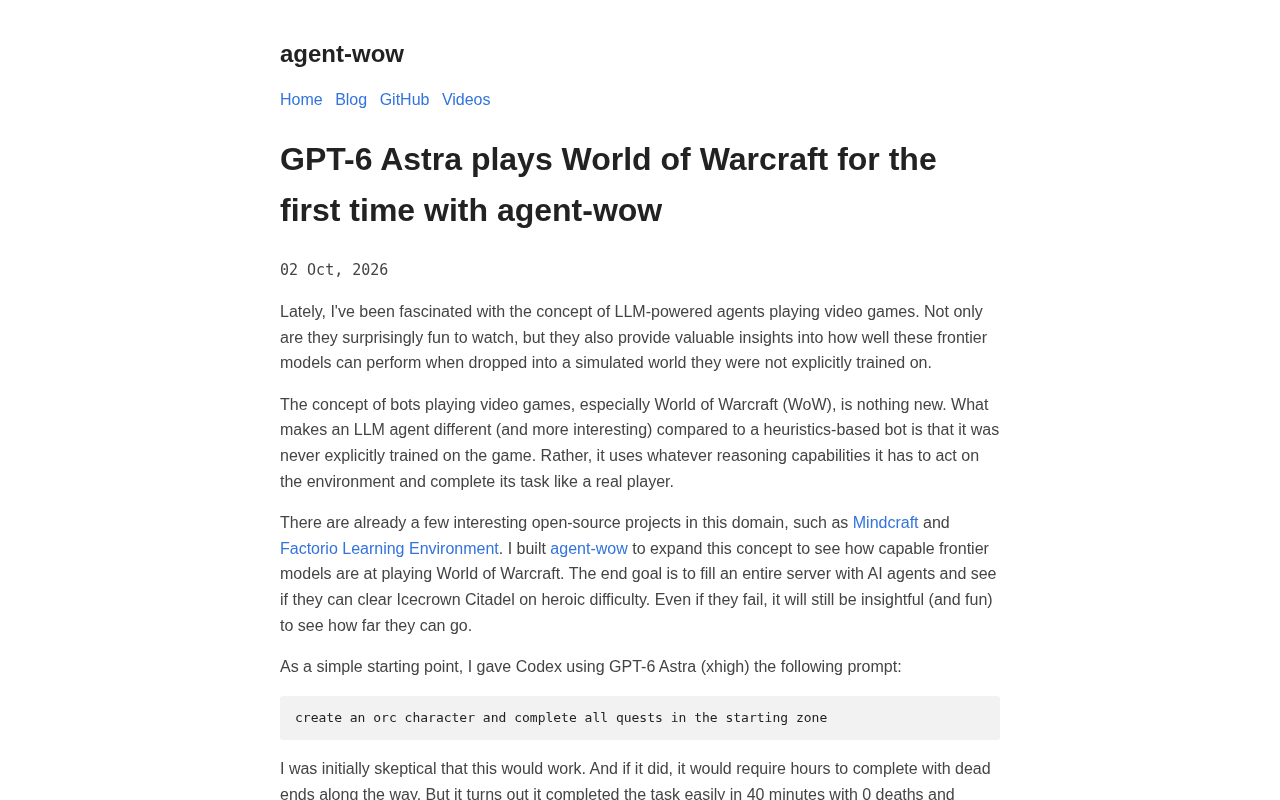
A project called agent-wow recently surfaced on Hacker News, claiming to be the first attempt at getting GPT-6 Astra to play the classic MMORPG World of Warcraft. While the post hasn't yet generated massive discussion or visibility, the direction it represents — using large language models to drive game agents — is very much at the cutting edge of AI research.
It's worth noting upfront that the name "GPT-6 Astra" lacks any authoritative official backing and appears to be community-driven or experimental in nature. This article therefore focuses on the technical ideas and broader significance behind this type of experiment, rather than endorsing any specific model version.
Why Use Games to Test AI Agents
Games have long served as the ideal testing ground for AI research. From DeepMind's AlphaGo and AlphaStar (StarCraft II) to OpenAI's Dota 2 team, complex game environments offer quantifiable objectives, rich state spaces, and demanding requirements for long-term planning and real-time decision-making.
As a massively multiplayer online role-playing game, World of Warcraft presents a far greater challenge than board games or MOBA titles. It requires an agent to understand quest text, navigate an open world, manage skill cooldowns and resources, interact with NPCs and the environment, and even handle social dynamics. An AI capable of genuinely "playing" WoW well would need to simultaneously demonstrate visual understanding, language comprehension, spatial reasoning, and long-horizon planning.
The Unique Challenges of MMORPGs
Unlike turn-based or closed-environment games, MMORPGs present several characteristics that raise the bar considerably for AI:
- Open worlds and long-horizon tasks: Quest chains can span hours of play, requiring sustained goal tracking and memory management.
- Multimodal input: Screen visuals, quest text, and UI state must all be parsed simultaneously.
- Real-time demands: Combat and movement require responses within tight time windows.
- Sparse feedback: Reward signals are often delayed and infrequent, which works against traditional reinforcement learning.
The sparse feedback problem is particularly thorny for traditional reinforcement learning, which relies on frequent reward signals to update its policy. In WoW, completing a quest chain might require hundreds of individual actions, while meaningful rewards — experience points, gear — only appear when the task is finally finished. This "credit assignment problem" makes it difficult for an agent to identify which actions actually contributed to reaching the goal. Ironically, this is where LLM-based approaches have an edge: the model can leverage its internal semantic understanding to "self-evaluate" the reasonableness of intermediate steps, rather than relying entirely on external reward signals to drive learning.
The Technical Approach Behind Projects Like agent-wow
Based on its name and framing, agent-wow most likely employs a "LLM as the brain" agent architecture: a multimodal large language model handles perception of the game screen and understanding of the current objective, then outputs keyboard and mouse-level action commands, which an execution layer maps to in-game actions.
This paradigm of "LLM + tool use + perception loop" has already seen considerable exploration in games like Minecraft — most notably the Voyager project. Its core appeal lies in the fact that, compared to purely reinforcement-learning-based approaches requiring vast amounts of training data, LLM-driven agents can leverage world knowledge and language understanding accumulated during pretraining to execute tasks out of the box with far fewer samples.
Likely Capabilities and Limitations
On the optimistic side, if a large model can complete basic tasks in WoW — accepting quests, navigating, combat, turning in quests — it would further demonstrate the generalization potential of general-purpose large models in complex interactive environments. In practice, however, these experiments tend to expose clear weaknesses: slow real-time combat responses, losing track of goals during long-horizon planning, and inconsistent recognition of UI elements.
Given how little public information is currently available, this looks more like an early proof of concept than a polished demonstration — a long way from "smoothly completing the game."
Voyager, proposed by Microsoft Research in 2023 and designed specifically for Minecraft, remains the most representative example of an "LLM-driven game agent" to date. Its core innovations consist of three mechanisms: having GPT-4 automatically write and execute JavaScript skill code; building a continuously expandable "skill library" that modularizes and reuses verified behaviors; and introducing an automatic curriculum mechanism that lets the model autonomously propose its next learning objectives based on current capabilities. In Minecraft, Voyager can continuously explore, mine, and craft tools without human intervention, covering far more ground than previous reinforcement learning agents. If agent-wow adopts a similar architecture for WoW, the biggest difference it faces is this: Minecraft has an open interface that allows direct code-level control of game state, while commercial games typically only permit interaction via screen visuals and simulated inputs — significantly raising the difficulty of both perception and execution.
What This Means for the Development of AI Agents
Regardless of how agent-wow ultimately performs, the direction these experiments represent is genuinely valuable. Games are a stress test for general AI capabilities, and pushing the testing ground from simplified environments toward real, complex commercial games reflects the field's ongoing effort to probe the boundaries of agent capability.
For developers and researchers, the important questions aren't just "can AI play this game?" — they're about how the agent handles multimodal perception, maintains coherence across long-horizon tasks, and self-corrects after failure. Once these capabilities mature, their applications extend far beyond gaming: the underlying logic is equally relevant to office automation, robotic control, and more.
Researchers often describe the journey from the lab to real commercial software as the leap from "sandbox environments" to "in-the-wild deployment." Sandbox environments — such as OpenAI Gym or Minecraft's Malmo API — provide standardized interfaces, resettable states, and precisely defined reward functions, dramatically lowering the barrier to research. The "wild" environment of commercial games, operating systems, and real websites is full of uncontrollable variables: UIs change across versions, visual elements are ambiguous, and action latency is inconsistent. The difficulty of this leap is frequently underestimated, which is why many agents that perform impressively in controlled settings suffer significant performance drops when confronted with real software. By choosing a high-complexity commercial game like WoW as its proving ground, agent-wow is deliberately challenging itself on "in-the-wild generalization."
Conclusion: Stay Curious, Stay Grounded
Given how limited the available information currently is, we can't make any definitive assessment of agent-wow's specific implementation, performance, or real-world results. The greater value of this news lies in what it reflects: a broader trend of AI agents accelerating their move from the laboratory into complex, real-world environments. For early-stage projects like this, the right approach is to stay engaged but maintain realistic expectations — and wait for more technical details and demonstrations before drawing firm conclusions.
Related articles

Understanding DeepSeek in 3 Minutes: The Rise from a Quant Hedge Fund to an Open-Source AI Leader
DeepSeek's history in 3 minutes: from High-Flyer Quant's compute build-up to V2's MLA inference cost cuts, V3's $5.576M training bill, R1's open-source global shock, and V4 with a $7B Series A.

Local Creative Writing Model Showdown: Fine-tuned Qwen3.8 27B Wins, DeepSeek v4.1 Underwhelms
Bilibili creator tests seven local creative writing models: Hemingway and HumanLike Chat based on Qwen3.8 27B perform best, DeepSeek v4.1 is plain, Dongfang Shuo ranks last with confused characters. Includes three test prompts, scores, and usage advice.

Liang Wenfeng's Three Big Bets: Why Did DeepSeek Open-Source Its 82% Gross Margin?
Why did DeepSeek open-source DeepInfer, its 82% gross margin inference framework, and then launch a hundred-billion funding round? An analysis of Liang Wenfeng's three big bets and the open-source strategy.