GPT-6 Astra Pro Upgrade: Multi-Agent Parallel Task Processing

GPT-6 Astra Pro upgrade: faster responses and multi-agent parallel processing, Pro users only.
GPT-6 Astra Pro in ChatGPT has been upgraded with faster responses and optimized plugin/tool use. The standout new feature is multi-agent parallel processing, which lets multiple agents handle different parts of a task simultaneously with real-time progress tracking. Available only to Pro users in the Chat tab.
Upgrade Overview: Faster Responses and Enhanced Plugins/Tools
According to the latest news on Twitter, the GPT-6 Astra Pro version in ChatGPT has received a significant update. The core of this upgrade lies in improved response speed and optimized plugin and tool invocation. For users who rely on ChatGPT to handle complex workflows, this means a smoother interaction experience and higher task completion efficiency.
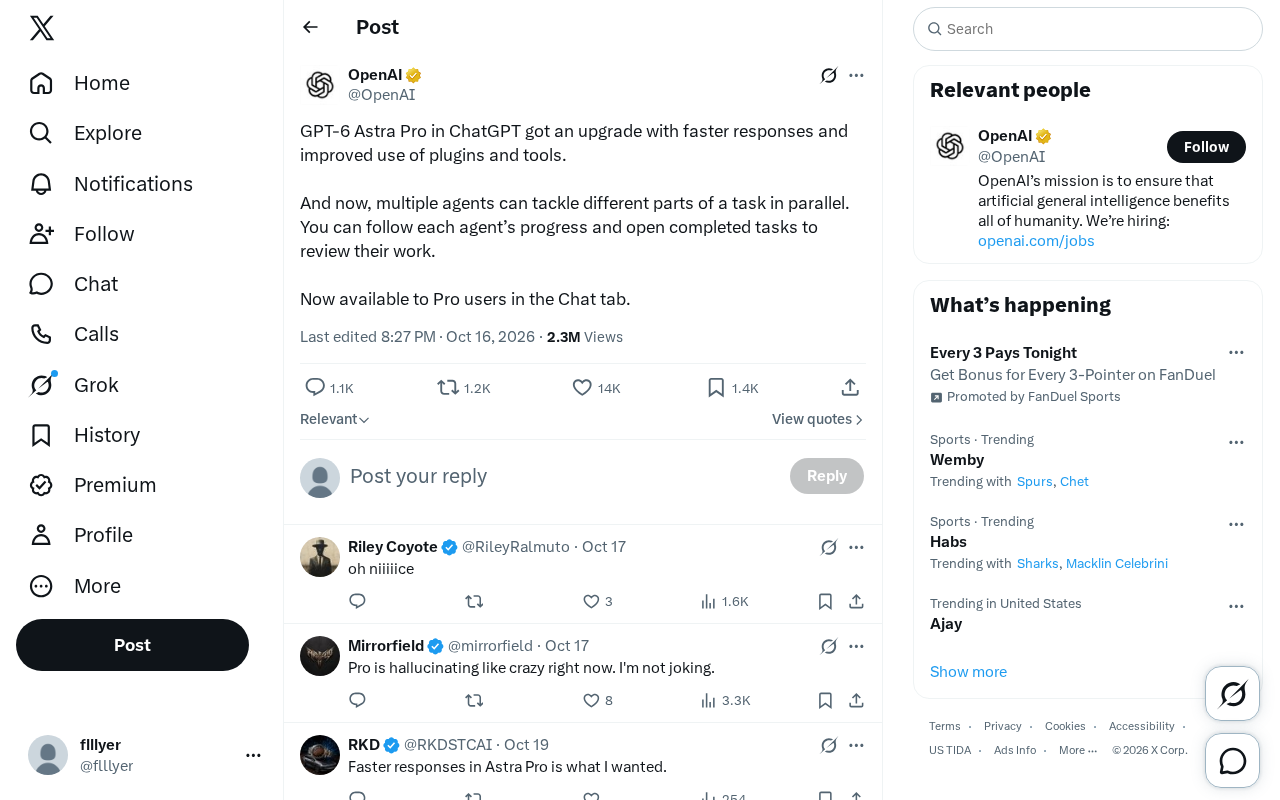
Although the official tweet did not disclose specific technical details, the two points "faster responses" and "improved plugin and tool use" directly point to optimization of the underlying model's inference efficiency and a redesign of the external tool scheduling logic. For users who frequently use plugins such as web search and the code interpreter, this improvement will significantly reduce wait times and lower the probability of tool invocation failures.
Plugins and Tool Use are key mechanisms for extending the capabilities of large language models. Plugins allow the model to call external APIs or services (such as web search, calculators, and code interpreters), thereby breaking through the time limitations of training data and the boundaries of inherent knowledge. Tool use is more general: it refers to the model autonomously deciding which external function to call based on a user request and generating parameters that conform to the specification. The model typically outputs tool invocation requests through special tokens or JSON format, and the runtime environment executes them and returns the results to the model for the next step of reasoning. Optimizing tool use involves reducing false trigger rates, improving parameter accuracy, reducing invocation latency, and handling retry logic after invocation failures. These improvements can significantly enhance the automation and reliability of complex workflows.
Multi-Agent Parallelism: Task Decomposition and Real-Time Tracking
The most eye-catching feature of this upgrade is multi-agent parallel processing. According to the tweet, the system can now dispatch multiple agents to simultaneously handle different parts of the same task. Users can not only track the real-time progress of each agent, but also open completed tasks to view their work results.
This feature marks ChatGPT's evolution from a single conversational model toward a "task orchestration platform." In the traditional mode, complex tasks require users to manually decompose them and guide the model step by step; the multi-agent architecture allows the system to automatically decompose tasks, execute subtasks in parallel, and ultimately aggregate the results. For example, a task involving market research might be split into three subtasks—data collection, competitor analysis, and report writing—advanced in parallel by different agents.
Currently, this feature is available only to Pro users and is located in the Chat tab. This positioning indicates that OpenAI is shifting the value of the Pro subscription from "higher usage quotas" to "more powerful task processing capabilities."
Multi-Agent System is an important concept in the field of artificial intelligence, referring to a system composed of multiple autonomous agents that can collaborate, communicate, and coordinate actions to complete complex tasks that a single agent would find difficult to handle. In the context of large language models (LLMs), each agent is typically a model instance with a specific role, tool access permissions, and reasoning capabilities. They can exchange information through shared context, message passing, or a blackboard architecture. The advantages of multi-agent architectures include parallelizable subtasks, improved system robustness (a single agent's failure does not affect the whole), and handling heterogeneous tasks through division of labor. Common collaboration patterns include pipeline (sequential dependency), parallel (independent subtasks), and debate (multiple agents discussing to reach consensus). Currently, multi-agent systems are moving from academic research to productization, and this upgrade by OpenAI is a typical attempt to integrate them into ChatGPT.
Impact on User Workflows
The introduction of multi-agent parallelism may bring substantive changes to knowledge workers' workflows. Tasks that previously required multiple tools and multiple interactions may now be completed collaboratively by multiple agents within a single conversational interface. The real-time progress tracking feature provides the necessary transparency, allowing users to monitor task execution status and detect deviations in a timely manner.
However, the details of the collaboration mechanisms among agents remain unclear—for example, how they share intermediate results and how they handle dependencies between subtasks. These technical details will determine the reliability of this feature in real complex scenarios.
Competitive Landscape and Future Outlook
Multi-agent systems are a hot direction in the current AI field. This upgrade to GPT-6 Astra Pro integrates multi-agent capabilities directly into a consumer-grade product rather than remaining at the research demo stage. For Pro users, this offers a way of handling tasks that differs from the traditional "conversation + plugins" paradigm.
As this feature becomes available to more user tiers and agent collaboration mechanisms further mature, ChatGPT is expected to evolve from an "intelligent assistant" into an "intelligent team." At this stage, however, the feature is limited to Pro users, and it remains unknown when ordinary users will be able to experience it.
One-line Summary
GPT-6 Astra Pro upgrade: faster responses, new multi-agent parallel processing, Pro users only.
Paragraph Summary
The GPT-6 Astra Pro version of ChatGPT has received a major update, centered on faster response speeds and optimized plugin and tool invocation, making user interactions smoother and task completion more efficient. Most notably, a new multi-agent parallel processing feature has been added: the system can dispatch multiple agents to simultaneously handle different parts of the same task, and users can track progress in real time and view the results of completed tasks. This marks ChatGPT's evolution from a single conversational model toward a task orchestration platform, shifting the value of the Pro subscription from usage quotas to task processing capabilities. The feature is currently available only to Pro users and is located in the Chat tab. The introduction of multi-agent systems may substantively change knowledge workers' workflows, but the details of inter-agent collaboration mechanisms remain unclear, and its practical reliability remains to be seen.
Related articles

Chain of Thought Isn't Just for AI: How Humans Can Use CoT to Improve Thinking Quality
Chain of Thought isn't just a prompt trick for large models. Starting from a Hacker News discussion, this article analyzes why CoT works for human thinking too, breaks down actionable ways to transfer it, and highlights the key differences between human CoT and machine CoT.
Cloudflare Teams Up with OpenAI: Closi…
Cloudflare Teams Up with OpenAI: Closing the Loop from Vulnerability Discovery to Defense with AI
Cloudflare uses OpenAI Daybreak to investigate security vulnerabilities and generate reviewable remediation plans, while developers use Codex to boost coding efficiency and quality.

Orca Multi-Agent Orchestration in Practice: A Guide to Parallel Collaboration with Claude and Codex
Orca is Stable AI's free open-source agent workbench supporting 34 agents like Claude Code and Codex in parallel. Learn its Git worktree isolation, multi-model orchestration, and mobile management.