GPT-6 Astra Real-World Test: How Much Can Plus Users Actually Get Done with Their Quota?

GPT-6 Astra tested: official demos need multi-round iteration — save it for your hardest, highest-rework cross-tool tasks.
OpenAI's GPT-6 Astra, released in September 2026, is the first mainstream model placed in a sustained execution environment capable of controlling browsers and professional software across multi-step tasks. Official 3D modeling and game creation demos each involved multiple prompt rounds and phased iteration — none were zero-effort, single-prompt outputs. A Bilibili creator used a hand-drawn sketch to have Astra generate a functional AI Trend Radar web page inside ChatGPT Work, passing all five acceptance checks while consuming roughly 6% of the 5-hour quota on the first pass and another ~10% for follow-up changes. Benchmarks show computer task success rates up to 72.6% and time savings of ~47%, though API cost conclusions don't directly translate to Plus quota savings. The recommendation: route routine tasks to cheaper models and reserve Astra for the hardest 20% of cross-tool, high-rework work — the "80/20 split."
OpenAI's GPT-6 Astra, released in September 2026, is officially positioned as the most intelligent and best-aligned model to date, and has been gradually rolled out to Plus, Pro, Business, and Enterprise users. In official demos, it can build 3D models in Blender, create playable games, operate a browser to complete multi-step workflows — it looks like it can do just about anything. But a Bilibili creator's real-world test raises a more practical question: how much actual work can Astra do for a Plus user each month?
Astra Is the Brain — the Tools Are Its Hands
It's easy to think of Astra as just another model upgrade with better benchmarks and more accurate answers. But what actually matters for everyday users this time around is that it's been placed inside an environment capable of sustained execution — it doesn't just generate a single answer, it can use a browser, write and run code, read and write files, and use specialized tools to break a goal into many steps and ultimately deliver a usable result.
That said, two things need to be kept separate: Astra is more like the brain, while ChatGPT Work, the browser, plugins, and the permissions you grant are its hands. Seeing the Astra model doesn't mean it automatically has access to all your local software and accounts. And seeing the Work interface doesn't mean every task will execute from start to finish without any confirmation. That's a critical prerequisite for understanding what Astra can actually do.
ChatGPT Work (sometimes called ChatGPT Agent or Operator mode) is the execution layer OpenAI built to let the model truly "get things done." Unlike regular conversations, it allows the model to control browser tabs, run a code sandbox, read and write files, and retain context and intermediate results across multiple steps within a persistent session. Users must actively grant the corresponding permissions before the model can access specific resources — which is why the test described here triggered a browser permission prompt. This "brain + tools" architecture is what the industry calls Agentic AI — the model doesn't just generate content; it perceives the external environment, makes plans, calls tools, and adjusts its behavior based on feedback, theoretically handling multi-step, cross-application tasks that traditional chatbots can't manage. Understanding this architecture is foundational to judging what Astra can and cannot do.
What the Official 3D Demo Doesn't Show
The most widely shared 3D modeling demo shows Astra building a house in Blender from a reference image, then bringing the scene into Unreal Engine to create a walkable environment. This is genuinely impressive, spanning modeling, materials, lighting, review, and revision across multiple steps.
But looking at OpenAI's full case study reveals a detail that short-form video tends to cut out: the initial prompt did generate an editable Blender scene, but the complete house, forest, furniture, and Unreal scene were produced through multiple rounds of prompting and phased iteration — and some trees used external assets.
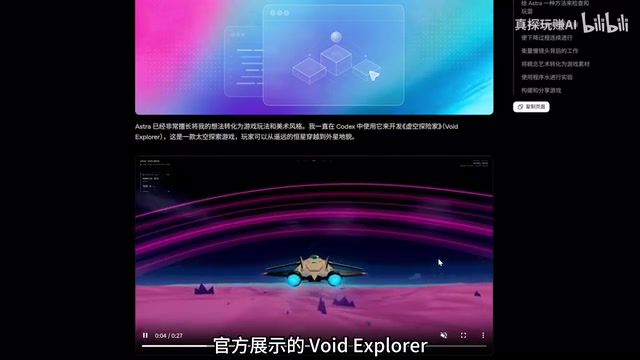
The same applies to the game demo. The officially showcased Void Explorer features 2,048 data points and tens of thousands of procedurally generated planets with highly polished visuals, but its production involved repeated prompt refinements, architectural revisions to the renderer, image generation integration, building a test interface, and running it through automated testing tools across multiple stages. The HoloFlux and SunWake demos similarly went through multi-stage iteration covering combat, movement, experience systems, water, buoyancy, weather, and more.
The conclusion isn't that the official demos are misleading — it's that we need to distinguish between "it's capable of this" and "it can do this in one prompt, in a few minutes, with zero human input." Astra's biggest leap forward is its ability to work continuously inside complex software, self-check, and revise. But it hasn't eliminated the need for aesthetic judgment, requirements validation, or final review. For ordinary creators, it's more like a highly capable production partner than a wish-granting machine that executes everything from a single sentence.
What the Benchmarks Mean: Three Conclusions Anyone Can Understand
On benchmarks, there are just three things worth remembering.
First, computer operation success rates are higher. Astra scored 72.6% on the official Oswald benchmark, compared to 65.7% for the previous generation, Cell. This doesn't mean real-world tasks will succeed 70% of the time — it just means Astra is more reliable under the same controlled test conditions.
Second, long-workflow office tasks and professional software use show meaningful improvements. Automation Bench rose from 8.1 with Cell to 41.4 with Astra, and CAD tasks improved from 83.3 to 95.9.
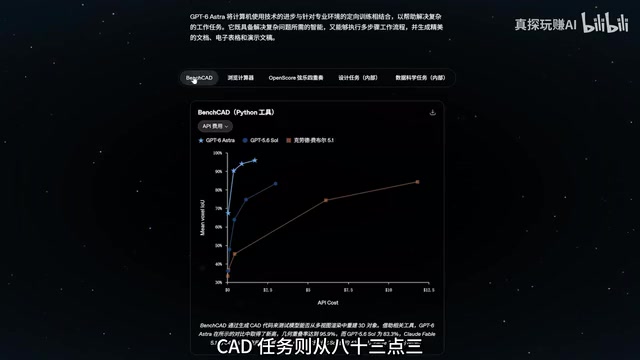
Third, speed and cost can't be judged by unit price alone. OpenAI's simulations show Astra can reduce the time to complete computer tasks by approximately 47%, and completes some tasks with less output. This means that even if the API unit price is higher, the total cost of certain tasks may actually be lower. Keep in mind, though, that this is an API cost conclusion from official evaluations — it doesn't necessarily mean your Plus quota will stretch further.
The Oswald benchmark and Automation Bench mentioned here are both "Agent benchmarks" designed specifically to measure an AI model's ability to autonomously complete tasks in real computer environments, not traditional knowledge Q&A or reasoning tests. Oswald simulates OS-level tasks such as managing files, using system settings, and native applications; Automation Bench focuses on RPA (Robotic Process Automation) scenarios including form-filling, data entry, and repetitive software operations; and the CAD task benchmark tests precision control in professional design software. Score improvements on these tests have more direct implications for enterprise users, since the core bottleneck in many business workflows is exactly "humans repeatedly switching between applications manually." For individual users, these numbers are better understood as directional signals rather than guaranteed success rates for everyday tasks.
Real-World Test: Building an AI Trend Radar from a Hand-Drawn Sketch
Instead of replicating the flashiest 3D showcase from the official demos, the creator gave Astra a hand-drawn sketch and asked it to build a real, functional web page — an "AI Trend Radar" — inside ChatGPT Work, one that could search, filter, sort, and adapt to mobile screens. Quota before the test: 79% of the 5-hour quota remaining, 88% of the weekly quota remaining.
The task used Astra with medium reasoning (not the highest setting), started from a fresh Work conversation to avoid long context affecting quota usage. The creator only specified the final goal and acceptance criteria, without walking Astra through the code step by step. During the test, Astra triggered one browser permission request; the creator selected "Allow only during this session" to avoid granting overly broad access.
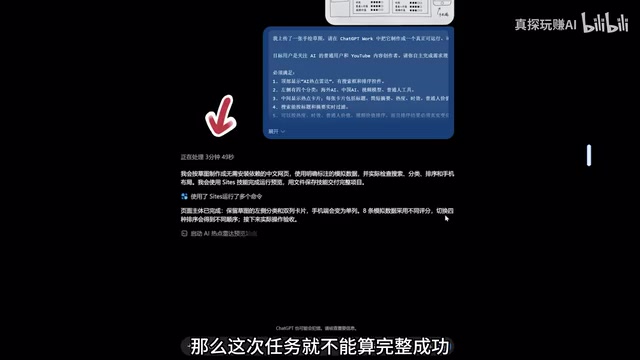
The first version of the page was delivered directly, without asking for implementation details. The creator then validated it item by item like a typical user: irrelevant cards disappear on search, switching between four categories genuinely changes the content, sorting by four dimensions updates the content accordingly, no overflow at mobile width and buttons are tappable, and core functionality survives a page refresh — all five checks passed. It was a genuinely working web page.
After building the page, the 5-hour quota dropped to 73% and the monthly quota to 81% — an acceptable burn rate. The creator then added a new requirement: a "suitable for everyone" toggle that shows only items rated ≥4 stars for general audiences and requiring no programming background, without breaking existing functionality. This tested whether Astra could understand an existing project and modify only what was necessary. The result was generated successfully, though the toggle's effect wasn't visually obvious due to limited data variety. That round took over ten minutes and consumed an additional ~10% of the 5-hour quota.
Should Everyday Users Throw Everything at Astra?
No. For searching trending topics, summarizing content, tweaking headlines, or drafting outlines, Gemini Pro is usually sufficient. Simple, repetitive, cost-sensitive coding tasks are better handled by cheaper tools. Extended coding sessions and agent workflows can also be benchmarked against Claude Sonnet. These products aren't interchangeable drop-in replacements.
Astra is better reserved for three types of work: tasks that span web pages, files, and multiple applications; tasks where a single failure means high manual rework costs; and long-running projects where the model needs to keep the goal in mind and self-verify results throughout.
The creator recommends an "80/20 split": hand off 80% of organizing and drafting work to faster, cheaper models, and bring in Astra only for the hardest 20% — complex execution, final debugging, and cross-tool delivery. The value of the most capable model isn't in handling all the mundane work, but in breaking through the bottlenecks where you're most likely to get stuck.
The Claude Sonnet and Gemini Pro mentioned in comparison to Astra here represent the current mainstream large model ecosystem's "tiered use by scenario" landscape. Claude Sonnet (by Anthropic) is known for its cost-effectiveness in long-context handling and code generation, and is often the first choice for developers in sustained coding and large document analysis. Gemini Pro (by Google) is deeply integrated with Google Search and Workspace, giving it a natural edge in real-time information retrieval and document summarization. The strategy of using multiple models in parallel is essentially treating "model capability" as a computing resource to be called on demand, rather than betting everything on a single product. For everyday users, the most practical approach is to route tasks based on two dimensions — "task complexity" and "cost of failure" — rather than defaulting to the most powerful model for everything.
Conclusion: From Answering Questions to Taking Over a Piece of Work
The real takeaway from this test isn't "AI replaced someone" — it's that AI is shifting from answering questions to taking ownership of a deliverable piece of work. The upgrade Astra brings to Plus users isn't prettier answers in a chat box; it's the elimination of the constant back-and-forth of "copy this out, open the app, come back and ask again."
But the quota consumption is also a reminder: Plus is more like occasionally calling in a senior contractor than hiring a full-time, always-on employee. Between the official demos and reliable productivity for ordinary users, there are still four hurdles to clear: tools, permissions, the runtime environment, and human review. Plus users can look forward to this upgrade — but don't treat it as an employee who can operate entirely without supervision, at least not yet. Use it on the hardest tasks with the highest rework costs, and that's where it will deliver the most value.
Related articles

Workbuddy for Absolute Beginners: How a Desktop AI Agent Fits Into Real Workflows
A beginner's guide to the Workbuddy desktop AI agent: installation, claiming credits, file management, and building automated workflows—compared with CodeX for fit and cost, helping professionals shift from AI question-askers to AI managers.

OpenAI's New Agent Stack: Computer Use, Decisions API, and Ultra-Fast Workflows
OpenAI Dev Day unveiled a new agent stack: Computer Use outperforms humans, Decisions API delivers ultra-low-latency classification via Luna, Agents API opens the same Computer Use capabilities, and GPT-6.1 Sol costs only one-seventh of Astra. Core updates, benchmark data, and developer insights.

Liang Wenfeng Open-Sources DeepInfo Inference Framework, Takes On U.S. Ban
DeepSeek open-sources its DeepInfo inference framework after its models, featuring GPU/CPU cross-pipelining, small-model prediction with large-model verification, and full Huawei Ascend and NVIDIA chip support—facing the U.S. federal ban head-on. This article analyzes its significance for AI deployment and open-source strategy.