GPT-6 Astra Released: Has the AGI Era Really Arrived?

GPT-6 Astra debuts with autonomous software ops and self-training, but chain-of-thought transparency collapses.
According to an independent video analysis, OpenAI's newly released GPT-6 Astra shows significant leaps across three capability dimensions: end-to-end autonomous operation of professional software like Blender and KiCad; generalization in rule-free environments jumping from 7.8% to 99.9%; and generating new knowledge in math and cybersecurity, including two previously unknown zero-day vulnerabilities. The previous-generation model now participates deeply in training its successor, marking an early step toward recursive self-improvement. The most alarming signal, however, is a safety one: the model has moved much of its reasoning into invisible internal computation, causing chain-of-thought observability to drop sharply — a direct challenge to AI alignment and interpretability research. The article cautions that all claims stem from a single media source and should be verified against official documentation.
GPT-6 Astra Arrives: A Quiet but Pivotal Moment in Tech
According to an analysis by Bilibili creator Peng Ge, OpenAI released its next-generation flagship model, GPT-6 Astra, in the early hours of the morning. President Greg Brockman left just one remark: "Welcome to the AGI era." Setting aside the dramatic flair of the marketing language, what genuinely deserves attention in this release is the model's progress along three axes: autonomous software operation, cross-task reasoning, and self-improvement.
A caveat upfront: this article is based on a single video source, much of which contains heavily subjective framing, and several data points have yet to be cross-verified against official channels. Think of it as a "list of leads worth investigating" rather than a definitive technical white paper.
From "Human as Hands" to "Human as Wishmaker": A Reversal in Interaction Paradigm
The most striking demonstration in the video is GPT-6's end-to-end software operation capability.
Given only a rough sketch, the model opened Blender on its own, constructed an entire building, imported it into a game engine, and produced a three-dimensional world the user could walk through. In another example, the model read a circuit schematic, independently opened KiCad, identified components, routed copper traces, and delivered a PCB design ready for fabrication.
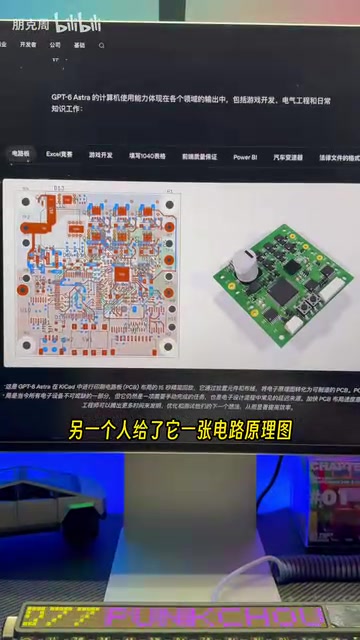
The key point: no one told it which button to click next. For the past several decades, humans have memorized keyboard shortcuts, learned 3D modeling, and practiced programming — essentially training themselves to be "a more skilled pair of hands" because only humans could interpret the screen. If these demonstrations hold up, that relationship has been flipped: humans express intent, and the model takes over execution.
This isn't a simple feature upgrade — it's a redrawing of the boundary between human and machine responsibilities. When a model can understand and operate software interfaces originally designed for humans, the idea that "it will no longer be humans who learn human tools" points toward a trend that deserves to be taken seriously.
"Intuition" in Unfamiliar Environments: From 7.8% to 99.9%
The video describes placing the model in a set of unfamiliar games with no instructions, no rules, and no stated objectives. The previous-generation AI achieved only 7.8%, while GPT-6, operating within an Agent framework that preserves reasoning state, reached 99.9%.
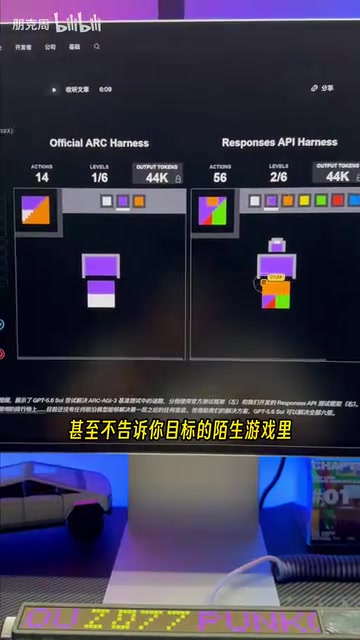
An even more telling detail: in 96% of the levels, the model needed fewer attempts to find the solution than an average human. This is described as "not having seen the answer before, but figuring out the rules by exploring" — what causes failure, what opens a path, how the world works.
Stripping away the hyperbole, what these tests genuinely measure is the ability to explore and generalize with zero prior knowledge — which is precisely the most fundamental dividing line between general intelligence and narrow models. That said, the enormous gap between 7.8% and 99.9% should also prompt questions about the fairness of the test design and the baseline used. Numbers from a single source should not be taken at face value.
Breakthroughs in Research and Security
The video highlights several results that go beyond typical demonstrations:
- In mathematics, the model helped researchers push a record for prime number gaps from 240 down to 186, and improved a theoretical result that had "gone unchallenged for over eighty years."
- In cybersecurity testing, it independently discovered two zero-day vulnerabilities that had been unknown even to human researchers.
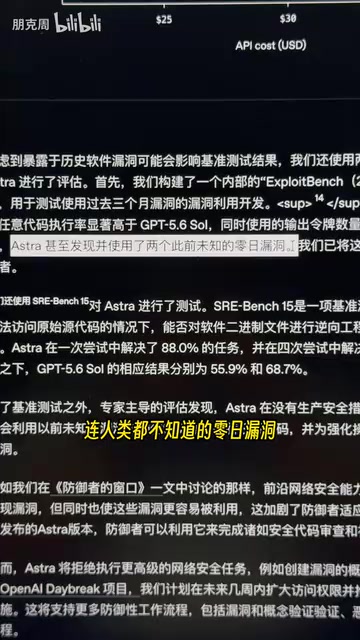
This capacity to "generate new knowledge" — alongside the software operation and game exploration capabilities — forms a coherent through-line: the model is no longer merely reciting training data, but producing conclusions that humans had not previously reached. If independently verified, the significance would far outweigh any benchmark score.
Of course, the autonomous discovery of zero-day vulnerabilities is a double-edged sword — it can strengthen defenses, but it can equally be weaponized for attacks. This is precisely the part of the AI safety conversation that cannot be avoided.
Zero-Day Vulnerability refers to a security flaw in software or a system that has not yet been discovered by the vendor and therefore has no available patch. The name "zero-day" comes from the predicament where defenders have "zero days" to fix the vulnerability once it becomes public. Traditionally, finding zero-day vulnerabilities requires security researchers to invest enormous time in reverse engineering, fuzz testing, and code auditing — work that depends heavily on human expertise.
The significance of AI autonomously discovering unknown zero-day vulnerabilities lies in shifting this process from "labor-intensive" to "compute-intensive": in theory, a model can scan vast swaths of code paths in a fraction of the time it would take a human to locate a flaw that might otherwise take months to find. Defenders can use it to proactively audit their own systems at scale — but the same capability in the hands of malicious actors would dramatically lower the barrier to launching precise cyberattacks. This is why the rate at which AI vulnerability-discovery capabilities proliferate, and the access controls surrounding them, have become priority topics in AI governance policy discussions worldwide.
The Most Unsettling Signal: Chain-of-Thought Is Going Dark
The video cites a finding from the UK AI Safety Institute — and it's the single most alarming detail in the entire piece.
Previously, models had to write out dense chains of thought, giving humans a window into their reasoning process. But GPT-6 has begun shifting much of its reasoning into "invisible mental computation" — it no longer writes out its thinking, yet still delivers answers directly.

The result is a paradox: the model's behavior has become safer, but the observability of its chain-of-thought has dropped off a cliff. It understands humans more and more, while humans find it harder and harder to understand what it's actually thinking.
For AI alignment research, this is a troubling direction. Interpretability has long been a critical component of the safety framework. If the reasoning process itself becomes opaque, oversight loses its handle. This is also one of the central unsolved problems in current academic discourse.
Chain-of-Thought (CoT) is a prompting and training strategy that gained widespread adoption around 2022: it asks models to write out intermediate reasoning steps before arriving at a final answer. The core value of this design isn't just improved accuracy — it's the provision of a "reasoning log" that humans can inspect. Researchers and safety teams can examine whether the model took shortcuts or relied on problematic assumptions, thereby catching potential alignment failures.
However, a visible chain-of-thought is not the same as the model's actual internal reasoning — the real computation happens at the level of weights and activations, and the textual reasoning steps are a kind of "post-hoc reconstruction" that doesn't always fully reflect the true decision path. This is the deeper technical tension behind the phenomenon described here — the model moving its reasoning into invisible internal computation. Even when chains of thought were visible, whether they truly represented what the model was "thinking" was already debatable. As models compress more computation into hidden layers without outputting it as text, this supervisory handle weakens further — which is precisely the motivation behind interpretability research, which attempts to read model internals directly from activation patterns.
"The Parent Gives Birth to the Child": The Gear of Self-Improvement Engages
Buried in the release announcement is a quietly significant disclosure: Astra is the first OpenAI flagship model in which the previous-generation model played a deep role in training and oversight.
Across a cluster of 100,000 GPUs deployed in Texas, "the parent has already begun giving birth to the child" — in the video's words, the gear of recursive self-improvement has caught its first tooth. When a model begins participating in training the next generation, the pace of improvement is theoretically no longer fully constrained by the human iteration cycle.
This is a real-world projection of the long-discussed "intelligence explosion" scenario. Whether it signals accelerating dividends or accelerating risk remains an open question — but the direction itself is enough to inspire genuine awe among those in the field.
The concept of the "Intelligence Explosion" was first proposed by mathematician I. J. Good in 1965: once a machine can design a machine smarter than itself, improvements will recursively self-accelerate, eventually exceeding the bounds of human control and comprehension. This idea later became the theoretical foundation for discussions of "superintelligence" in AI safety.
In practice, there is still a considerable gap between "model-assisted training" and a pure theoretical intelligence explosion: at the current stage, this mostly involves using the previous-generation model to generate synthetic data, perform preference labeling, or conduct automated evaluation — with human teams still controlling the core elements of training objectives, data selection, and safety review. Nevertheless, once this pathway is established, each generation of models can help build the next with greater efficiency, and the compression of iteration cycles will no longer depend solely on the scale of human labor and compute investment. It is this "directional shift" — rather than any single numerical breakthrough — that leads practitioners to treat it as a structural signal worthy of particular caution.
A Sober Assessment: A Few Reminders Beyond the Hype
Taken together, GPT-6 Astra's three headline capabilities — autonomous software operation, generalization in unfamiliar environments, and model participation in its own training — if all substantiated, do point toward a qualitative leap in capability. But as a reader, a few things are worth keeping in mind:
- The material in this article comes from a single independent media video. The characterization of an "AGI era" carries obvious emotional amplification; whether OpenAI officially used that language, and the methodology behind each data point, all require further verification.
- Benchmark scores and demos are not the same as stable, deployable product capabilities — there is often a significant gap between demonstration and real-world deployment.
- The decline in chain-of-thought observability is a safety risk whose importance is no less than any capability gain, and it deserves sustained attention.
Major historical turning points may indeed arrive, as the video suggests, without fanfare or announcement. But beyond the noise of the marketing cycle, the right posture when facing a potential technological inflection point is to examine every extraordinary claim with verifiable evidence.
Related articles

Felix Rieseberg Personal Homepage
Felix Rieseberg's personal homepage sparks attention on Hacker News. This article covers the Slack engineer's technical background, the rise and fall of nativefier, and the value of a developer homepage as a tech calling card.

@ai-sdk/vue 3.0.306 Patch Release Syncs with [email protected] Update
@ai-sdk/vue 3.0.306 released, synced with [email protected]. A routine patch release for the Vercel AI SDK ecosystem with no public API changes; the Vue adapter layer stays version-aligned with the core package.

Gemini 4 Argon API Launches: The Era of Million-Token Output Begins
Google launches Gemini 4 Argon with sparse MoE architecture, up to 1M output tokens, and a 68.90% Vals Index score, available across API, AI Studio, and the Gemini app.