GPT-6 Astra vs 5.6: An 8-Hour Head-to-Head Across 4 Real Tasks — Which One Wins?

8-hour real-task showdown: GPT-6 Astra dominates GPT-5.6 on requirement fidelity and autonomous tool use, with one exception.
Bilibili creator 香酥幻想 ran an 8-hour, four-category real-world comparison between GPT-6 Astra and GPT-5.6. Astra clearly outperformed in frontend design, game recreation, and 3D interaction — especially in understanding vague prompts and autonomously invoking tools like downloading a portable Blender. GPT-5.6 was faster overall and edged ahead in video editing due to correct use of a pre-configured Remotion skill, though the creator attributes this to prompt ambiguity rather than a true capability difference.
An 8-Hour Hardcore Model Showdown
Bilibili creator 香酥幻想 ran a no-nonsense model evaluation using identical prompts to pit GPT-6 Astra against its predecessor, GPT-5.6, across the same set of tasks. Four task categories, eight test rounds, and more than eight hours of total runtime — by the time everything finished, it was well past midnight. This kind of "real deliverable" evaluation reveals far more about a model's practical capabilities than any benchmark score.
The four test areas covered: a frontend UI overhaul of an AI creation platform, recreating the classic mini-game "Bubble Gum," editing 40+ minutes of raw footage into a finished cut, and building an interactive 3D experience based on the painting Along the River During the Qingming Festival. Both models ran at "high" thinking intensity throughout, on a Pro-tier account (5X). The creator also noted a telling usage stat: between these 8 tests and other tasks, 80% of the weekly credit quota was consumed over two days.
Frontend UI Redesign: The Gap in Understanding Vague Requirements
The frontend redesign task had two versions. The first used an intentionally abstract prompt — just one line: "I like that clean, comfortable feeling of Apple products" — leaving the model to interpret the existing page and make adjustments on its own. This mirrors how many non-designer users actually communicate: through adjectives like "clean" and "elegant" rather than precise specifications.
The gap was stark. GPT-5.6 took 25 minutes (including a mid-task question about which reference image to prefer — when told to decide on its own, it spent another 18.5 minutes), and the final output barely qualified as a redesign: the same AI-favored blue-purple palette, with button text that was illegible in dark mode. Astra delivered its first version in 30 minutes — and despite the equally vague prompt, it produced clearly superior visual hierarchy and navigation design, without making basic mistakes like unreadable dark-mode text.
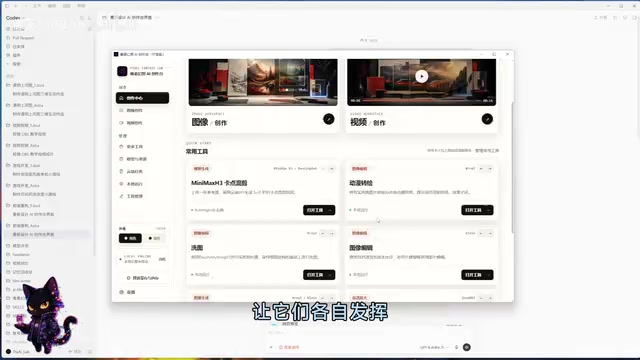
The second version used a much more specific prompt: Apple-style simplicity and refinement, card-based layout, clear visual hierarchy. Here, Astra delivered the biggest surprise of the test — it proactively surfaced an H3 prompt-expansion feature that hadn't been placed in the toolbar, moving it to an appropriate spot on the homepage, demonstrating a genuine understanding of product logic. The dark mode toggle felt immediately comfortable on first glance. GPT-5.6, by contrast, stuttered during theme color switching, and despite its animated effects, the layout remained cluttered.
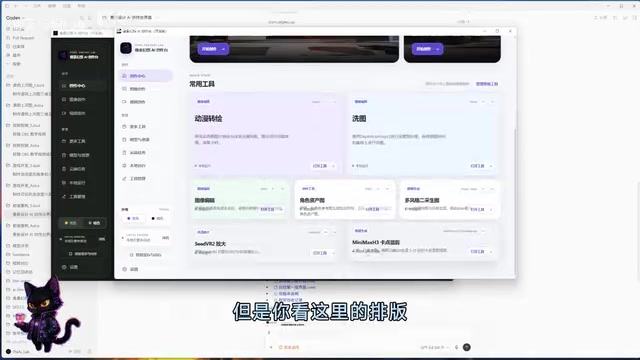
On speed: GPT-5.6 completed both rounds in under an hour — significantly faster than Astra. But as the creator pointed out, speed without quality doesn't count for much.
Game Recreation and 3D Interaction: Requirement Fidelity Is the Deciding Factor
The second task — recreating the childhood game Bubble Gum — resulted in similar time costs (5.6 took ~27 minutes, Astra ~34 minutes). The difference showed up in the details: Astra implemented all the power-ups specified in the brief — extended water stream, increased bubble count, and so on — with a more polished overall look. GPT-5.6 missed several items that were explicitly listed as point five of the prompt.
The biggest gap emerged in the Along the River During the Qingming Festival 3D interaction task. The prompt called for more than free walking and path navigation — users needed to enter small spaces and complete interactions like buying tea and asking for directions. GPT-5.6 produced output in just 23 minutes, an impressive speed — but the result completely missed the mark. None of the interactive features were implemented, and the creator abandoned the idea of a second attempt.
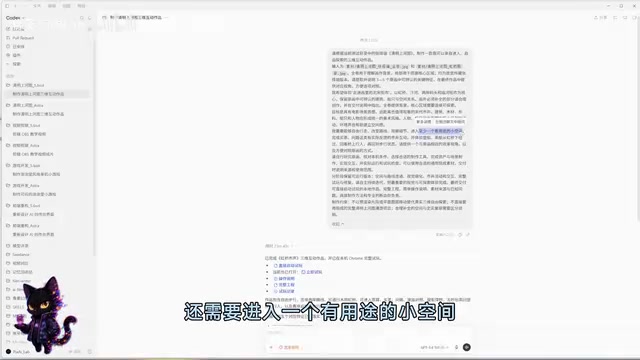
Astra's first version took 56 minutes, but came back with severe frame drops (the browser was rendering at 1 fps because it hadn't utilized the GPU). Fixing that took another 34 minutes. The visuals were still rough, but the experience was functional: you could ask for directions, follow route guidance, press Shift to sprint, interact with the tea shop owner and a boatman, and even board the boat. The map was cross-referenced against the original painting. The first version had already fulfilled all the requirements — so the creator asked Astra to refine it further, which took about another hour and a half.
One technical detail stood out: since Blender wasn't installed on the machine, Astra downloaded a portable version of Blender on its own to handle the modeling work. This kind of autonomous external tool acquisition gave the creator a glimpse of its potential as a 3D modeling and even video production assistant.
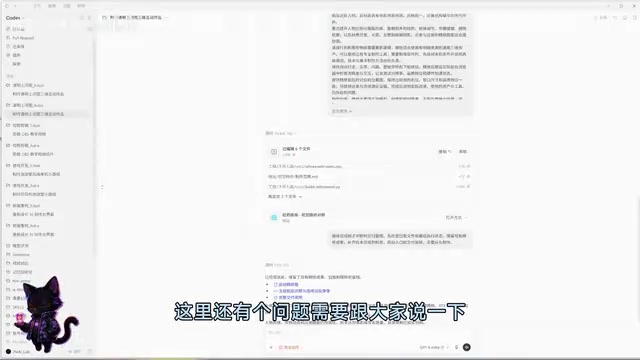
Blender is an open-source 3D creation suite supporting modeling, rendering, animation, video editing, and more — widely used in professional 3D production pipelines. A "portable version" is a form of software that runs without installation, typically distributed as a compressed archive. The fact that Astra could detect a missing local dependency, download the appropriate portable package, and invoke it autonomously means it's not just generating code — it's actively sensing and completing its execution environment. In the AI Agent capability framework, this represents the intersection of "tool use" and "environment awareness," and is one of the key frontiers separating today's large models from purely conversational assistants versus truly autonomous execution agents.
Video Editing: The One Task Where Astra Lost
The fourth task — video editing — was the only one where GPT-5.6 came out ahead. The creator provided two clips totaling over 40 minutes of raw footage (with plenty of stumbles and repeated takes), asking for a polished final cut. Neither model delivered a passing result — both left repeated segments uncut. GPT-5.6 produced a 13-minute 54-second cut; Astra's was 14 minutes 27 seconds and inexplicably added a border around the frame.
The creator's analysis of why GPT-5.6 edged ahead: the project included an instruction saying "you may use general tools but should not install specialized skills specifically for this editing task." Remotion — a skill already configured in the project — was interpreted by GPT-5.6 as fair game under that rule, so it used it successfully. Astra did not invoke the skill, likely due to a different reading of the same instruction, which may have cost it performance. This looks more like a prompt ambiguity issue than a clear difference in raw capability.
Remotion is a programmatic video creation framework built on React that lets developers describe video timelines, animations, and editing logic through code rather than traditional drag-and-drop timelines. In AI Agent workflows, a "skill" typically refers to a pre-configured tool-calling capability or functional module — similar to a plugin. In this test, the Remotion skill had been pre-loaded into the project context, and the two models' divergent interpretations of "you may use general tools" directly determined whether they used this pre-built capability. This highlights an important lesson in prompt engineering: how tool permissions are described significantly shapes model behavior, and ambiguous boundary conditions can lead to completely different execution strategies across models.
Takeaways: Clear Capability Gains, But Still Some Blind Spots
Across all four task categories and eight test rounds, Astra demonstrated what the creator called a "night and day" improvement over GPT-5.6 in tasks requiring deep understanding and autonomous execution — particularly in requirement fidelity and self-directed tool use. GPT-5.6's edge lies in speed, and in the video editing task where a specific skill-invocation pattern worked in its favor.
On practical usage, the creator shared one useful rule of thumb: setting thinking intensity to "high" is more than sufficient for everyday use. There's no need to max it out for every task — save that for complex, large-scale code changes involving tens of thousands of lines or more. As a single-source real-world evaluation, this video's value lies in exposing the generational gap between these two models when it comes to "understanding what you want and actually delivering it" — and in reminding us that prompt wording has a direct and measurable effect on tool-calling behavior.
Related articles

Workbuddy for Absolute Beginners: How a Desktop AI Agent Fits Into Real Workflows
A beginner's guide to the Workbuddy desktop AI agent: installation, claiming credits, file management, and building automated workflows—compared with CodeX for fit and cost, helping professionals shift from AI question-askers to AI managers.

OpenAI's New Agent Stack: Computer Use, Decisions API, and Ultra-Fast Workflows
OpenAI Dev Day unveiled a new agent stack: Computer Use outperforms humans, Decisions API delivers ultra-low-latency classification via Luna, Agents API opens the same Computer Use capabilities, and GPT-6.1 Sol costs only one-seventh of Astra. Core updates, benchmark data, and developer insights.

Liang Wenfeng Open-Sources DeepInfo Inference Framework, Takes On U.S. Ban
DeepSeek open-sources its DeepInfo inference framework after its models, featuring GPU/CPU cross-pipelining, small-model prediction with large-model verification, and full Huawei Ascend and NVIDIA chip support—facing the U.S. federal ban head-on. This article analyzes its significance for AI deployment and open-source strategy.