GPT-6 + Blender Full Workflow Test: Building a 3D Game from Scratch with AI — No Experience Required

A non-developer built a complex 3D strategy game in a weekend using GPT-6, Blender, and MCP servers.
An AI agent platform developer spent one weekend validating GPT-6's game development ceiling. Using a "reference screenshot as verifiable target" methodology, he built an F-Zero-style racing game in about an hour with noticeably better visuals than previous models. More remarkably, he automated a pipeline connecting agents to Blender via MCP servers — using dual agents to generate reference images and then model and animate assets overnight — while GPT-6's visual self-inspection let the agent autonomously catch and fix model errors. The final game runs in the browser via Three.js. The core lesson: converting vague subjective goals into demonstrable, verifiable objectives is what enables agents to work efficiently and autonomously.
A Weekend Experiment by a Non-Game Developer
A software developer focused on building AI agent platforms decided to spend an entire weekend testing GPT-6's real capabilities in game development. His goal was clear: not to reverse-engineer an existing game, nor to stitch together pre-made assets, but to create a brand-new 3D game from scratch based on his own ideas.
His background is worth noting — he built an AI agent platform called Lashloop and works with various agents all day, but has never made a game and doesn't know how to use Blender. That's precisely what makes this test a genuine reflection of what an ordinary creator can realistically achieve.
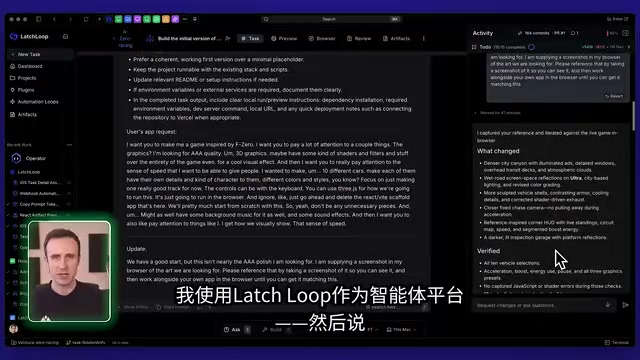
The results surprised him. With just two prompts, he produced a game inspired by the classic racing title F-Zero, centered on the core experience of "speed." The whole process took about an hour, and the visual quality clearly surpassed what previous models had produced.
Using a Single Screenshot to Define the "Target" Standard
The most critical methodological insight from this experiment is how to get the model to work efficiently. His first prompt was simply a detailed description of the game he wanted to make — the results weren't impressive. The real breakthrough came in the second step: he used ChatGPT's image generation feature to create a reference screenshot of "what the game should look like," then handed that image to GPT-6 with the instruction to "keep improving the graphics until they match this screenshot as closely as possible."
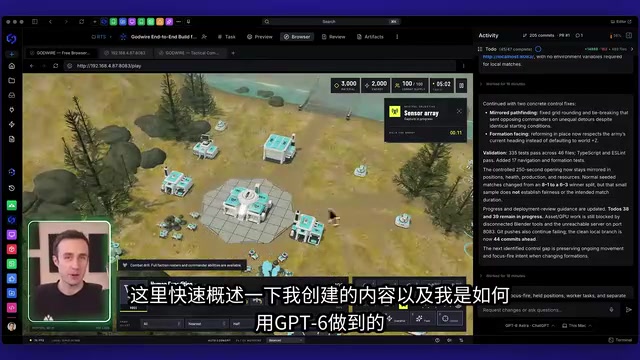
This reflects an important engineering principle: don't give the model subjective tasks like "make it look as good as possible." "Best" means different things to different people, and the model has no way to know when it's done. "Match this image" is a verifiable, objective target — the model can self-evaluate and iterate until it's achieved. The developer noted that GPT-6 is excellent at interpreting visual images, which makes an "image-as-spec" workflow genuinely viable.
Some might question whether basing everything on an AI-generated screenshot limits creativity. His view is that the reference image is a starting point, not an endpoint — creative control remains with the human, and you can adjust direction at any point during iteration.
Two Qualitative Leaps Over Previous Models
The developer compared this to his earlier experience using GPT-5.6 to build a Minecraft-style game for himself and his daughter. That project did achieve split-screen multiplayer, controller support, and TV play — but getting the frame rate optimized to 60 FPS took over five hours of repeated iterations and more than $350 in API costs.
With GPT-6, a comparable racing game was built in just one hour. Two changes stood out:
First, the final quality is noticeably better. In the past, non-game developers had to accept dated, rough 3D graphics. Now, using any coding agent, you can achieve a reasonably polished visual result.
Second, there's a genuine sense of "sustainable development." He described his previous experience as ending with "okay, I made a game" — full stop. This time, he genuinely felt like "I could keep pushing this forward," as if the game had real room to grow.
Connecting GPT-6 to Blender for Batch 3D Asset Production
The standout highlight of this experiment was connecting GPT-6 to Blender to automate 3D art asset generation. The workflow went roughly like this:
First, through conversation (via ChatGPT, Claude, or any agent), he defined the game's genre, mechanics, and key features. This time he wanted something strategically deep, skill-intensive, and competitive, while still accessible to players who don't want to memorize complex button layouts. Once the direction was set, he had the agent scaffold a basic game framework.
Next, he downloaded Blender locally and connected it to the agent via a component called an MCP server. He used a dual-agent strategy:
- One agent, after generating basic gray geometry, wrote detailed image prompts for each unit and building type, automatically producing multi-angle reference images — front, top, bottom, and side views.
- A second agent (Codex) received these references along with a "visual mood board" compiled from multiple images, then modeled each asset in Blender and ensured the 3D objects matched the references.
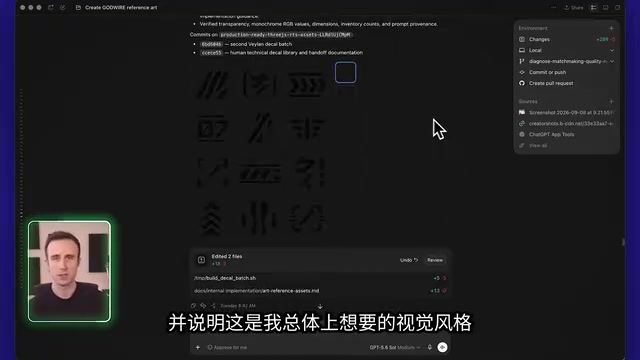
Since a strategy game requires a large number of diverse units, buildings, and animations, he simply let the agent run overnight. By morning, it was still continuously creating units — not just modeling them, but also developing animations. For example, the main command center had a turret on top with an idle animation when stationary, and when enemies approached, it would automatically trigger an attack animation and fire. All of these details were integrated by the agent without needing to be spelled out one by one.
What is an MCP Server? MCP (Model Context Protocol) is an open protocol released by Anthropic in late 2024, designed to give AI models a standardized "tool-calling" interface. In simple terms, it lets agents operate local software or external services the same way they'd call an API — in this case, the agent sends modeling instructions to Blender and reads scene state via the MCP server, like remotely controlling a workstation. Blender itself is a free, open-source 3D creation suite that supports modeling, rigging, and animation, and its Python scripting interface makes it an ideal endpoint for AI automation pipelines. The MCP + Blender combination means the agent isn't just "generating code for a human to paste and run" — it completes the full operation loop directly inside the software. That's the technical foundation that makes "overnight unattended modeling" possible.
Autonomous Screenshot Self-Inspection: The Agent "Plays" Its Own Game
Texturing and lighting also relied heavily on visual understanding. The developer collected reference images in a "hyper-modern realistic" style from multiple sources, processed them in Photoshop, and handed them to the agent as art standards, along with a request to generate decal graphics and textures that could be overlaid on the 3D models.
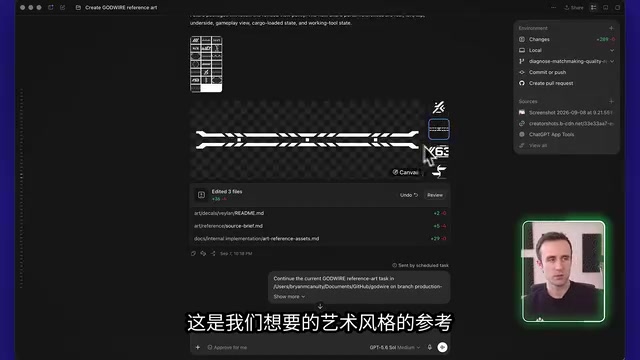
The most impressive feature was autonomous quality control: the agent could launch the game on its own, run benchmarks, and catch anomalies by taking screenshots — like units clipping into the ground or floating eerily in mid-air — then fix them independently. At one point, after adding ambient lighting, the floor texture detail was washed out. He simply noted that "this detail matters to me," and rather than arguing about parameter values, the agent took another screenshot, independently judged whether the detail was visible, and corrected it.
He described the entire process as a management job of "checking in once an hour and sending corrective messages." The human defines what matters, maintains the unique vision, and sets direction. The agent handles execution and iteration. As long as the goal is demonstrable and verifiable, the agent can work autonomously and continuously.
Technical Realities to Consider Before Shipping
The developer used Three.js to build the game — he simply told the agent to use it, and the agent knew how to implement everything in JavaScript. This choice has practical implications: Three.js runs in a web browser, meaning the game can be shared online and players don't need to download anything.
He also flagged a real risk: running in the browser means the code is technically accessible to anyone who wants to copy it, making it less than fully secure for a paid game. His current business thinking is — single-player vs. AI mode would be free, while multiplayer would require a matchmaking server and a web backend for leaderboards and player profiles, serving as the monetization layer. He emphasized this is currently a hobby project; his main work remains his SaaS products and the Lashloop agent platform.
What is Three.js? Three.js is a JavaScript 3D rendering library built on WebGL, allowing developers to render complex 3D scenes in the browser without needing deep knowledge of low-level graphics APIs. WebGL itself is a hardware-accelerated graphics interface built into the browser; Three.js layers a more approachable scene management, camera, lighting, and materials system on top of it. The core trade-off of choosing Three.js over traditional engines like Unity or Unreal comes down to distribution friction: a Three.js game is a webpage — click a link and play, no installation required — dramatically lowering the barrier for user acquisition. The cost is a lower performance ceiling compared to native engines, and the fact that all JavaScript source code is technically visible in the browser's developer tools, which poses a risk for commercial projects that need to protect core logic.
Conclusion: The Only Limit Is Your Imagination
The core takeaway from this experiment isn't about any single capability of GPT-6. It's about an entire workflow — reference image as standard + dual-agent division of labor + autonomous screenshot self-inspection + Blender batch production — that enables someone with zero game development experience to push a complex 3D game forward. The developer himself is still actively refining the project. For creators who want to try this, the key is converting vague notions of "best" into verifiable, objective targets. After that, as he put it, the only limit is your imagination.
Related articles

Felix Rieseberg Personal Homepage
Felix Rieseberg's personal homepage sparks attention on Hacker News. This article covers the Slack engineer's technical background, the rise and fall of nativefier, and the value of a developer homepage as a tech calling card.

@ai-sdk/vue 3.0.306 Patch Release Syncs with [email protected] Update
@ai-sdk/vue 3.0.306 released, synced with [email protected]. A routine patch release for the Vercel AI SDK ecosystem with no public API changes; the Vue adapter layer stays version-aligned with the core package.

Gemini 4 Argon API Launches: The Era of Million-Token Output Begins
Google launches Gemini 4 Argon with sparse MoE architecture, up to 1M output tokens, and a 68.90% Vals Index score, available across API, AI Studio, and the Gemini app.