GPT-6 Luna Drops at Rock-Bottom Prices: The AI Price War Is On

OpenAI's GPT-6 Sol & Luna ignite a brutal AI price war — Luna matches open-source rock-bottom pricing.
The AI industry has shifted from competing on intelligence to competing on price and practicality. OpenAI's GPT-6 Sol and Luna cut costs in half versus the prior generation and rebuild caching to slash real-world API bills by up to 90%. Anthropic countered minutes earlier with Claude Opus 5.5 — smarter (58 vs. 48) but twice the price. Meanwhile, open-source models from MiniMax, GLM, and Qwen are closing the capability gap fast, pushing Luna to a rock-bottom $0.10/M token input price to fight them off.
For the past two or three years, AI headlines have been dominated by narratives of "peak intelligence" and "benchmark records shattered." Every major release seemed to demand models that were smarter, bigger, and more expensive to run — as if spending obscene amounts of money was a prerequisite for accessing top-tier AI. But the winds have shifted dramatically.
OpenAI dropped two models from the GPT-6 family in one shot — Sol and Luna — and just 90 minutes before the launch event, longtime rival Anthropic pulled a surprise ambush, rushing out Claude Opus 5.5. Three heavyweights on the same stage sent an unmistakable signal: the AI industry has officially fired the opening shots of a brutal, race-to-the-bottom price war. This article breaks down exactly how that war is being fought.
The Rules Have Changed: From IQ to ROI
The industry playbook has shifted from "who's smarter" to "who's cheaper and faster."
For the enterprise customers actually writing the checks, the pain point stopped being "whose model is the world's best" a long time ago. It's now "whose model can I run all day without my CFO having a meltdown." Flagship models like Astra are more like a company's chief scientist — reserved for the trickiest problems. But what keeps a business running day-to-day is handling high-frequency, budget-conscious workloads.
In other words, today's real battleground isn't some unreachable intelligence ceiling — it's the unglamorous, everyday grind. The entire industry is undergoing a major reshuffling, and the core direction can be summed up in two words: maximum value.
Sol and Luna: Built for High-Volume, Low-Budget Work
To capture this mass market, OpenAI dropped its pretenses entirely. Sol and Luna were purpose-built for high-frequency, low-budget grunt work — packing cutting-edge underlying capabilities into a faster, cheaper shell.
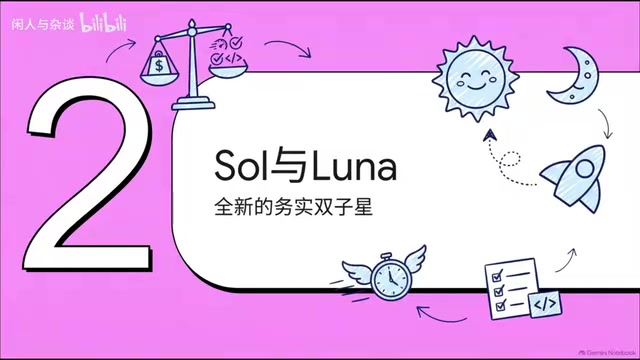
A workplace analogy makes this easy to understand: Sol is like the senior core engineer on your team — the one you trust with complex code that needs multiple passes, or long-horizon Agent workflows that can't afford mistakes. Luna is the hyper-ambitious new hire who works at terrifying speed, blazing through bulk document summarization and initial data cleaning in an instant.
The two have different roles but share the same DNA — both inherit Astra's training methodology, support multimodal (image + text) input, and come with a massive context window of approximately 115,000 tokens. The cleverest design touch is the adjustable reasoning dial: a throttle for AI thought depth. Simple tasks get a light touch; hard problems get full cognitive horsepower. This generation also ships with improved alignment and safety, with noticeably less filler output.
The Ultimate Cost-Cutting Weapon: A Rebuilt Caching System
Sol and Luna's sticker prices are already half of the previous generation — compelling on their own. But OpenAI's real money-saving magic is hidden somewhere easy to overlook: a complete overhaul of the caching mechanism.
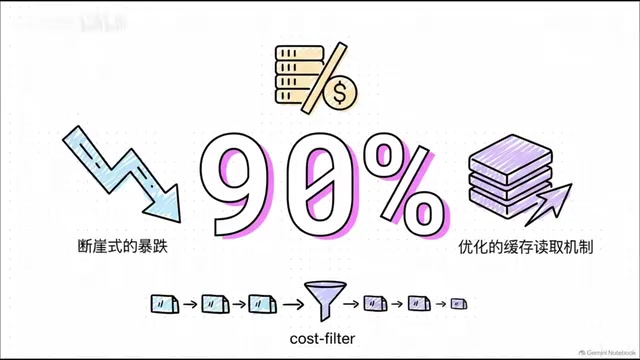
How much can smart caching actually save? Up to 90%. This isn't hype. Thanks to a ground-up rebuild of the cache-read layer, API bills for long conversations or Agent scenarios that repeatedly reference context can drop off a cliff.
Here's how it works in practice: default cache hit rates are extremely high, and critically, if you boost the AI's reasoning level mid-conversation or introduce new tools, it no longer invalidates the cache the way it used to — forcing you to pay for the whole context again. Add in new precision breakpoint controls and an intuitive cache visualization dashboard, and developers can cut their "redundant prompt billing" ratio by more than half with minimal effort. This is the real cost-cutting weapon.
Prompt Caching is a mechanism that temporarily stores recurring context — system prompts, long documents, conversation history — on the server side. When the same content appears again in a subsequent request, the model skips reprocessing those tokens and reads directly from cache, dramatically reducing compute and billing costs. The classic pain point with older caching implementations: if any request parameter changed — tweaking inference temperature, swapping tool lists — the cache would invalidate, and the entire context would be billed again from scratch. The core of OpenAI's rebuild is making the cache immune to these mid-session changes, so Agents can dynamically adjust their behavior without triggering full-context rebilling. For enterprise-grade Agents where system prompts run to thousands of tokens and the same session may be called dozens of times, this change delivers real-world savings that far exceed what the headline price cut alone would suggest.
Going Head-to-Head with Claude Opus 5.5
OpenAI isn't alone in targeting this mid-market. The most dramatic moment of the business battle came when Anthropic jumped the gun 90 minutes before OpenAI's event, dropping Claude Opus 5.5 with its sights locked squarely on the same tier.
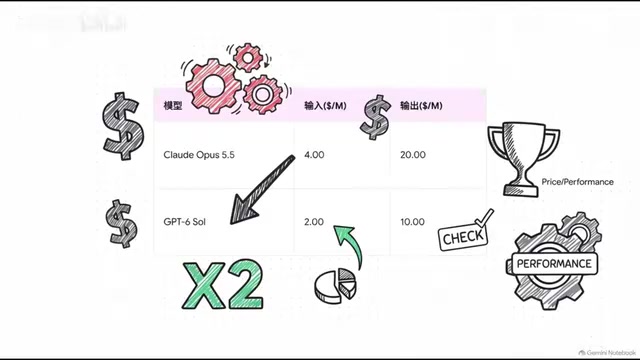
Setting aside price for a moment, let's compare raw capability. According to independent Artificial Analysis benchmark data, Opus 5.5 scores approximately 58 on the intelligence index; GPT-6 Sol scores approximately 48. On absolute capability, Opus 5.5 is more well-rounded and already nearing flagship-model territory. Sol, by comparison, is a notch behind on hardcore reasoning.
But reality is always a business trade-off. Do the math: Opus 5.5's input/output costs run $4 and $20 per million tokens respectively, while Sol is $2 and $10 — exactly half the price of Opus 5.5. For businesses where cost control is non-negotiable and "good enough" beats "best-in-class," Sol can literally cut your bill in half.
Artificial Analysis is an independent third-party AI benchmarking firm that specializes in standardized capability evaluations and cost-performance analysis across major language models. Their scoring system covers multiple dimensions including coding, reasoning, and instruction-following, and is widely regarded as a relatively neutral reference for cross-model comparisons. It's worth noting that any single benchmark score has limitations: it reflects average performance on a specific test set, not real-world effectiveness in a particular vertical use case. That's precisely why the article recommends A/B testing with real business workloads — Opus 5.5's 58 versus Sol's 48 is a meaningful gap in the abstract, but on high-frequency, simple tasks where cost is the hard constraint, that 10-point difference is often entirely offset by the price advantage.
The Open-Source Counterattack
If you're only watching the closed-source giants fight it out, you're missing the most intense part of the show. Shift your gaze to the open-source camp, where DeepSeekAd, GLM, MiniMax, and others are hammering AI cost floors toward absolute zero at an unprecedented pace.

Look at the benchmark scores from top open-source models: MiniMax M2.6 Pro clocks in at 46, while GLM 5.3 and Qwen 3.8 Max both sit solidly around 45. Against GPT-6 Sol's 48, this clearly demonstrates that open-source models have the raw intelligence to serve as drop-in replacements for major commercial models in specific tasks.
And on pricing, they show no mercy. To defend against this wave, OpenAI priced Luna aggressively: input at approximately $0.10 per million tokens, output at $0.50 — going toe-to-toe with the ultra-low-cost open-source tier like MiniMax Flash and DeepSeek Flash. OpenAI's message is unambiguous: match open-source on price and choke off the ecosystem's spread.
To objectively map the landscape: open-source models' biggest advantages are ultra-low marginal cost, data privacy via self-hosting, and maximum "governance per dollar." Closed-source models like Sol and Luna, meanwhile, are no longer selling pure "intelligence" — they're selling frictionless out-of-the-box deployment, a robust and stable tool ecosystem, and worry-free alignment and compliance services.
Self-hosting means deploying an open-source model on your own servers or private cloud rather than calling a third-party API. The core advantage: once the initial deployment is done, the marginal cost of each inference is just electricity and hardware depreciation — theoretically unlimited free calls. All data stays on your internal network, completely eliminating compliance risks around sensitive information leaving the building. The trade-offs are significant upfront hardware investment, ongoing ops overhead, and more complex engineering integration compared to a commercial API. For scenarios with extremely high call volumes, highly sensitive data (finance, healthcare), or needs for deep custom fine-tuning, the total cost of ownership (TCO) of self-hosted open-source models often substantially undercuts commercial API pricing. MiniMax, DeepSeek, and others offer both API access and open model weights precisely to capture both customer segments simultaneously.
The Ultimate Buyer's Decision Guide
With models everywhere, many people are suffering from "model fatigue." Here's how to cut through the noise and find your fit:
- Zero tolerance for errors, highly complex workflows: Go straight to Opus 5.5 or GPT-6 Astra — no second-guessing.
- Everyday complex coding and Agent workflows where value matters: Sol and Opus 5.5 are the top picks; teams with strong engineering chops can also lean on top-tier open-source Pro models.
- Bulk data cleaning and large-scale summarization: Luna and open-source Flash models are a natural pairing.
- Absolute cost minimization: Deploy open-source models yourself — lowest possible marginal cost.
One final piece of practical advice: every official benchmark leaderboard is just a signpost. The only thing that actually makes the decision is data from your real business scenarios. Run a few A/B tests on your highest-frequency workloads — and don't forget to enable caching. The actual bill after accounting for cache hit rates is the only number that matters.
In this industry-wide race to the bottom, even the once-untouchable closed-source giants have started digging moats through tool ecosystems, service convenience, and caching efficiency. This may well signal the end of the classical AI era, where piling on compute and chasing benchmark scores was the only game in town. The AI battlefield now rewards whoever can integrate into our daily lives most practically and most affordably.
Related articles

@ai-sdk/vue 3.0.306 Patch Release Syncs with [email protected] Update
@ai-sdk/vue 3.0.306 released, synced with [email protected]. A routine patch release for the Vercel AI SDK ecosystem with no public API changes; the Vue adapter layer stays version-aligned with the core package.

Gemini 4 Argon API Launches: The Era of Million-Token Output Begins
Google launches Gemini 4 Argon with sparse MoE architecture, up to 1M output tokens, and a 68.90% Vals Index score, available across API, AI Studio, and the Gemini app.

DukaanAI: Turning Product Photos into Inventory Lists with Open-Source AI
DukaanAI is an AI inventory tool for small retailers that turns product photos into inventory entries using the open-source Gemma 3 model, with local inference, editable fields, and CSV export.