GPT-6 Performs "Brain Surgery" on Another AI: Large Models Begin Rewriting Small Models

Reddit post claims GPT-6 performed "brain surgery" on another AI; this article breaks down its technical meaning and doubts.
The article centers on a Reddit title, suggesting "brain surgery" most likely refers to model editing (targeted modification of model knowledge or behavior) or using a strong model to generate plans for transforming a weak model. The core trend is that models are beginning to be treated as operable objects by another model. If the direction holds, capabilities could be transferred in a targeted way, the human link in the optimization loop compressed, and model release forms, evaluation systems, and security auditing impacted. However, it stresses the original material is only a title, lacking parameter-level modification evidence, with "smarter" undefined and "GPT-6" unverified—it should be viewed as a signal, not a result.
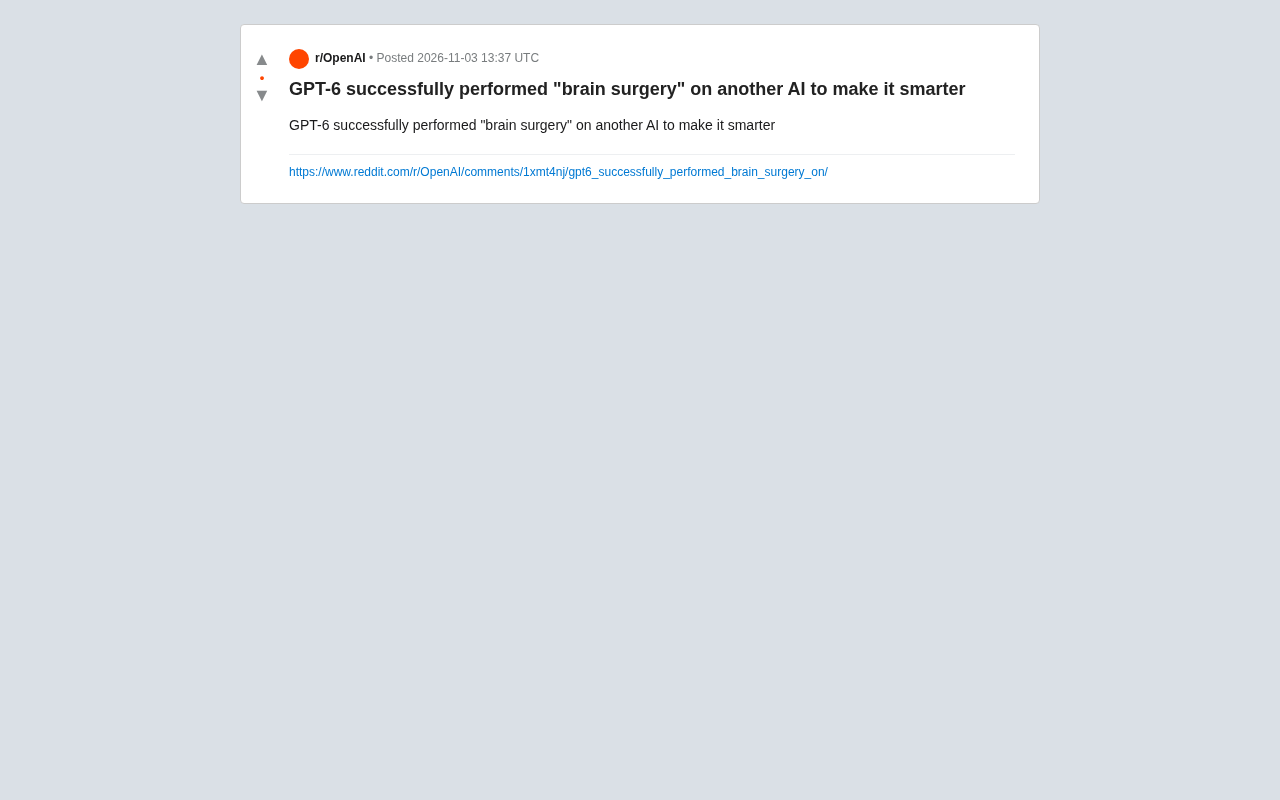
A recent Reddit post has a rather eye-catching title: GPT-6 successfully performed "brain surgery" on another AI to make it smarter. Taken literally, it means GPT-6 successfully performed "brain surgery" on another AI, making it smarter.
The post itself doesn't contain much information—beyond the title, it offers no further technical details. But the claim touches on a genuinely existing line of technical development: using a stronger large model to transform and optimize another model. Below, we break down what this might refer to from a technical perspective, and why it's worth paying attention to.
What the metaphor is actually saying
"Brain surgery" is a figurative expression. In the AI context, it most likely doesn't refer to actual model architecture surgery, but rather using a large model as a tool to directly intervene in another model's behavior or parameters.
One interpretation is model editing. Researchers can already make targeted modifications to a model's knowledge or behavioral patterns without retraining, similar to locating a region in the brain and changing it.
The other interpretation is more radical: having a strong model like GPT-6 generate training data, design reward signals, or even directly output modification plans for a target model, which are then implemented by an execution layer. In this case, the large model plays the role of "surgeon," and the small model is the "patient."
The Reddit title doesn't specify which one it is, but either way, the core logic is the same—models are beginning to be treated as operable objects by other models, rather than just being tuned by humans.
Model editing is a specific research direction aimed at making targeted modifications to specific knowledge or behaviors within a model without retraining the entire model. Representative methods include locating and modifying key-value memories in feed-forward layers (such as ROME, MEMIT), or overriding certain factual outputs through external memory patches. Such methods can typically precisely change "the answer to a certain question," but their impact is limited to the edited association pathways and can hardly bring about overall reasoning capability improvements. Therefore, equating model editing with making a model "smarter" involves a clear technical leap—the former is local patching, while the latter involves changes to broad capability distributions, and there is still no verifiable bridge between the two.
Why this deserves serious attention
If you dismiss this post as mere clickbait, you might miss the trend behind it.
"Generational transfer" of model capabilities
The capability gap between large and small models has always existed. In the past, closing this gap relied on distillation: having small models imitate the output distribution of large models. The "brain surgery" approach goes further—rather than having the small model learn the large model's answers, it has the large model directly modify the small model's structure or behavior.
If this path works, it means capabilities can be transferred in a targeted way, rather than just being built up through data scale. For scenarios sensitive to deployment costs, this is more attractive than retraining a medium-sized model.
Knowledge distillation has been the mainstream approach for closing the gap between large and small models: using the large model's outputs (logits or generated text) as supervision signals to train a small model to imitate the large model's behavioral distribution. The key limitation of distillation is that it transfers "input-output mappings" rather than the model's internal reasoning mechanisms. If a strong model directly participates in modifying a weak model's structure or training objectives, this limitation could theoretically be bypassed—but the cost is requiring sufficient operability of the target model, which is nearly impossible for closed-source models. This also explains why such claims currently remain mostly at the conceptual level.
The closed loop of automated optimization
You may not have noticed the change in process. Traditional model iteration requires human researchers to design experiments, analyze results, and adjust plans. When GPT-6 can diagnose another model's problems and propose modification plans on its own, the "human link" in the optimization loop is compressed.
This doesn't mean humans are kicked out of the game, but it does mean that model optimization is beginning to have a degree of automation. The popularity of this Reddit post largely comes from this intuitive impact.
In the field of automated model optimization, there are already some real works for comparison, such as using large models to search for better prompts, data recipes, or training hyperparameters (e.g., attempts to combine automated prompt engineering, neural architecture search with large models). What these works have in common is that what the large model outputs are "suggestions" or "configurations," and what actually changes the model parameters is still the training pipeline. Therefore, a key distinction for judging whether the "brain surgery" claim holds is—whether the large model directly modified the parameters, or only generated plans for humans or training pipelines to execute. The two differ greatly in degree of automation, and the latter doesn't go further than existing AutoML.
A needed reality check
The post has only a one-sentence title, with no verifiable experimental details. The following points must be questioned:
Did parameter-level modification actually occur? Model editing techniques exist, but their effects are usually limited to specific knowledge points; whether they can bring about overall "smarter" behavior is another matter. The word "smarter" in the title lacks definition—is it stronger reasoning, more accurate knowledge, or just a higher score on some benchmark?
The term "GPT-6" itself also requires caution. Such posts often abbreviate the most cutting-edge model with a code name, which may not correspond to an officially released product. Treating it as a symbol of a technical direction is safer than treating it as a fact about a specific product.
Single source, no cross-verification. Currently there is only this one piece of information on Reddit, with no accompanying paper, code, or reproduction record. In the absence of evidence, the more reasonable attitude is to view it as a signal worth tracking, rather than a confirmed result.
If the direction holds, where are the impacts
Assuming the path of "strong models transforming weak models" continues to be validated, several changes will appear first.
The form of model releases may change. In the past, releasing a model meant giving a set of weights; in the future, it might also include "modification plans for certain types of tasks," allowing users to customize small models on the spot using large models.
Evaluation systems will also be challenged. When a model can modify another model, it becomes harder to define whose capabilities benchmark scores actually reflect.
The security dimension is even more direct: model editing itself is a double-edged sword—it can be used to target harmful behaviors for repair, but also to implant them. Once this process is automated, the difficulty of auditing and tracing will rise significantly.
Conclusion
This Reddit post offers a directional signal, not a verifiable technical report. What's worth paying attention to isn't the code name "GPT-6," but the trend that models are beginning to be treated as editable objects.
For those following AI applications and frontier research, what's worth watching next is: whether accompanying technical details emerge, and whether reproducible public works appear in directions like model editing and automated optimization. Until then, stay curious—and stay skeptical.
One-line Summary
A Reddit post claims GPT-6 performed "brain surgery" on another AI; this article breaks down its technical implications and doubts.
Paragraph Summary
The article revolves around a Reddit title, pointing out that "brain surgery" most likely refers to two technical paths: model editing (targeted modification of model knowledge or behavior) or using a strong model to generate plans for transforming a weak model. The core trend is that models are beginning to be treated as operable objects by another model. The article argues that if the direction holds, capabilities could be transferred in a targeted way, the human link in the optimization loop would be compressed, and model release forms, evaluation systems, and security auditing would all be impacted. At the same time, it emphasizes that the original material is only a title, lacking evidence of parameter-level modification, with "smarter" undefined and the "GPT-6" code name unverified—it should be viewed as a signal rather than a result.
Related articles
 Tech Frontiers
How Do You Stop AI Agent Emails From Sounding Like AI? One Developer's Solution
AI agent emails always sound like AI? A developer shares reright: a rewrite step that validates numbers, names, and links, preventing humanizers from tampering with key info. Test data and integration details inside.
 Tech Frontiers
Starlink Mobile: SpaceX's Carrier Ambitions and the 5G Deployment Challenge
SpaceX plans to make Starlink Mobile a mainstream carrier, deploying thousands of direct-to-cell satellites and building a terrestrial 5G network to challenge AT&T, Verizon, and T-Mobile. This article analyzes its dual-track strategy, 5G deployment challenges, and the competitive landscape.
 Tech Frontiers
OpenAI Raises Another $11 Billion, Valuation Hits $1.25 Trillion
OpenAI has raised an additional $11 billion in a new funding round at a valuation of $1.25 trillion. The deal is not yet closed and is expected to be completed in the coming weeks, further consolidating its leading position in AI.