GPT-6 Practical Guide Released, ChatGPT Financial Features Now Available to Free Users

OpenAI drops GPT-6 guide and financial tools for free users as Broadcom offers Anthropic a $42B compute loan.
October 3rd's AI highlights span products, research, safety, and capital. OpenAI launched a GPT-6 usage guide (Astra/Solo/Luna), rolled out financial management features to free users, and upgraded its plugin ecosystem with MCP support. Meta's Muse hit 5.1M downloads in 22 days — 2.2× ChatGPT's pace. Google's CogenTik solved five open theoretical CS problems without expert prompting, while Meta mathematicians used its model to complete six papers. On safety, Apple tightened macOS full-disk access and Google mandated human review of AI content. In financing, Broadcom extended up to $42B in loans to Anthropic, spotlighting a new "vendor financing for lock-in" dynamic in the AI compute race.
October 3rd's AI news roundup is packed with updates spanning model usage guides, product feature upgrades, safety and compliance shifts, and infrastructure financing. Here's a breakdown of the day's most noteworthy developments, along with analysis of the broader industry trends behind them.
OpenAI on Three Fronts: GPT-6 Guide, Financial Features, and Plugin Ecosystem
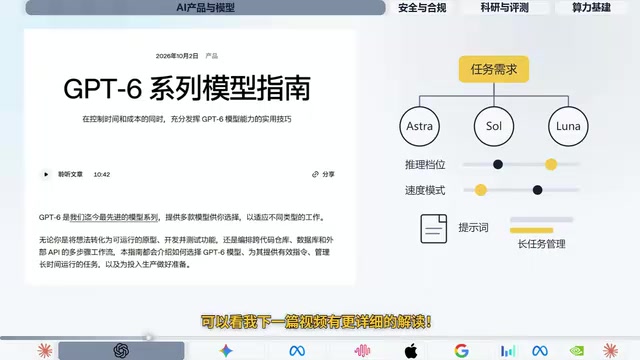
OpenAI had the busiest day. First, it published a usage guide for the GPT-6 series, explaining how to choose between the Astra, Solo, and Luna models based on task requirements, and how to adjust reasoning levels and speed modes. The guide also covers prompt writing and long-task management, aiming to help users more effectively navigate different model capabilities across scenarios. For users accustomed to a single model, the "tiered model variants + adjustable reasoning levels" design raises both the barrier to entry and the learning curve — and the official guide is meant to bridge that knowledge gap.
On another front, ChatGPT's financial features have begun rolling out to free and Go users in the United States. Users can connect their accounts to track forgotten subscriptions, unfamiliar charges, and duplicate payments, as well as view billing increases, reasons behind monthly spending, and weekly updates. This pushes ChatGPT from a "Q&A assistant" toward a "personal finance manager" role, and signals OpenAI's continued push to expand consumer-facing use cases.
The plugin ecosystem also saw new developments. Plugins can now bring interactive experiences from tools like Adobe into ChatGPT, and support wrapping Skills or MCP services. ChatGPT Sites can now host MCP services and convert them into cross-platform plugins, with the plugin creation, review, and recommendation system also upgraded. This marks ChatGPT's evolution from a closed chat window into a platform capable of hosting third-party applications.
Also worth noting on the defense side: Lockheed Martin revealed that OpenAI is collaborating with the F-35 fighter jet team to help solve complex math and physics problems. OpenAI has previously worked with U.S. defense agencies, and this latest disclosure has once again sparked debate about the use of advanced models in military engineering.
MCP (Model Context Protocol) is an open protocol proposed by Anthropic in late 2024, designed to establish a standardized communication interface between AI models and external tools and data sources. The core idea is analogous to the universal USB standard: developers simply wrap a "service" according to MCP specifications, and any AI client that supports the protocol can call it directly — no need for platform-specific adapters. ChatGPT Sites' support for converting MCP services into cross-platform plugins means OpenAI is incorporating this open standard into its own ecosystem, allowing developers to reuse existing MCP tools while reaching more users through ChatGPT's distribution channels. The broader implications for the AI tooling ecosystem are worth watching — when a single MCP service can interface with multiple platforms like Claude and ChatGPT simultaneously, plugin developers' marginal returns will increase significantly, accelerating the emergence of third-party applications.
Claude Code and Feature Updates Across Model Tools
Anthropic's Claude Code added a built-in plugin called "You Should Know." The plugin scans Claude's output and alerts users to important information they might have missed, and can be enabled via a plugin activation command. This kind of "reverse reminder" mechanism addresses the issue of critical details getting lost in lengthy AI outputs — a useful complement to existing interaction patterns.
In the open-source space, MiniMax open-sourced a self-deployable OpenAgent Core offering an OpenAI-compatible Agents API. Developers don't need to modify their application code — just swap the endpoint URL to connect, with access to state management and task scheduling capabilities. For teams looking to reduce dependence on closed-source APIs, this lowers the migration barrier considerably.
On the video generation front, third-party inference platform MarkGen launched a video generation option for MiniMax H3, supporting clips of 16 to 30 seconds — exceeding the model's native 15-second limit. The platform says the output is a single continuous shot rather than stitched footage, with the feature now open for testing on the web and via API.

Meta's Muse Surges, Google Stays Active
Meta's AI app Muse hit 5.1 million U.S. downloads in its first 22 days, topping the App Store overall chart for 12 consecutive days. ChatGPT saw approximately 2.3 million downloads over the same period, making Muse's growth rate roughly 2.2 times faster. These numbers reflect how fiercely competitive the consumer AI app space has become, with Meta leveraging its social ecosystem for strong distribution advantages.
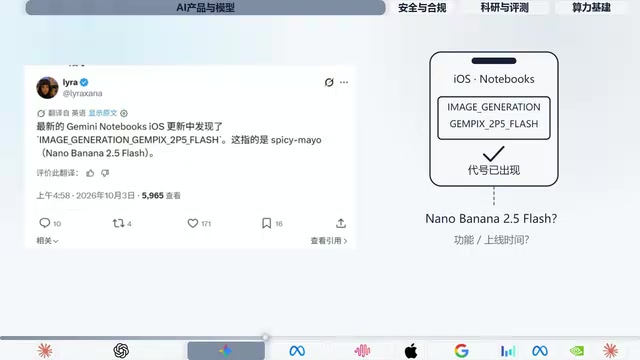
There's quite a bit happening at Google, though much of it is still unconfirmed: reports suggest Google could push Gemini 4 to users as early as next week, though nothing has been officially confirmed; an undisclosed full-disk access setting was spotted in the Gemini desktop app, which, if enabled, could allow it to read files and run applications — currently still hidden; an image generation model codename has also appeared in the iOS Gemini Notebooks, reportedly corresponding to Nanobanana 2.5 Flash, though both the feature and its release timeline remain unconfirmed. Additionally, Google's recent large-scale sales of TPU compute capacity to outside parties have raised questions about whether its own internal compute supply is sufficient.
Safety and Compliance Tighten: Permission Management and Content Review
As AI agent capabilities grow, the question of safety boundaries has become increasingly urgent. Apple announced it is tightening macOS full-disk access permissions, incorporating AI agent risks into system-level permission management. Once an agent gains this access, it could potentially read user files, emails, messages, and browsing history — posing significant privacy risks. The hidden full-disk access feature in Google's Gemini desktop app underscores just how real these concerns are.
On the content side, Google updated its search guidelines to emphasize that websites must have AI-generated content reviewed by humans for accuracy and credibility before publishing. Google noted that AI can generate information that appears plausible but is inaccurate, and that websites and marketing teams producing content at scale need to strengthen their review processes. This is a clear policy signal for sites relying on AI to mass-produce content.
Research Breakthroughs: AI Tackles Math and Theoretical Problems
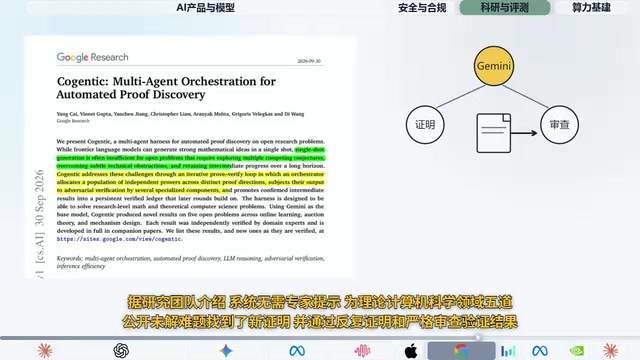
Several impressive research advances emerged. Google Research released CogenTik, a multi-agent system based on Gemini that, according to the research team, found new proofs for five open problems in theoretical computer science — all without expert prompting — and verified the results through repeated proofs and rigorous review.
Meta also announced that a team of mathematicians, working with its models through an ordinary chat interface, completed six papers — five of which solved open research problems with no existing solutions, and one of which disproved a conjecture in non-associative algebra. No custom tools were used throughout the collaboration. ByteDance, meanwhile, released DMAD, a video generation distillation method that allows the MiniMax H3 video model to complete generation in just four steps. The model weights, project page, and paper are all publicly available.
Infrastructure Buildout and Massive Financing Rounds
At the infrastructure level, the scale of capital and compute investment continues to climb. According to leaked reports, xAI plans to bring approximately 420,000 NVIDIA GPUs online in November to fulfill billions of dollars in compute commitments, suggesting xAI is aggressively expanding its computational infrastructure — though the claim that it will provide compute to other AI companies remains speculative.
Separate disclosures from a confidential prospectus and related reporting indicate that Broadcom has extended a loan of up to $42 billion to Anthropic, to be used for renting AI chip compute built through Broadcom's partnership with Google. This financing will support a compute leasing agreement totaling approximately $125.2 billion, and signals that chip vendors may be using financing to drive customer procurement — a "vendor financing to lock in customers" model that is emerging as a noteworthy new dynamic in the AI compute race.
Vendor financing is a business model common in traditional manufacturing: a supplier extends a loan or credit line to a customer, earmarked specifically for purchasing the supplier's own products, thereby locking in long-term procurement. In the context of the AI compute race, the emergence of this model carries particular significance. Broadcom's provision of up to $42 billion in loans to Anthropic for renting its chip compute looks like financial support on the surface, but is fundamentally a deep binding of the customer's purchasing decisions to its source of capital — if Anthropic ever wants to switch vendors in the future, it would face enormous pressure to repay the debt ahead of schedule. For AI startups that are capital-intensive but not yet generating stable cash flows, this kind of financing arrangement is quite attractive, yet it quietly amplifies dependence on a single supplier. As chipmakers like NVIDIA and Broadcom grow increasingly flush with capital, this "financing in exchange for lock-in" competitive strategy is likely to be replicated more broadly across the industry.
Related articles

Chain of Thought Isn't Just for AI: How Humans Can Use CoT to Improve Thinking Quality
Chain of Thought isn't just a prompt trick for large models. Starting from a Hacker News discussion, this article analyzes why CoT works for human thinking too, breaks down actionable ways to transfer it, and highlights the key differences between human CoT and machine CoT.
Cloudflare Teams Up with OpenAI: Closi…
Cloudflare Teams Up with OpenAI: Closing the Loop from Vulnerability Discovery to Defense with AI
Cloudflare uses OpenAI Daybreak to investigate security vulnerabilities and generate reviewable remediation plans, while developers use Codex to boost coding efficiency and quality.

Orca Multi-Agent Orchestration in Practice: A Guide to Parallel Collaboration with Claude and Codex
Orca is Stable AI's free open-source agent workbench supporting 34 agents like Claude Code and Codex in parallel. Learn its Git worktree isolation, multi-model orchestration, and mobile management.