GPT-6 Shows Intrinsic Protein-Design Capabilities: A New Signal for AI for Science
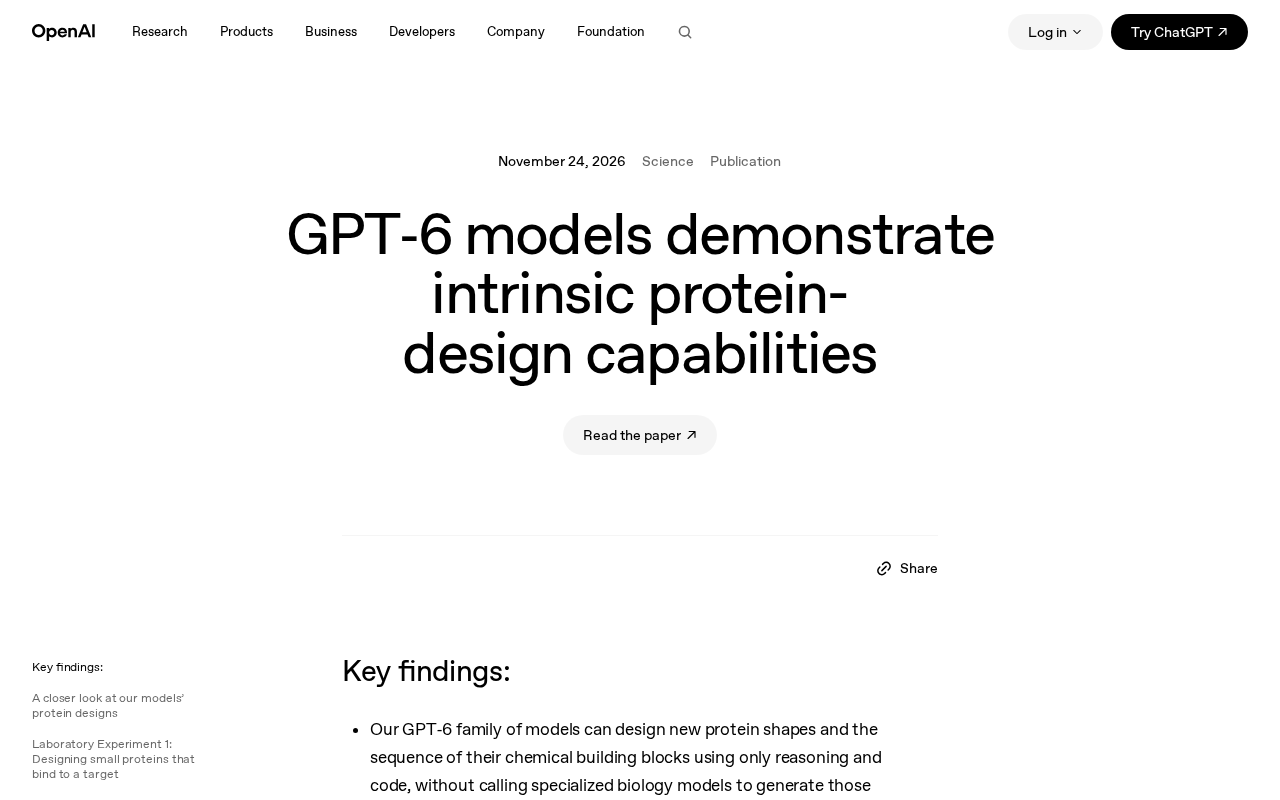
HN post claims GPT-6 has intrinsic protein-design capabilities, but lacks evidence—better treated as a trend signal.
A Hacker News post claims GPT-6 models exhibit "intrinsic" protein-design capabilities—handling protein sequence and structural constraints without domain fine-tuning or external tools. The article notes that if true, this would challenge the traditional "generation + screening" division of labor, compress the protein design toolchain, and lower barriers for small labs. But with no paper, benchmark, or experimental details and zero comments, it frames the claim as an illuminating trend signal rather than a citable conclusion, listing open questions on evaluation tasks, training data overlap, and missing wet-lab validation.
A discussion appeared on Hacker News: "GPT-6 models demonstrate intrinsic protein-design capabilities." The post itself doesn't carry much information, but the claim in the title is specific enough—not that the model "assists" with protein design, but that it has an "intrinsic" capability. The difference between those two words is what makes this discussion worth taking seriously.
What "Intrinsic Capability" Means
In the context of AI for Science, "intrinsic" usually means the model has not undergone targeted domain fine-tuning or been paired with an external toolchain, yet still exhibits a specialized capability purely through general pretraining and inference. If this description holds, it points to a deeper form of generalization: the model has implicitly learned the constraints between protein sequences and structures during training, rather than relying on external scoring functions or structure-prediction modules as a fallback.
This stands in contrast to the mainstream approach to protein design over the past few years. Previous work has largely relied on dedicated structure-prediction networks, diffusion models, or reinforcement learning pipelines, with general-purpose language models playing more of a supporting role—for example, generating candidate sequences that are then handed to downstream tools for screening. The claim of "intrinsic capability" implies that general-purpose models themselves are beginning to approach the core of this specialized pipeline.
It should be noted that this discussion thread includes no paper, benchmark, or experimental details—only a title and very little engagement data. The analysis below is therefore more of an unpacking of what it means rather than an endorsement of the conclusion.
The difference between pretraining and fine-tuning: Pretraining refers to a model learning broad patterns from large-scale general corpora through self-supervised objectives (such as predicting the next token), without targeting any specific downstream task; fine-tuning means continuing to train on labeled data for a particular domain or task to align with specialized needs. The so-called "intrinsic capability" emphasizes the former: the model exhibits usable performance on downstream tasks without supervised fine-tuning in the protein domain. This distinction depends on the evaluation method—only testing in zero-shot or in-context learning settings can rule out the possibility of fine-tuning data leakage.
The difference between structure prediction and sequence design: Structure prediction takes an amino acid sequence as input and infers its three-dimensional conformation (as AlphaFold does); sequence design goes in the opposite direction, taking a target structure or function and working backward to feasible sequences (as inverse-folding models like ProteinMPNN do). The two have different constraint directions and different difficulty distributions. If the "protein design capability" discussed here refers to sequence design, then the model would need to grasp both structural constraints and functional feasibility—bringing it closer to a complete specialized pipeline than mere structure prediction.
Why Protein Design Is a Tough Nut to Crack
Protein design is hard because three challenges hold simultaneously: the sequence space is extraordinarily vast, with feasible combinations of amino acid chains far exceeding what can be exhaustively enumerated; structural constraints are strict, since the shape a sequence folds into is determined by physicochemical laws with little room for error; and functional validation is expensive, with each round of wet-lab experiments taking a long time and costing a lot.
In the past, these problems were solved through a division of labor: "generation + screening." The model proposed candidates, specialized tools judged feasibility, and experiments made the final call. Each link had clear boundaries. If a general-purpose large model can directly produce structurally sound, functionally promising sequences at inference time, that would compress the first two links into a single model, significantly shortening the pipeline.
This is also why the word "intrinsic" stands out so much in the discussion—it challenges the division-of-labor assumption itself.
Sequence space and folding constraints: For a protein about 100 residues long, the possible amino acid combinations number roughly 20^100, far exceeding the total number of atoms in the universe—exhaustive enumeration is infeasible. At the same time, not every sequence can fold into a stable structure—physicochemical rules such as hydrophobic cores, hydrogen-bond networks, and dihedral angle restrictions jointly constrain the proportion of feasible solutions. "Protein design" is essentially sampling within this vast and sparse feasible region, requiring both diversity and structural stability—exactly the direction that specialized generative models (such as diffusion models) have focused on.
Potential Impact on the AI for Science Landscape
If it truly holds, the most direct change would be in the shape of the toolchain. Specialized protein design software could shift from "essential" to "optional," with general-purpose models plus a small amount of validation covering a considerable share of scenarios. For small laboratories with limited resources, this would mean a lower barrier to entry.
Another layer of impact concerns evaluation methods. The intrinsic capabilities of general-purpose models are hard to measure with a single benchmark; cross-task, cross-distribution testing is needed to clarify them. Communities like Hacker News have always been cautious about "capability claims," and when reproducible evaluation details are lacking, discussions tend to stall at the skepticism stage—the fact that this post has zero comments partly reflects the wait-and-see attitude caused by insufficient information.
Reasonable Grounds for Skepticism
Without experimental data, several questions must remain open: On what tasks was this "intrinsic capability" measured? Sequence generation, structural plausibility judgment, or function prediction? Is there overlap between the evaluation set and the training data? Have the designed sequences been validated through wet-lab experiments, or do they remain at the level of computational metrics?
Until these questions are resolved, "intrinsic" is more of an illuminating observation than a citable conclusion. The downstream validation chain for protein design is long, and computational optimism can easily be falsified at the experimental stage.
Training data overlap and benchmark contamination: The pretraining corpora of general-purpose large models are enormous and very likely already include textual descriptions of sequences and structures from the Protein Data Bank (PDB). If samples used in evaluation tasks were seen by the model during pretraining, its performance cannot be considered "intrinsic generalization" but rather memorization or nearest-neighbor retrieval. Determining this requires rigorous data decontamination processes and out-of-distribution test sets.
The necessity of wet-lab validation: Computational metrics (such as predicted structure confidence pLDDT or sequence likelihood) only indicate internal consistency of the model; they cannot prove that designed sequences will fold, remain soluble, and possess the target function in a real cellular environment. The gold standard for protein design remains wet-lab experiments such as expression, purification, and functional assays, which typically take weeks to months and are costly. Without this link, claims of "design capability" can only remain at the hypothetical level.
Directions Worth Watching
Setting aside the information density of this particular post, the trend it reflects is clear: general-purpose models are penetrating specialized scientific domains, and the way they do so is shifting from "external tools" to "endogenous capability." What's worth watching next is whether any team provides a reproducible evaluation protocol, and whether the community can form consensus testing standards for such capability claims. Until then, treating it as a signal worth tracking is more prudent than treating it as a conclusion.
One-line Summary
An HN post claims GPT-6 has intrinsic protein-design capabilities, but lacks evidence—better treated as a trend signal.
Paragraph Summary
A Hacker News discussion thread claims that GPT-6 models demonstrate "intrinsic" protein-design capabilities—that is, handling protein sequence and structural constraints without domain fine-tuning or external tools. The article notes that if this claim holds, it would challenge the traditional "generation + screening" division of labor, compress the protein design toolchain, and lower the barrier to entry for small labs. However, the post includes no paper, benchmark, or experimental details, and has zero comments. The article therefore frames it as an illuminating trend signal rather than a citable conclusion, and lists open questions such as unclear evaluation tasks, training data overlap, and the lack of wet-lab validation, emphasizing the need to wait for reproducible evaluation protocols and community consensus.
Related articles

New York's Proposed Five-Year Ban on AI Toys: The Clash Over Children's Privacy and AI Regulation
New York proposes a five-year ban on AI toys, sparking debate over children's privacy and AI hardware regulation. This article examines the ban's targets, supporting and opposing views, and compliance implications for AI hardware developers.
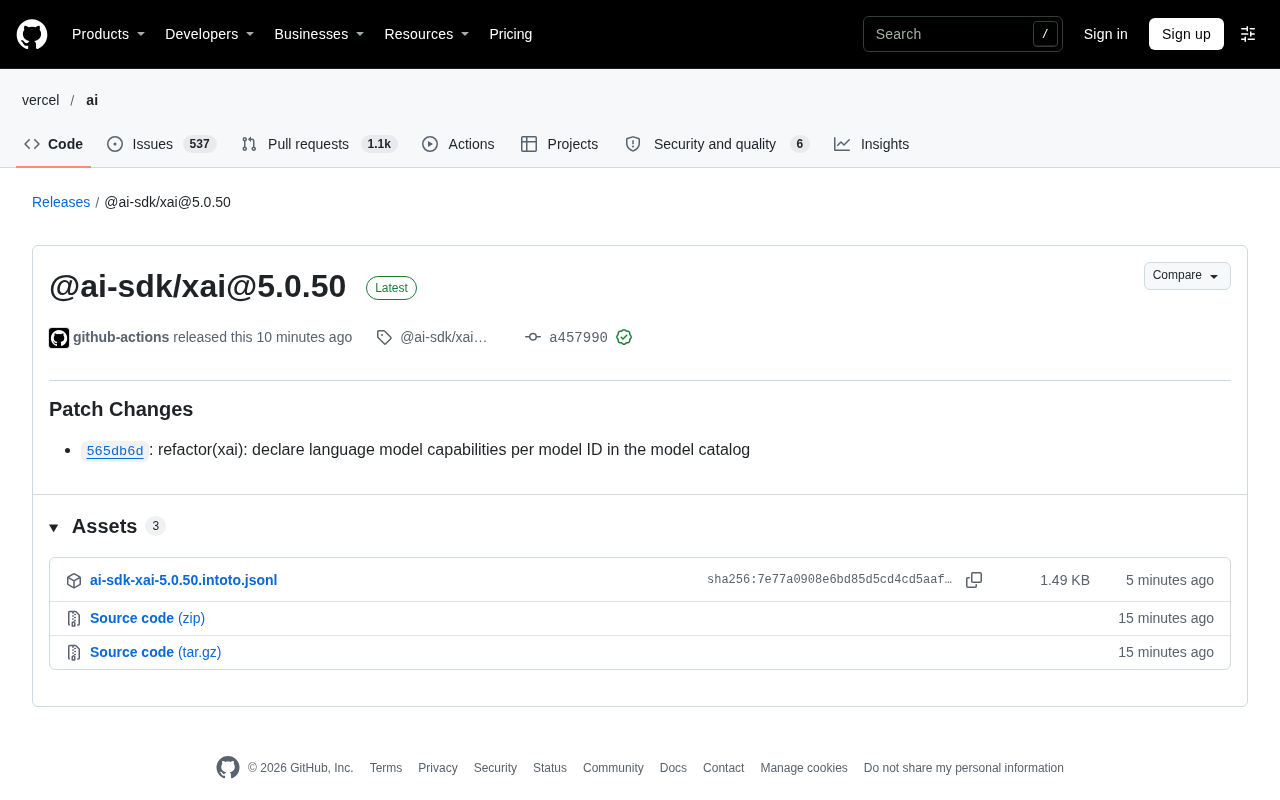
Vercel AI SDK's xAI Package Update: Declaring Capabilities per Model ID
Analysis of the @ai-sdk/xai 5.0.50 patch update: declaring language model capabilities per model ID in the model catalog, and its impact on Vercel AI SDK multi-model adaptation.
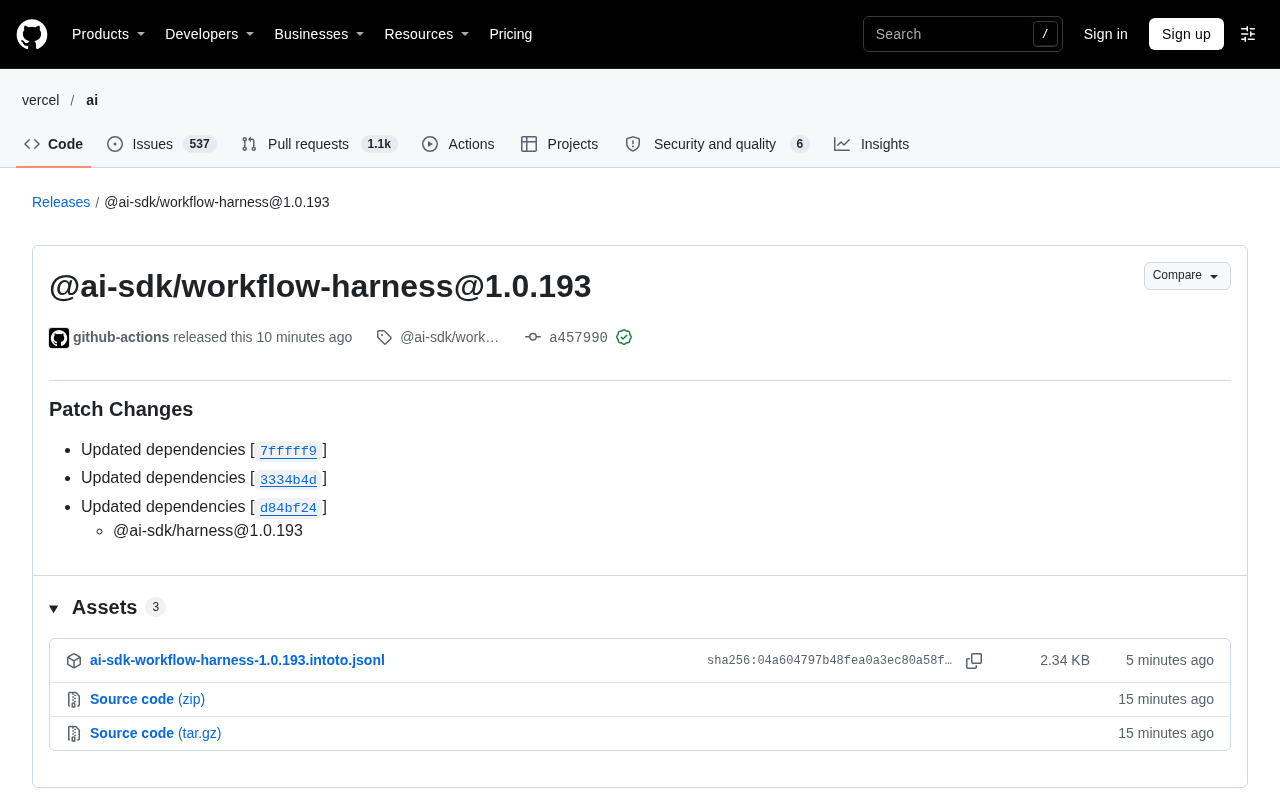
AI SDK Workflow Toolkit 1.0.193 Update Analysis
AI SDK workflow toolkit @ai-sdk/workflow-harness releases 1.0.193 patch update, primarily syncing dependencies with the underlying @ai-sdk/harness to maintain workflow orchestration stability.