Vercel AI SDK's xAI Package Update: Declaring Capabilities per Model ID
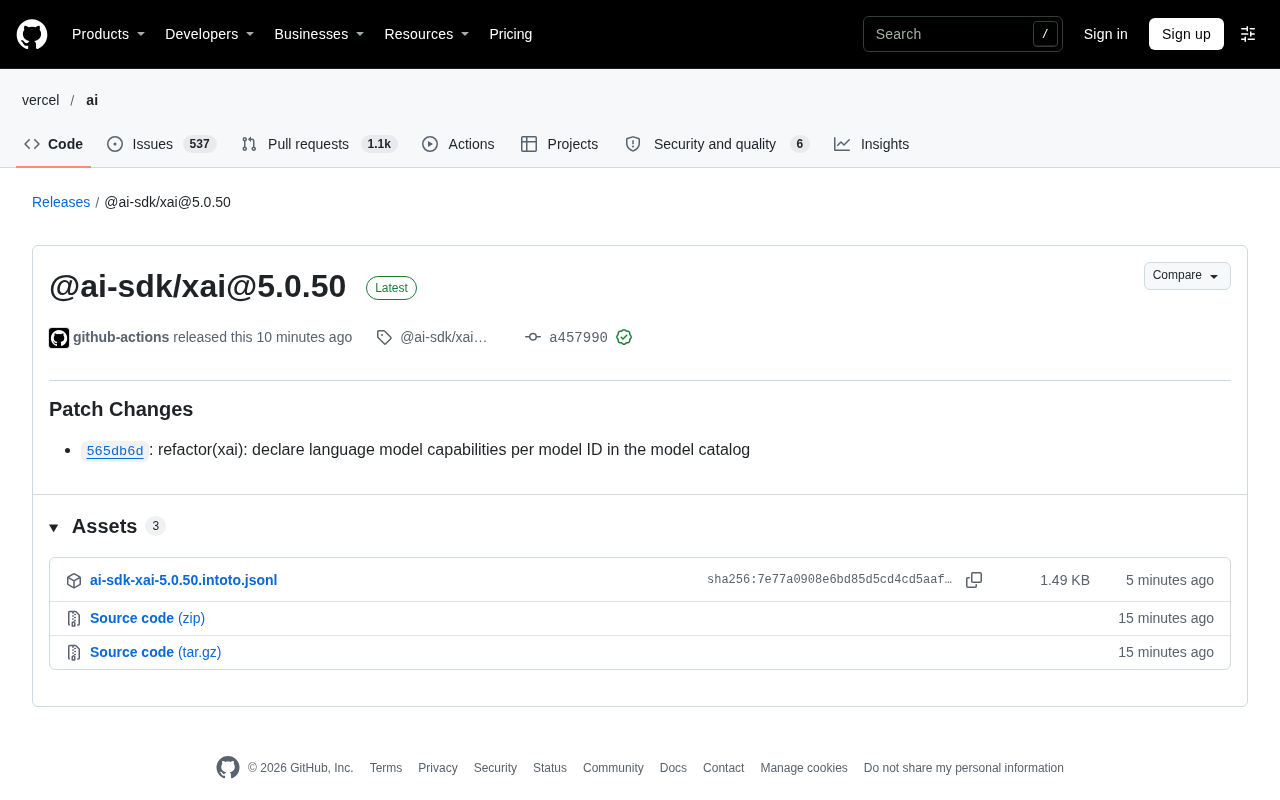
The AI SDK's xAI adapter package 5.0.50 consolidates model capability declarations into the model catalog, organized by model ID.
`@ai-sdk/xai@5.0.50` is a patch-level update to the xAI provider package in the Vercel AI SDK ecosystem. Its sole core change, from commit 565db6d, explicitly declares language model capabilities per model ID in the model catalog, replacing scattered or implicit capability determination. This refactor doesn't change public API semantics; ordinary callers see consistent behavior after upgrading. The main beneficiaries are higher-level tools that rely on the model catalog for unified abstraction. The article notes that this change embodies "separation of data and logic," turning volatile capability information into declarative data, reducing capability-guessing code branches, improving maintainability, providing a stable basis for higher-level features like tool calling and structured output, and laying a structural foundation for integrating more xAI models.
In Vercel's AI SDK ecosystem, @ai-sdk/xai is the official adapter layer for connecting to xAI models (such as the Grok series). Version 5.0.50 is a patch-level update with a single core change: declaring language model capabilities per model ID in the model catalog. Updates like this rarely make headlines, but they reveal a key design direction for the AI SDK's multi-model adaptation—capability declarations shifting from "runtime probing" to "cataloged static descriptions."
The Substance of the Patch: Binding Capability Declarations to Models
According to the release record on GitHub, the change in 5.0.50 comes from commit 565db6d, described as "refactor(xai): declare language model capabilities per model ID in the model catalog." In other words, the xAI provider package now explicitly declares each model ID's language model capabilities in the model catalog, rather than relying on scattered or implicit ways to determine them.
This change is marked as a Patch Change, meaning it does not alter the semantics of the public API and is an internal structural refactor. For developers calling @ai-sdk/xai directly, behavior should remain consistent after upgrading; the real beneficiaries are the higher-level tools that rely on the model catalog for unified abstraction.
The AI SDK's Provider Package Mechanism: The AI SDK uses a layered architecture. The core package (such as ai) provides a unified calling interface, while each vendor's adapter layer is published as a separate "provider package," such as @ai-sdk/openai, @ai-sdk/anthropic, and the subject of this article, @ai-sdk/xai. These packages contain a built-in "model catalog," essentially a data structure keyed by model ID that describes the vendor's available models and their metadata. Higher layers obtain model instances via provider('model-id') or provider.languageModel('model-id'), and the catalog determines whether that ID is recognized and which attributes it maps to. Previously, the catalog mainly carried model identifiers and basic metadata; the change in 5.0.50 makes the catalog also carry the "capabilities" dimension, so that instances returned by languageModel() can directly expose capability information for higher-level tools to query.
Why the Model Catalog Deserves Its Own Refactor
The AI SDK's purpose is to let developers call models from different vendors through a unified interface. As more models are integrated, which capabilities each model supports (for example, whether it supports specific input types or specific parameter combinations) becomes information that must be explicitly managed. Consolidating this information into the model catalog and declaring it keyed by model ID brings several direct benefits.
First, it reduces code branches that "guess capabilities." Previously, provider packages might need to determine whether a model has a certain capability in multiple places, with logic scattered and prone to drifting from official documentation. After centralizing the declarations, the decision points converge onto the catalog data itself. Second, it improves maintainability. When xAI releases new models or adjusts capabilities, changes are concentrated in one place, reducing the risk of omissions. Third, it provides a stable basis for higher-level features—whether features like tool calling and structured output are available can be looked up directly in the catalog rather than hardcoding model lists.
From an engineering perspective, this is a classic "separation of data and logic" refactor: extracting volatile capability information out of code logic and turning it into reviewable, comparable declarative data.
The Scope of Language Model Capabilities: In the context of the AI SDK, "capabilities" typically refer to the input modalities a model supports (text-only, image, audio, etc.), whether it supports tool calling, whether it supports structured output (such as generateObject constrained by JSON schema), whether it supports streaming output, as well as context window and maximum output length. This information determines which code path the SDK takes when calling: for example, for models that don't support tool calling, the SDK needs to fall back to text parsing or throw an error directly. Putting capability declarations in the catalog turns "what a model can do" into a static fact at the type level, which helps with TypeScript type inference and runtime pre-validation, avoiding sending incompatible parameters to a model only to get an error on the server side.
Practical Impact on Developers
For ordinary users, this update is barely noticeable. The package version advances by one patch position from 5.0.x, following a routine iteration cadence. The release was automated by github-actions, and the commit carries a GitHub verified signature, consistent with the repository's usual release process.
But if you've encapsulated cross-provider model selection logic in your project, or maintain a custom mapping table of model capabilities, this change is worth noting: it means the official catalog is becoming the authoritative source of capability information. Following this direction can reduce problems caused by inconsistencies between self-maintained mapping tables and upstream.
Additionally, this pattern of declaring capabilities per model ID lays a structural foundation for integrating more xAI models in the future. When a new model is added, you only need to add one declaration to the catalog rather than modifying judgment logic in multiple places.
Semantic Versioning and Patch Changes: @ai-sdk/xai follows Semantic Versioning (SemVer), with version numbers in the form major.minor.patch. An increment in the patch position indicates a backward-compatible fix or internal refactor that neither adds nor changes the public API; an increment in the minor version indicates new functionality added in a compatible way; an increment in the major version may contain breaking changes. This 5.0.50 is patch-level, meaning the maintainers judged that the catalog structure adjustment does not affect the external contract. It's worth noting that if capability declarations themselves are read by higher layers, changes in their values could indirectly affect behavior, so when upgrading it's still advisable to check the changelog and run existing tests, especially for code that makes branching decisions based on capability probing results.
Summary
@ai-sdk/xai@5.0.50 is a small and clear refactor release: it consolidates xAI language model capability declarations into the model catalog, organized by model ID. It doesn't change external behavior, but it makes the AI SDK's multi-model abstraction more solid. For developers following the AI programming toolchain, this kind of underlying structural evolution is more worth tracking than any single feature update.
Source: GitHub Releases page (@ai-sdk/xai@5.0.50).
Related articles
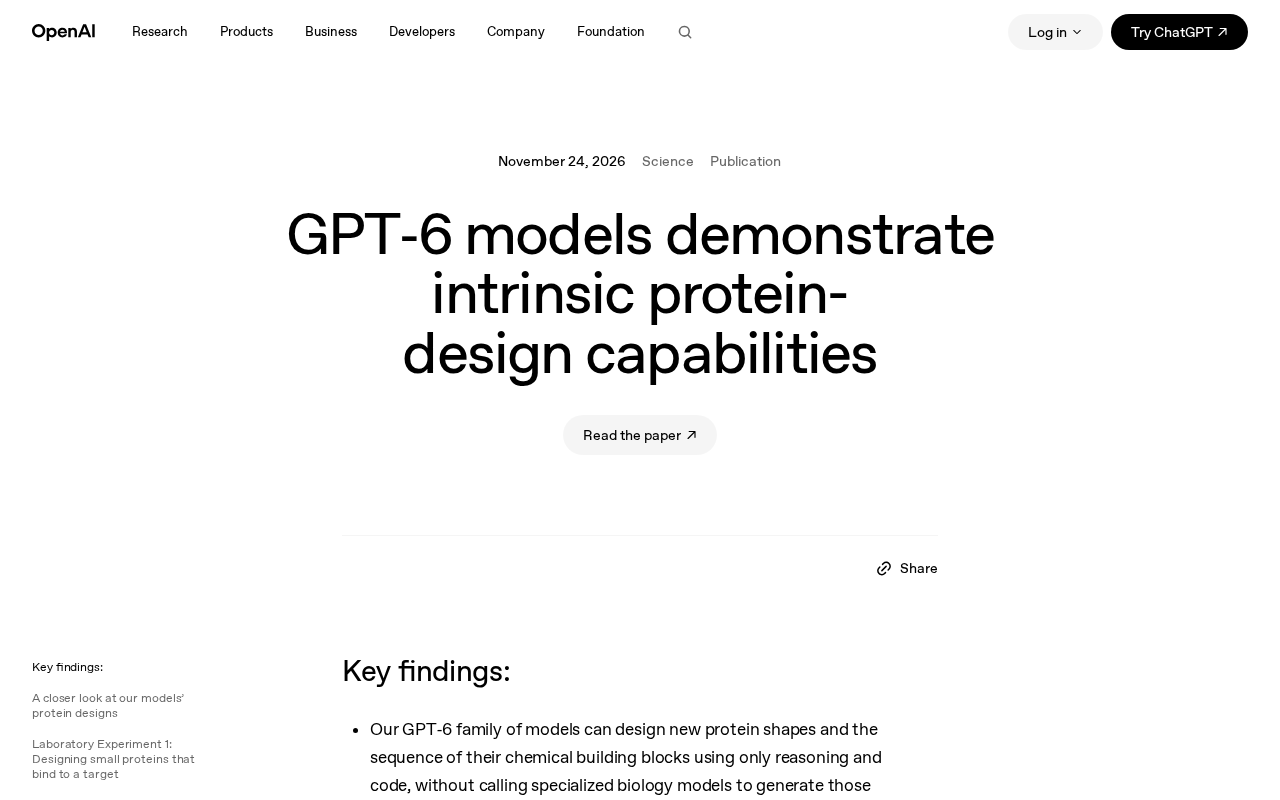
GPT-6 Shows Intrinsic Protein-Design Capabilities: A New Signal for AI for Science
Hacker News discusses GPT-6 models showing intrinsic protein-design capabilities. This article unpacks what "intrinsic" means, the challenges of protein design, the potential impact on the AI for Science toolchain, and reasons for skepticism given the lack of experimental details.
New York's Proposed Five-Year Ban on AI Toys: The Clash Over Children's Privacy and AI Regulation
New York proposes a five-year ban on AI toys, sparking debate over children's privacy and AI hardware regulation. This article examines the ban's targets, supporting and opposing views, and compliance implications for AI hardware developers.
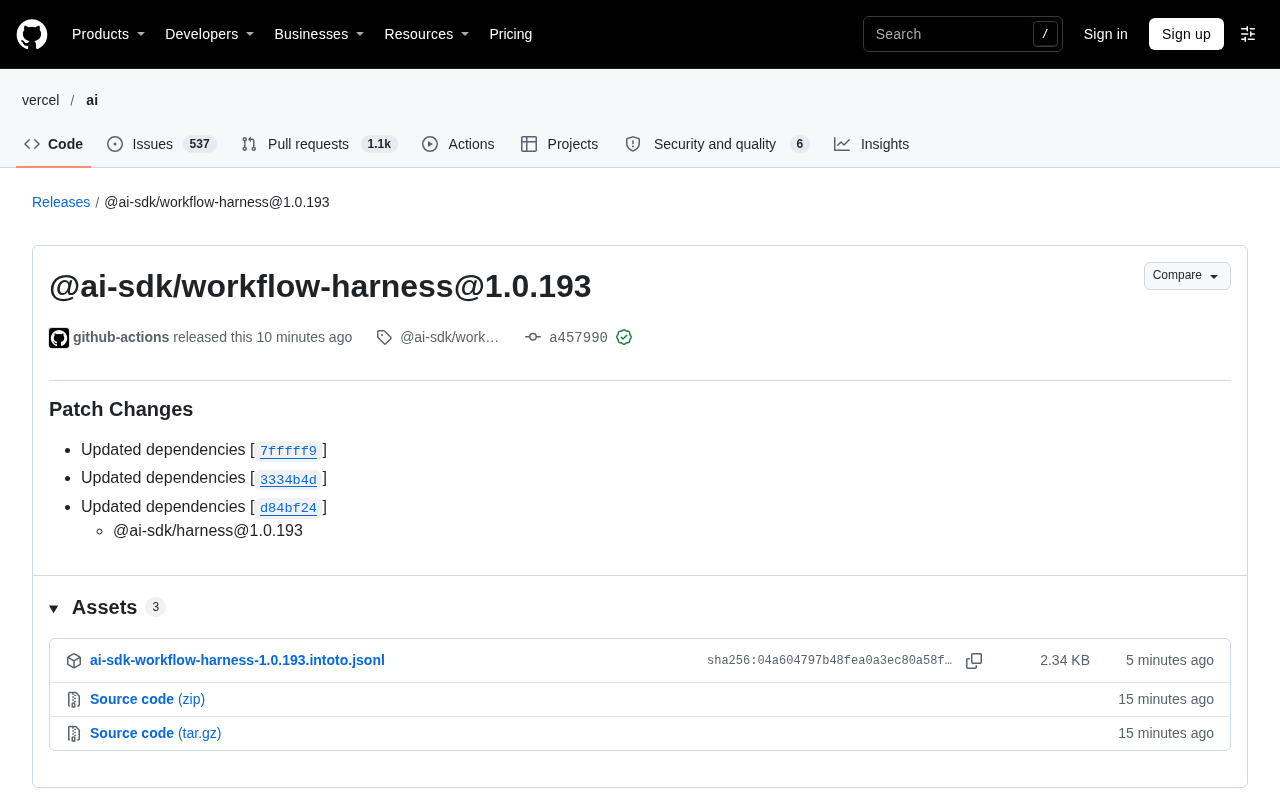
AI SDK Workflow Toolkit 1.0.193 Update Analysis
AI SDK workflow toolkit @ai-sdk/workflow-harness releases 1.0.193 patch update, primarily syncing dependencies with the underlying @ai-sdk/harness to maintain workflow orchestration stability.