GPT-6 Sol/Luna vs. DeepSeek: Which Model Wins at Article Layout Replication?

GPT-6 Sol tops a layout replication test against Luna and DeepSeek on speed, cost, and fidelity.
This article benchmarks GPT-6 Sol, GPT-6 Luna, and DeepSeek V4.1 on a WeChat Official Account layout replication task across four dimensions: speed, token consumption, layout fidelity, and style retention after pasting. Sol leads on speed and efficiency and delivers the best layout replication. Luna offers strong cost-effectiveness but stumbled on instruction-following. DeepSeek lagged on speed and token use but matched Sol on final style retention. All three models struggled with multi-image layouts, highlighting a common limitation in handling complex visual arrangements.
The large model market has been caught up in a fresh wave of price wars. According to hands-on testing shared by Bilibili creator Xiangzi, Anthropic released Opus 5.5 with dramatically improved performance at nearly half the previous price. OpenAI followed suit with two new models — GPT-6 Sol and GPT-6 Luna — which, while not matching Anthropic's performance leap, came with even steeper price cuts: reportedly just one-tenth the cost of the previous generation.
This article takes a real-world "article layout replication" test as its starting point, comparing GPT-6 Sol, GPT-6 Luna, and DeepSeekAd V4.1 side by side to see how large these gaps actually are in a concrete productivity scenario.
The Test: A Tough Layout Replication Challenge
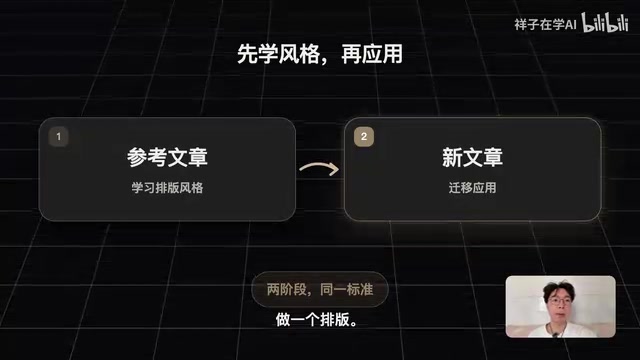
The core task here isn't a standard knowledge Q&A — it's something much closer to real-world workflows: layout replication. The tester gave all three models the same pre-formatted article, asked them to learn the layout style, and then apply that style to a plain, unformatted piece of text.
The evaluation dimensions were quite specific: (1) layout fidelity — whether the model could reproduce the original color palette, decorative elements, text spacing, and multi-image arrangements; (2) task execution speed; (3) token consumption; and (4) the most critical real-world factor — whether the output retained its formatting after being copy-pasted into the WeChat Official Account editor. All three models were run inside the tester's custom auto-layout skill, with thinking intensity set to high (Max for Sol and DeepSeek, High for Luna), reflecting typical daily usage.
Worth noting: Luna ran into a minor issue early on. Instead of strictly following the prompt, it read other requirements inside the skill and applied a pre-built template directly. The tester had to restart and add supplementary instructions to the prompt before Luna got back on track. This detail reveals an interesting difference in how models prioritize context under complex instruction environments.
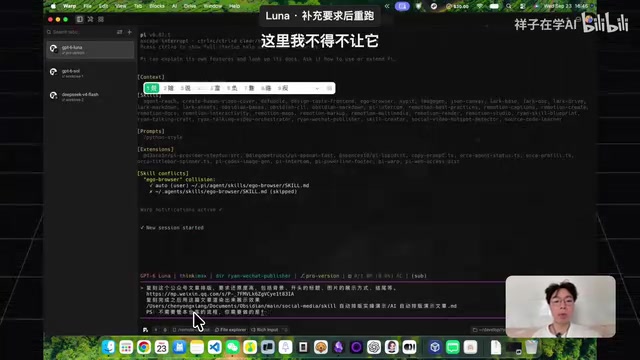
"Layout replication" is a high-frequency yet tedious task in WeChat Official Account production workflows. Operators typically need to maintain consistent brand visuals — applying the same color schemes, letter spacing, dividers, and image-text arrangements to new content repeatedly. The traditional approach relies on manual paragraph-by-paragraph adjustments. Automating this with a large model requires the model not only to understand natural language instructions, but also to generate and reproduce HTML/CSS style code with precision. The "auto-layout skill" used in this test is essentially a pre-configured workflow that packages the user's sample article and raw content into the model, which then outputs rich text or HTML code ready to paste directly into the editor. This kind of task places high demands on code generation accuracy, long-context understanding, and instruction-following — all quite different from general Q&A scenarios.
Speed and Cost: Sol Takes a Clear Lead
Speed-wise, the three models diverged significantly. GPT-6 Sol was the fastest — subjectively taking only four to five minutes to complete the task — earning a perfect score of 5. Luna took roughly three times as long, clocking in around twenty minutes, earning a 3. DeepSeek was the slowest at nearly half an hour, scoring just 2.
Token consumption followed a similar ranking. Sol consumed the least, scoring 5. Luna used just over twice as many tokens as Sol, earning 3.5. DeepSeek ran slightly higher than Luna, scoring 3.
These results make for an interesting counterpoint to the pricing trends mentioned earlier. While OpenAI wasn't the most aggressive on performance improvements, it tuned Sol into a "fast and lean" model. In high-frequency production scenarios, where speed and token consumption translate directly into real costs, Sol's efficiency advantage compounds quickly.
Layout Fidelity: Sol Looks the Best, Multi-Image Layouts Trip Up All Three
Layout replication was the most revealing part of this test. GPT-6 Sol replicated the overall color palette, decorative elements, and text spacing quite faithfully — the only notable gap was multi-image layout, which diverged from the original. Sol scored 4 overall.
GPT-6 Luna had a decent overall appearance, but added quite a few dividers between paragraphs, making the article feel fragmented. Multi-image layout also fell short. Luna scored 3. DeepSeek also looked acceptable, but an unexplained ellipsis appeared at the beginning (likely a placeholder for text or elements that failed to render), and multi-image layout didn't come through either. DeepSeek scored 3.
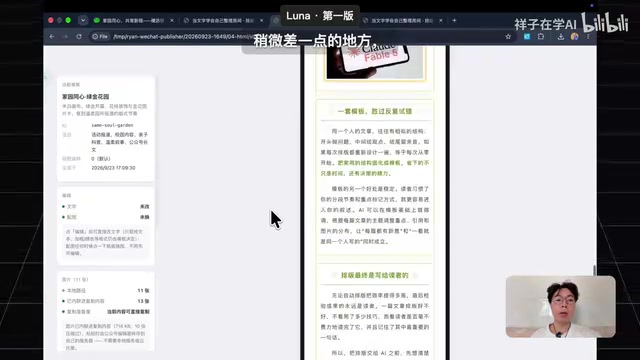
All three models stumbled on multi-image layouts — suggesting this remains a universal challenge for current large models when handling complex visual arrangements. After the tester asked them to go back and fix this, results improved: Sol not only produced the multi-image layout but also filled in the decorative text beside the images. Luna and DeepSeek managed to produce the multi-image layout too, but neither added the decorative text. This follow-up round further confirmed Sol's lead on detail completeness.
The reason multi-image layout is a shared weak point comes down to how these outputs are generated. Side-by-side multi-image arrangements in WeChat Official Accounts typically rely on CSS Flexbox or Grid, along with platform-specific constraints on inline style support. When generating this kind of code, a model must infer the visual intent of the original while choosing compatible syntax within the platform's style whitelist — any unsupported property can cause images to stack or misalign. Decorative text beside images often requires absolute positioning or float layouts, which are even harder to render reliably in WeChat's restricted environment. Multi-image layout therefore tests not just code generation ability, but also the model's implicit knowledge of the target platform's rendering rules.
Real-World Deployment: Style Retention After Pasting
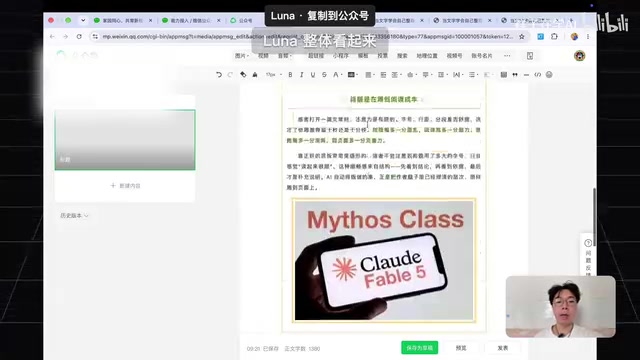
Even a beautifully formatted output is useless if the styles collapse when pasted into the platform. Sol performed most reliably here — styles were largely preserved after pasting, earning a 5.
DeepSeek also kept its styles mostly intact, likewise scoring 5 — actually tying Sol in this final, most practical dimension. Luna looked acceptable overall, but some styles broke at the end of the article, earning a 4.
Interestingly, DeepSeek finished last on speed and token consumption but held its own in the final deployment test. For users who care less about execution speed and more about output stability, it remains a viable option worth considering.
Overall Verdict: Sol Is the Most Balanced Choice Right Now
Across speed, cost, layout fidelity, and real-world deployment, GPT-6 Sol is the clear winner of this test. It offers improved performance over the previous generation, faster execution, and a lower price — even Plus subscribers can comfortably use it as their daily go-to model.
Luna also saw a significant price drop. For high-frequency use cases, the cost-effectiveness is strong, making it a solid backup for cost-sensitive tasks. DeepSeek V4.1 delivered solid style retention but lagged on speed and token consumption, making it better suited for scenarios where turnaround time isn't critical.
To be fair, these are the conclusions of a single tester in a specific scenario — WeChat Official Account layout replication — and the scores carry some subjectivity. They also don't represent each model's full capability across coding, reasoning, long-form text, or other dimensions. But they do offer a genuine productivity perspective: as the price war intensifies, what users actually care about is no longer just benchmark scores — it's whether a model can get the job done quickly, cleanly, and cost-effectively.
Related articles

Chain of Thought Isn't Just for AI: How Humans Can Use CoT to Improve Thinking Quality
Chain of Thought isn't just a prompt trick for large models. Starting from a Hacker News discussion, this article analyzes why CoT works for human thinking too, breaks down actionable ways to transfer it, and highlights the key differences between human CoT and machine CoT.
Cloudflare Teams Up with OpenAI: Closi…
Cloudflare Teams Up with OpenAI: Closing the Loop from Vulnerability Discovery to Defense with AI
Cloudflare uses OpenAI Daybreak to investigate security vulnerabilities and generate reviewable remediation plans, while developers use Codex to boost coding efficiency and quality.

Orca Multi-Agent Orchestration in Practice: A Guide to Parallel Collaboration with Claude and Codex
Orca is Stable AI's free open-source agent workbench supporting 34 agents like Claude Code and Codex in parallel. Learn its Git worktree isolation, multi-model orchestration, and mobile management.