GPT-6 Sol vs. Opus 5.5: Half the Price, But Can It Code?

GPT-6 Sol costs half as much as Opus 5.5, but benchmarks show a clear gap in completion quality and long-horizon tasks.
OpenAI's GPT-6 Sol and Anthropic's Opus 5.5 launched nearly simultaneously at 2x different price points ($2 vs. $4 per million input tokens). Third-party benchmarks from Artificial Analysis show Opus leading across the board at roughly 5.4x the cost per evaluation. In KingBench 3's eight tasks, Opus won 93.75% to 82.5%, with gaps driven by 3D modeling clipping issues and incomplete interaction mechanics. Opus swept all four long-horizon app development tasks. The core takeaway: Sol wins on unit price, Opus wins on completion rate — and the hidden cost of fixing incomplete outputs often erases Sol's pricing advantage.
OpenAI's GPT-6 Sol and Anthropic's Opus 5.5 landed almost simultaneously, both targeting coding and Agent workflows — but they take very different approaches. One slashes the price to half of its competitor's; the other keeps stacking capabilities for complex tasks. A Bilibili creator ran a systematic benchmark using their custom KingBench 3 suite — from elevator simulations to 3D contact lens cases to long-horizon app development — and came away with some remarkably clear conclusions.
Pricing & Specs: Sol's Value Play
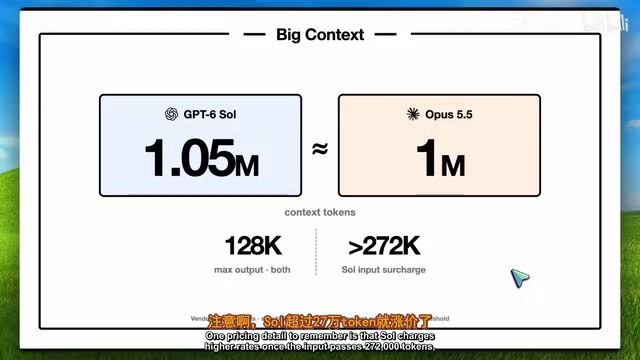
In this comparison, price is GPT-6 Sol's sharpest weapon. Based on the creator's data, Sol's standard pricing is roughly $2 per million input tokens and $10 per million output tokens — exactly half the previous-gen GPT promotional price. Opus 5.5's API pricing sits at approximately $4 per million input and $20 per million output, precisely double Sol's rates. Both models compress cached reads down to around $0.20 per million tokens, which meaningfully cuts repeat request costs in Agent workflows where the same instructions and context get re-read constantly.
On context length, both hover in the million-token range, with differences in effective limits at standard tiers (Sol around 128K, with larger windows at higher tiers). OpenAI claims Sol's error rate in internal SLA testing is half that of other models and doubles their stability benchmark; Anthropic says Opus 5.5 is more than 30% faster than its predecessor and saves roughly 40% compute under default settings. These are vendor-reported figures — directionally useful, but not gospel.
Third-Party Benchmarks: Opus Leads, but Costs More
On Artificial Analysis's Intelligence Index (version 4.32), the gap is clear. GPT-6 Sol scores around 40 at mid-tier, while Opus 5.5 hits 51; at full power, Sol reaches roughly 58 but Opus still leads. More striking is the cost comparison — Sol runs about $0.25 per evaluation, Opus about $1.34, making Opus roughly 5.4× more expensive per evaluation. Worth noting: Opus's evaluation costs include fallback charges when safety mechanisms trigger a switch to other Claude models, and "mid-tier" means different things across providers, so cross-vendor numbers are directional at best.
Individual test results reinforce Opus's capability edge:
- Terminal Bench 4.0 (medium difficulty): Opus 53% vs. Sol 19% — a massive gap on coding-heavy terminal tasks
- CICS / Coding: Opus 59% vs. Sol 54%
- Human Exam: Opus 55% vs. Sol 41%
- Automation Bench: Opus 61% vs. Sol 58% — the smallest gap here
Overall, public data favors Opus, while Sol's core advantage stays concentrated on the cost side.
Terminal Bench is a benchmark specifically designed to evaluate how well LLMs complete programming tasks in command-line/terminal environments. Tasks typically include debugging scripts, fixing code errors, and manipulating file systems — scores reflect real-world usability in actual developer workflows, not just code generation ability. The 53% vs. 19% gap means Opus 5.5 can independently complete nearly three times as many tasks as Sol in these scenarios. For developers using Agent-style automation for terminal tasks, this is a substantive capability chasm, not a marginal difference.
Automation Bench focuses on evaluating a model's ability to drive multi-step automated workflows — including cross-tool calls, state tracking, and error recovery — which maps directly to Agent use cases. The fact that the gap here is smallest (61% vs. 58%) suggests Sol's weaknesses are less severe on structured automation pipelines, with most of the shortfall concentrated in tasks requiring creative judgment and complex reasoning.
KingBench 3 Results: Completion Rate Decides the Winner
The creator's KingBench 3 comprises eight tasks, each scored out of 10, with both models run at medium intensity. Completion rate and interaction quality turned out to be the key differentiators.
On the 3D contact lens case task, Opus produced a complete model with a lid and a lens inside — detail-accurate and functional. Sol (running via the Codex route) produced a model with clipping issues between the lid and body parts, directly hurting usability. Final score: Opus 10, Sol 6. The archery simulator told a similar story — Sol's arrows had no arc and the mechanics were overly simple, while Opus added more complex interaction mechanics. Score: Opus 9, Sol 6.
That said, Sol isn't comprehensively behind. On the panda SVG, combinatorics problem, and Pandas dataset fine-tuning tasks, the two tied at perfect scores. The Pandas dataset task in particular was Sol's standout performance.

In the final 3D watch task, both models produced a complete clock with hour/minute hands, date, day of week, and dual time zones — each earning a perfect 10. The creator had frequently complained about Codex in the past, but noted it got all four of the related questions right this time.
Across all eight tasks: Sol scored 66/80 (82.5%), Opus scored 75/80 (93.75%) — an 11.25 percentage point lead. On the creator's current KingBench 3 leaderboard, Opus 5.5 ranks first, ahead of Fable 5.1, GRM 5.3, and even GPT-6 itself.
Long-Horizon Tasks: Opus's Dominant Zone
The creator also designed four separate "Long Horizon" tasks with extended prompts, testing the models' ability to handle multi-source data and build complete applications. These were scored independently from the eight benchmark tasks.
The first was a terminal movie tracker using the TMDB API. Sol's version had font size issues and couldn't load posters — which is a core feature — making the whole app feel unfinished. Opus's version worked correctly with a complete experience. The gap was stark. The second task, a poster generation and print app, saw Sol revert to that familiar "generic AI aesthetic" frontend, while Opus's visual presentation was far more appealing — though the gap was smaller than on the movie tracker.
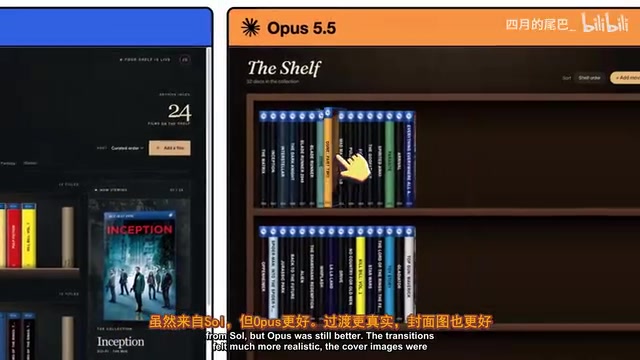
In the 3D Blu-ray collection task, Sol actually performed well — solid 3D positioning and practical utility, earning genuine praise from the creator. But Opus delivered smoother transitions, crisper cover art, and better use of detail — earning the creator's description of it as "the king of frontend interfaces." In the final task, a modern Obsidian clone (with Markdown, animations, and an OpenCode SDK Agent), Sol was feature-complete and not a failure by any means, but the visuals again fell back to generic territory. Opus was overall closer to the intended vision. Across all four long-horizon tasks, Opus basically swept.
"Long Horizon" tasks represent an increasingly important dimension in AI evaluation. They require models to sustain coherent, multi-step work within a single conversation — for example, completing a runnable application end-to-end, from requirements analysis and API design to frontend implementation and error handling. Unlike single Q&A or code snippet generation, long-horizon tasks amplify a model's tendency to "lose the thread" or forget early constraints: the more complex the task, the more likely the model is to drop features, shift style mid-way, or leave key behaviors unimplemented near the end. This explains why even when short-task gaps are manageable, Opus nearly swept all four long-horizon tasks. Stronger instruction-following and higher completion rates compound as the task chain grows longer.
How to Choose: The Hidden Bill Is Repair Time
The creator's final verdict is refreshingly pragmatic: for this kind of development work, they personally prefer Opus 5.5, because it consistently delivers more complete results and saves significant downstream repair time. They emphasize that the choice isn't about which screenshot looks better — Opus's elevator simulation wasn't visually impressive, but the mechanics worked; Sol's Blu-ray app felt cohesive and deserved credit too.
On Sol's pricing, the creator doesn't dismiss its appeal: if your tasks are straightforward, you're running batch API jobs, and you're cost-sensitive, Sol's half-price rate is genuinely worth considering. But the key point is this — when a frontend falls short or a critical interaction is missing, cheap tokens don't help, because fixing the output costs more time. And that "total repair cost" usually isn't included in the comparison.
In short: Sol wins on unit price, Opus wins on completion rate and reliability. For developers who need to get it right the first time and minimize rework, Opus 5.5 is the safer choice right now. For budget-constrained, well-scoped batch scenarios, Sol still has a competitive case.
"Total Cost of Repair" is a frequently overlooked dimension when evaluating a tool's real-world value in software engineering. It refers to the additional time and effort a developer must invest after receiving model output to bring it to a usable state. API pricing comparisons typically only count token consumption — but if the output has clipping artifacts, missing features, or a subpar frontend, the developer needs to debug, re-prompt, or manually fix things. In batch or deadline-driven scenarios, those time costs can far exceed the tokens saved. This framing shifts the model selection question from "how much per million tokens" to "how much does it actually cost to complete work of equivalent quality" — and for teams focused on development velocity, the latter is the more honest measure.
Related articles

Chain of Thought Isn't Just for AI: How Humans Can Use CoT to Improve Thinking Quality
Chain of Thought isn't just a prompt trick for large models. Starting from a Hacker News discussion, this article analyzes why CoT works for human thinking too, breaks down actionable ways to transfer it, and highlights the key differences between human CoT and machine CoT.
Cloudflare Teams Up with OpenAI: Closi…
Cloudflare Teams Up with OpenAI: Closing the Loop from Vulnerability Discovery to Defense with AI
Cloudflare uses OpenAI Daybreak to investigate security vulnerabilities and generate reviewable remediation plans, while developers use Codex to boost coding efficiency and quality.

Orca Multi-Agent Orchestration in Practice: A Guide to Parallel Collaboration with Claude and Codex
Orca is Stable AI's free open-source agent workbench supporting 34 agents like Claude Code and Codex in parallel. Learn its Git worktree isolation, multi-model orchestration, and mobile management.