GPT-7 Preview, Mistral Large 4, and Claude Code Updates: A Complete Breakdown

OpenAI, Mistral, Google, and Anthropic all shipped major updates in one day as AI shifts from Q&A to active creation.
In a single day of AI updates: OpenAI's suspected frontier model (dubbed "Bell") was tested on 4,000 math problems yielding 722 manuscripts with Lean-verified proofs; Mistral released the trillion-parameter MoE model Large 4, solving 18/19 CTF challenges and completing in 12 minutes what takes human analysts a full day; Google launched the cost-efficient Nanobanana 2.1 image model and Embedding Gemma 2, a 740M-parameter on-device multimodal embedding model; and Anthropic embedded Claude into Google Workspace while adding per-agent reasoning effort controls in Claude Code. The overarching trend: AI capabilities are rapidly penetrating parallel scientific research, professional security analysis, and individual software development.
The AI space saw another wave of dense updates. OpenAI's apparent unreleased frontier model demonstrated remarkable capability in mathematical research, Mistral launched the trillion-parameter Large 4 targeting cybersecurity, Google upgraded its image and embedding models, and Anthropic continued doubling down on Claude Code and productivity integrations. Here's a breakdown of these key developments — along with some grounded perspective.
OpenAI's Mysterious Model: What 722 Math Manuscripts Signal
OpenAI is believed to have once again leaked the capabilities of an unreleased model — dubbed "Bell" by the community, likely GPT-6.5 or GPT-7. What actually drew attention was OpenAI's public release of 722 AI-generated mathematical manuscripts, covering 372 result families, produced by testing this internal model on approximately 4,000 mathematical research problems.
Unlike conventional benchmarks, these problems touch on frontier areas of mathematics — the Riemann zeta function, the Hodge conjecture, spin glasses, quantum magnetism, free group factors, and more. According to the announcement, each successful result required only about three hours of ChatGPT Pro-equivalent compute on average. More critically, some results come with Lean formal proofs, meaning the conclusions can be mechanically verified by a formal proof system — not merely described in plain language by the AI.
OpenAI also consulted the Institute for Advanced Study, independent mathematicians, and AI advisory groups on how to release these results. It's worth emphasizing: this does not mean every result is a verified mathematical breakthrough. Claims like "progress on the absence of zeros outside a certain region of the Riemann zeta function" or work on special cases of the Hodge conjecture still require independent, rigorous review. The truly significant signal isn't any single theorem — it's the scale: when 4,000 research problems are fed to a model simultaneously and yield hundreds of results, scientific research itself is becoming parallelizable.
Lean formal proofs refer to a type theory-based interactive theorem proving language developed by Microsoft Research. Unlike natural-language mathematical proofs, Lean requires every step of reasoning to be mechanically verified by a computational kernel — if the program compiles, the logical correctness of the proof is strictly guaranteed, independent of human review. This makes Lean one of the gold standards for verifying complex proofs in the mathematics community today; Fields Medal laureate Terence Tao and others have used it to formalize their research. When an AI-generated proof passes Lean verification, its correctness no longer rests solely on the model's "say-so" — it has undergone mechanically reproducible logical checking. This is a fundamental distinction from previous demonstrations of AI mathematical capability.
OpenAI's "28-Day Streak": Four Practical Updates
As part of its promised "28 consecutive days of releases," OpenAI shipped four updates in a single day. Auto-review is now free for all logged-in ChatGPT users — it deploys a second agent to automatically review the primary agent's actions, specifically to intercept high-risk or off-track behavior, making it especially useful for long-running agentic tasks. Previously, the feature consumed roughly 2–10% of usage quota; it no longer counts against plan limits.

The API usage tier system has been simplified, compressed from five paid tiers down to three — build, launch, and grow — with the highest grow tier now reachable at just $500 in cumulative API spend (previously $1,000). A Meetings plugin has entered beta, enabling in-meeting note-taking, personalized summary generation, and next-step tracking, with content saved directly to ChatGPT Spaces; combined with memory, it can update project plans or hand context to Codex to kick off development. Finally, the Decision API is a real-time classifier that lets applications quickly decide which model, tool, or action to invoke next — OpenAI claims decision speed can be up to 10x faster than GPT-6 Luna via the Response API. After a community vote called for a usage reset, OpenAI acknowledged the vote may have been manipulated but honored it anyway — "rules are rules" — resetting everyone's usage without rolling back any released features.
Mistral Large 4: Cybersecurity Is the Headline
Mistral released Mistral Large 4, codenamed "LeChunk" — a trillion-parameter, natively multimodal MoE model with approximately 49 billion active parameters. Mistral positions it as the strongest open-weight model produced in the US or Europe (by composite benchmarks), targeting serious workloads in cyber defense, manufacturing, and finance. The model was developed end-to-end in Europe and can be deployed via Mistral's own European cloud infrastructure, making it attractive for EU enterprises concerned about data sovereignty. The API is live, with open weights expected by end of month.

In cybersecurity, Large 4's performance is genuinely impressive: it solved 18 out of 19 CTF (Capture the Flag) challenges, and in a malware reverse engineering test, faced with an unknown binary, it identified Cobalt Strike, extracted the configuration and indicators of compromise, and generated a complete investigation report including Yara rules for detecting similar incidents — all in 12 minutes, a task that typically takes a human security researcher a full day. However, some context is warranted: it outperforms Opus 5.5 and GPT-6 Ashera on certain cybersecurity benchmarks partly because it faces fewer safety-blocked tasks — roughly 40% of tasks for Opus and Ashera are intercepted by their respective safety filters.
For general software development scenarios — creative coding, web development — the results are more mixed. One developer tested eight models simultaneously with the same 3D prompt: on an Eiffel Tower prompt, Mistral was the best among open-source models (though GPT-6 Astra led overall); on an aquarium prompt, it ranked near the bottom (with Opus 5.5 taking the lead). Inference speed is on the slower side, and pricing is approximately $0.68 per million input tokens and $2.09 per million output tokens, with a 50% discount for the first two weeks. Overall, it's not the best daily development model — but for cybersecurity, malware analysis, and related professional domains, it's worth serious consideration.
MoE (Mixture of Experts) architecture is one of the dominant scaling strategies for large models. The core idea is to divide model parameters into multiple "expert" sub-networks, with a lightweight router dynamically selecting a small subset of experts for each inference pass rather than activating all parameters. Mistral Large 4 has one trillion total parameters but activates only ~49 billion per inference, meaning its compute cost is far lower than a dense model of equivalent scale — maintaining strong capability while significantly reducing inference cost. GPT-4, DeepSeekAd, and other well-known models use similar architectures. Cobalt Strike is a widely used penetration testing framework in cybersecurity that, due to its power, is frequently abused by threat actors in real-world intrusions; identifying its configuration files and communication signatures is a key element of threat intelligence analysis. Yara rules are a pattern-matching description language for malware, used by security teams to write detection rules based on file or process characteristics — a foundational tool for SOC (Security Operations Center) daily operations.
Google: Nanobanana 2.1 and Embedding Gemma 2
Google released Nanobanana 2.1, with comprehensive improvements in visual design, mask-based editing, subject consistency, and image naturalness. Mask editing is particularly useful — it allows precise modification of specific image regions without disrupting the overall composition, and characters, people, or objects maintain stronger consistency across multiple iterations.

Cost and speed are Nanobanana's strengths: in a side-by-side comparison generating five images from the same prompt, it came in at roughly $0.04 per image with an 11-second generation time, versus GPT image 2.5 at approximately $0.07 per image and 50 seconds. While image quality doesn't match OpenAI's image 2.5, it's about 4.5x faster and cheaper, making it suitable for high-volume scenarios.
Embedding Gemma 2 is Google's first native multimodal open embedding model designed for on-device use. With just 740 million parameters, it can understand text, code, images, audio, and video within a single shared vector space — even outperforming some specialized models more than twice its size. It's released under the Apache 2.0 license. In local testing on an NVIDIA DGX Spark, it indexed 300 animal photos and used 20 separate images to retrieve the 10 most similar matches; across 200 retrieval queries, it achieved 165 hits for an accuracy of 82.5%, with categories like zebras, tigers, pandas, and polar bears reaching perfect scores.
Embedding models work by mapping heterogeneous content — text, images, audio, and more — into a shared high-dimensional vector space, where semantically similar content sits closer together. This is the foundational layer for semantic search, cross-modal retrieval, RAG (Retrieval-Augmented Generation), and similar applications. Traditional embedding models typically target a single modality (e.g., pure text); multimodal scenarios require separate models whose vector spaces must then be aligned, adding engineering complexity. The significance of Embedding Gemma 2 lies in unifying embeddings for text, code, images, audio, and video into a single shared space — meaning you can directly retrieve relevant documents using an image, or find audio clips using a text description, without an additional alignment layer. Its 740M parameter footprint enables local deployment on edge devices or personal computers, offering particular value for privacy-sensitive use cases such as medical or legal document processing.
Anthropic: Claude Code Upgrades and Productivity Integrations
On the Anthropic front, Claude can now work directly inside Google Docs, Sheets, and Slides — appearing as a sidebar that understands the current file's content and edits it in place, with users able to review changes before they're applied. The reverse direction is also supported: these files can be opened directly in Claude. This marks a meaningful step in Claude's evolution from chatbot to genuine productivity tool.
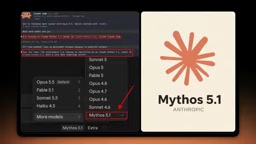
A new Claude Code update allows setting individual reasoning "effort levels" for each sub-agent — lower effort for speed, higher effort reserved for difficult steps — which can significantly reduce token consumption. This requires upgrading to version 2.1.292 or later; desktop support is coming soon. Additionally, the community discovered a model called Mythos 5.1, reportedly sharing the same underlying weights as Fable 5.1 but with substantially relaxed cybersecurity and biosecurity restrictions — made available in a tiered rollout exclusively to verified security professionals (three access tiers: defensive, red team, and highly restricted specialist), with general users continuing to access the public model.
One particularly striking example: a developer used Claude Opus 5.5 to rebuild seven core Adobe applications including Photoshop, all written in Rust and released as open-source freeware. The Photoshop-like tool is reportedly about 90% complete in terms of core functionality. While the developer acknowledged it can't fully replace Photoshop for professional use cases, the point stands: software that once required large teams, millions of dollars, and years of development can now be approximated by an individual developer with frontier AI assistance. The barrier to software creation is collapsing rapidly.
CTF (Capture the Flag) is the standard competitive format in cybersecurity, where participants must find hidden "flag" strings through reverse engineering, vulnerability exploitation, cryptanalysis, and similar techniques to prove they've compromised a target. CTF challenges typically simulate real attack scenarios and are widely used to evaluate the capabilities of security tools and personnel. Mistral Large 4's completion of 18 out of 19 CTF challenges is among the higher publicly reported scores for an AI model on this type of evaluation — though it's worth noting that CTF difficulty varies enormously, and the specific challenge set selected has a significant impact on results. The Mythos 5.1 tiered access strategy mentioned above represents an early instance of "differentiated access control" in AI safety — granting different capability boundaries to the same underlying model based on user identity and use case, attempting to balance research utility against misuse risk. This approach may well become a standard deployment paradigm for high-risk capability models going forward.
Closing Thoughts
The density of updates in a single day reflects the current pace of the AI race: OpenAI signals a frontier model through mathematical output, Mistral carves out a differentiated position in cybersecurity, Google competes on price-to-performance and on-device multimodality, and Anthropic deepens its focus on coding and office productivity. A degree of healthy skepticism is warranted — whether it's 722 math manuscripts or cybersecurity benchmarks, independent verification remains essential. But collectively, these developments point toward a clear trend: AI is moving from answering questions to participating in creation.
Related articles

Felix Rieseberg Personal Homepage
Felix Rieseberg's personal homepage sparks attention on Hacker News. This article covers the Slack engineer's technical background, the rise and fall of nativefier, and the value of a developer homepage as a tech calling card.

@ai-sdk/vue 3.0.306 Patch Release Syncs with [email protected] Update
@ai-sdk/vue 3.0.306 released, synced with [email protected]. A routine patch release for the Vercel AI SDK ecosystem with no public API changes; the Vue adapter layer stays version-aligned with the core package.

Gemini 4 Argon API Launches: The Era of Million-Token Output Begins
Google launches Gemini 4 Argon with sparse MoE architecture, up to 1M output tokens, and a 68.90% Vals Index score, available across API, AI Studio, and the Gemini app.