GPT_API_free: Complete Guide to Free ChatGPT/DeepSeek and Other LLM API Access
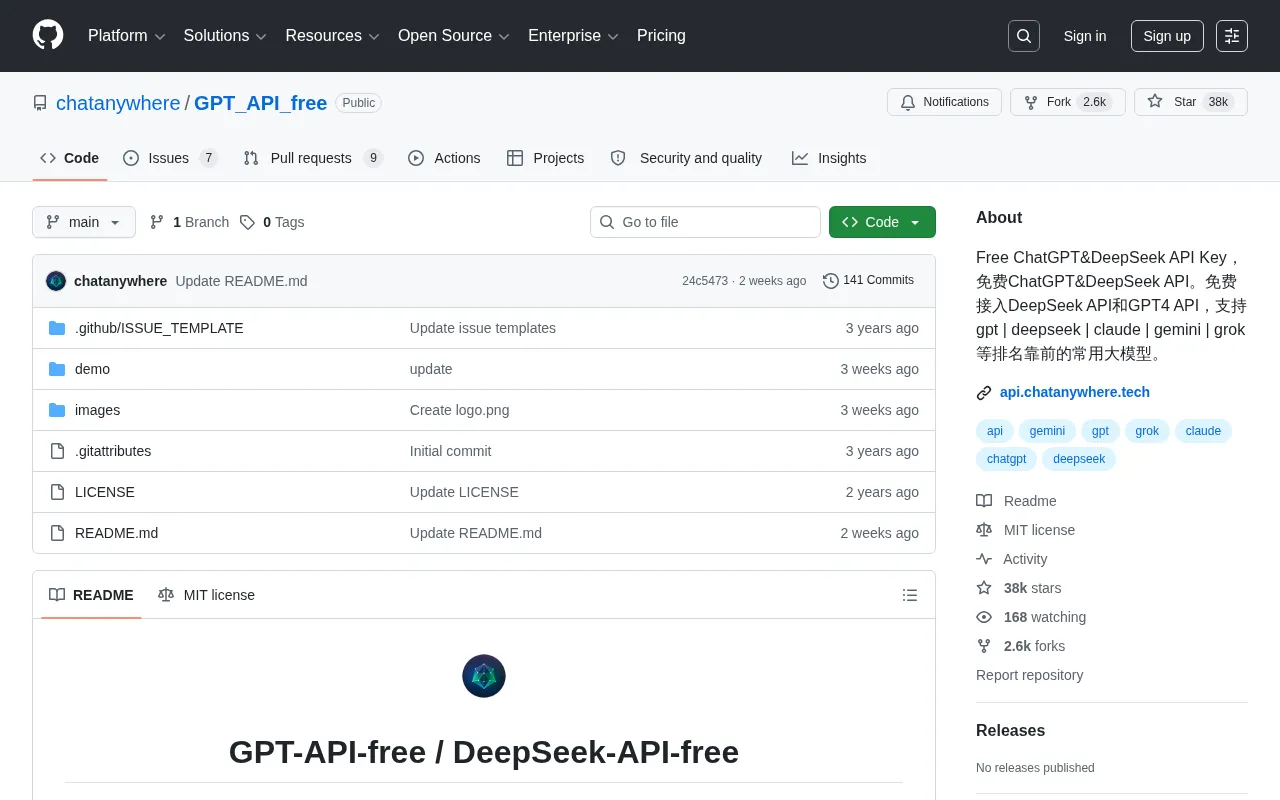
GPT_API_free provides free multi-model API aggregation to reduce AI development costs
The GitHub open-source project GPT_API_free (37,700+ Stars) provides developers with free API Keys, aggregating five major LLM families — GPT-4, DeepSeek, Claude, Gemini, and Grok — through a unified OpenAI-compatible interface. It solves the problems of high API call costs and the hassle of registering across multiple platforms, essentially functioning as an API Gateway handling protocol translation, request routing, and other responsibilities.
GPT_API_free Project Overview: A Free LLM API Solution with 37,700+ Stars
In AI application development, API call costs remain an unavoidable challenge for developers. Current mainstream LLM APIs universally adopt a token-based pricing model — charging based on the number of input and output text tokens.
Understanding the Underlying Logic of Token Pricing: A token is the basic unit that large language models use to process text. Unlike the intuitive human concept of "characters" or "words," tokens are determined by a tokenizer — in English, one token corresponds to roughly 0.75 words, while in Chinese, one character typically maps to 1-2 tokens. OpenAI uses the tiktoken tokenizer based on the BPE (Byte Pair Encoding) algorithm, which compresses high-frequency character combinations into single tokens to balance vocabulary size and encoding efficiency. More critically: the model processes not only the question you send, but the entire conversation history (all messages within the Context Window), meaning token consumption in multi-turn conversations grows linearly with each turn, and API costs for long conversations far exceed those of single Q&A exchanges.
Take OpenAI's GPT-4o as an example — input pricing is approximately $2.5 per million tokens, and output pricing is approximately $10 per million tokens. The higher-end GPT-4 Turbo once cost as much as $10/million tokens for input and $30/million tokens for output. For developers who need to iterate and test frequently, a few dozen calls per day could easily amount to tens of dollars. This doesn't even account for the separate billing systems and top-up thresholds of Claude 3.5 Sonnet, Gemini Pro, and other models.
The open-source project chatanywhere/GPT_API_free on GitHub offers a practical solution — free access to multiple mainstream LLM APIs. It has already garnered over 37,700 Stars and 2,625 Forks, making it one of the most popular open-source projects in this space.
The core idea behind this project is straightforward: provide developers with free API Keys supporting ChatGPT, DeepSeekAd, Claude, Gemini, Grok, and other major large language models, allowing you to run through AI application development and testing workflows without spending a dime.
Which LLMs Are Supported? Covering Five Major Model Families
Multi-Model Aggregation: One Key to Call All Major LLMs
GPT_API_free supports models covering the most representative camps in the current AI landscape:
-
OpenAI Series: GPT-4, ChatGPT, and more — the benchmarks of the LLM field. OpenAI's GPT series is based on autoregressive language models built on the Transformer architecture. From GPT-3's 175 billion parameters to GPT-4's multimodal capabilities (supporting image input), it has consistently led the industry. GPT-4 delivers the most balanced performance in reasoning, code generation, and complex instruction following, making it the default baseline model for most developers.
-
DeepSeek: A Chinese-developed LLM that has shown impressive recent performance with exceptional cost-effectiveness. Developed by DeepSeek AI, its DeepSeek-V3 employs a Mixture of Experts (MoE) architecture — a key technical breakthrough in recent large model scaling. Unlike traditional Dense models that activate all parameters during inference, MoE distributes parameters across multiple "expert" sub-networks, with a lightweight Router/Gating Network dynamically selecting the most relevant few experts for each inference pass. DeepSeek-V3 has a total parameter count of 671 billion, but only activates approximately 37 billion parameters per inference — inference costs are comparable to a Dense model of equivalent active parameters, yet model capacity far exceeds the latter. DeepSeek-R1 focuses specifically on reasoning capabilities, achieving mathematical and programming reasoning levels approaching OpenAI's o1 through reinforcement learning training, while API pricing is merely a fraction of GPT-4's — earning it the industry nickname "price killer."
-
Anthropic Claude: Outstanding in long-text processing and safety. Claude is developed by Anthropic, founded by former OpenAI researchers. Its core technical feature is Constitutional AI — an AI alignment training method that internalizes predefined "constitutional principles" (harmlessness, honesty, helpfulness) through a two-stage process: first, supervised learning teaches the model to critique and revise its own outputs based on principles, then reinforcement learning is conducted using AI-generated preference data. Compared to traditional RLHF, this approach reduces dependence on human annotation of harmful content while making model values more transparent and interpretable — this is the technical foundation behind Claude's strong reputation for safety and controllability. Claude 3.5 Sonnet supports a 200K token ultra-long context window (approximately 150,000 words), making it particularly suitable for long document analysis, codebase comprehension, and similar scenarios.
-
Google Gemini: Google's latest-generation multimodal LLM. Gemini was designed from the ground up as a natively multimodal architecture, capable of simultaneously understanding and generating text, images, audio, video, and code. Gemini 1.5 Pro supports a context window of up to 1 million tokens, the longest among currently publicly available models, making it ideal for processing ultra-long documents and complex multi-turn conversations.
-
xAI Grok: The AI model under Elon Musk's umbrella. Grok is developed by xAI, with its unique advantage being real-time access to the X (formerly Twitter) platform's data stream for the latest internet information. Grok 2 excels in mathematical reasoning and code generation, and xAI has also open-sourced the early version Grok-1's 314 billion parameter weights.
Developers don't need to register separate accounts on each platform or deal with different authentication processes — they can call all models through a unified interface.
Technical Advantages of a Unified API Interface
The technical foundation of a unified API interface is that the OpenAI API format has become the de facto industry standard. Most LLM providers (including domestic ones like Tongyi Qianwen and Zhipu GLM) offer OpenAI-compatible API endpoints, with a unified request format of /v1/chat/completions, using the same JSON structure to pass messages, temperature, max_tokens, and other parameters.
GPT_API_free is essentially an API Gateway — a core component in microservices architecture that serves as a unified entry point between clients and backend services. In this context, it handles protocol translation, request routing, load balancing, authentication, and rate limiting/circuit breaking. When a developer sends a standard OpenAI-format request, the gateway identifies the target model based on the model parameter, forwards the request to the corresponding official API endpoint (such as Anthropic's /v1/messages or Google's generateContent interface), and then converts the response back into a unified OpenAI-compatible format before returning it to the caller. This "adapter pattern" approach significantly simplifies multi-model integration for developers.
Related articles
 Product Reviews
The Programmer's Desk Setup Guide: Building a Workspace That Feels Like Home
Discover how programmers build productive, comfortable workspaces. From multi-monitor setups to ergonomic design, explore the desk philosophy that drives focus and flow.
 Product Reviews
Qoder vs Cursor Real-World Comparison: Which $20/Month AI IDE Is Better?
Hands-on comparison of Qoder vs Cursor AI IDEs: Agent autonomy, human interaction count, and architecture decisions. Qoder needed only 2 interactions vs Cursor's 8.
 Product Reviews
Cursor Cloud Agent Demo: Eliminating Bottlenecks Across the Entire Software Development Lifecycle
Deep analysis of Cursor's Cloud Agent demo showing how cloud VMs, automated test artifacts, and a full-chain control plane systematically eliminate human bottlenecks across the software development lifecycle.