GPT_API_free: Tutorial for Free Access to ChatGPT, DeepSeek, and Other LLM APIs
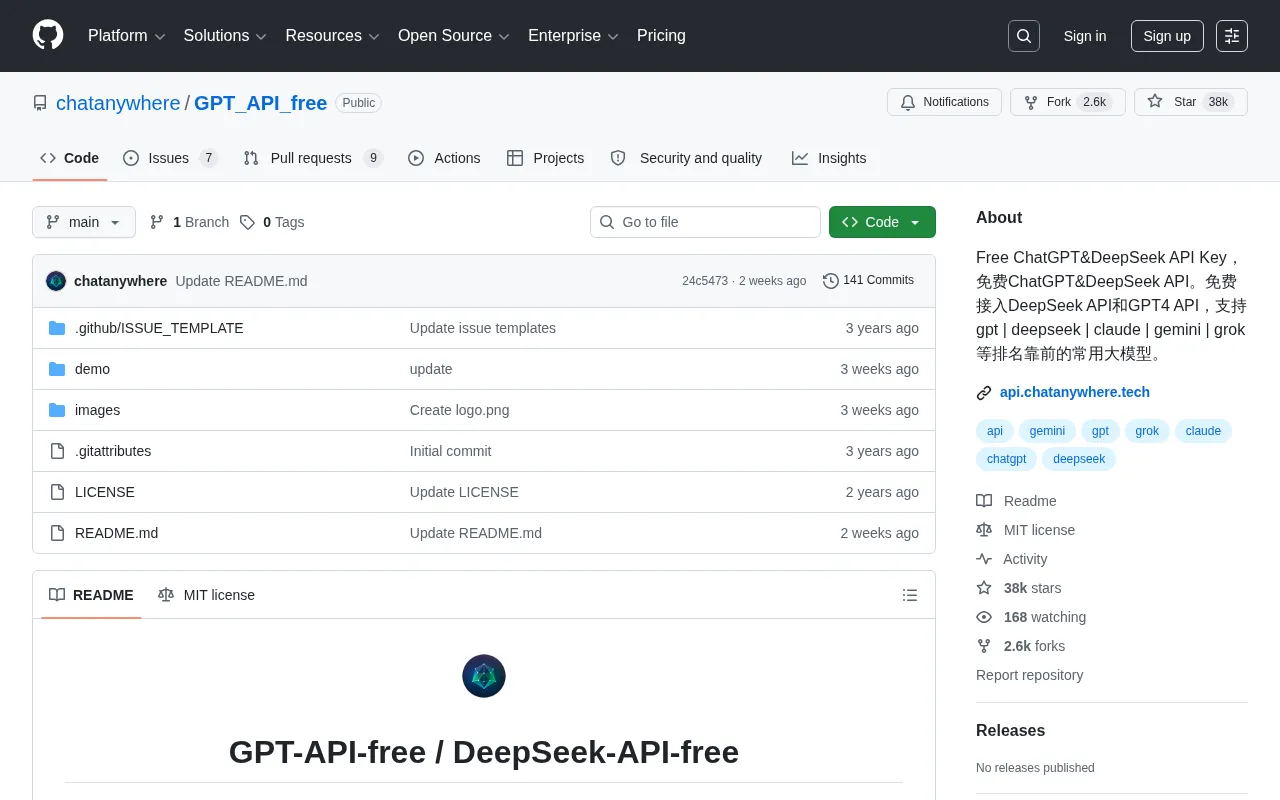
GPT_API_free provides free API access to mainstream LLMs via an open-source solution
The GitHub open-source project chatanywhere/GPT_API_free (37,700+ Stars) provides developers with free API Keys to access GPT-4, DeepSeek, Claude, Gemini, Grok, and other mainstream LLMs through a unified interface, solving the pain points of high API costs and complex registration processes faced by individual developers and students.
Project Overview
High API costs and complex registration processes have long been pain points for individual developers and students. Take OpenAI's GPT-4 Turbo as an example — input pricing is approximately $10 per million tokens, while output pricing is around $30 per million tokens. Tokens are the smallest units of text that models process; one English word corresponds to roughly 1-2 tokens, and one Chinese character typically maps to 1-3 tokens. A single conversation may consume hundreds to thousands of tokens, and during development and debugging phases where you need to make hundreds or even thousands of API calls, costs accumulate rapidly. For students and independent developers, spending tens to hundreds of dollars per month on API usage is a significant burden.
Interestingly, token segmentation isn't a simple character-by-character or word-by-word process. Mainstream models use BPE (Byte Pair Encoding) or similar subword tokenization algorithms to split text into frequently occurring character combinations. For example, "unhappiness" might be split into two tokens: "un" and "happiness," while rare vocabulary may be broken into more fragments. Chinese, due to its large character set and lack of natural whitespace delimiters, typically has lower token efficiency than English — the same semantic content in Chinese often consumes 1.5 to 2 times more tokens than in English. This is the technical reason why Chinese users often face higher actual API costs than English users. OpenAI provides the open-source tiktoken library, allowing developers to estimate token consumption before making calls for better cost control.
The open-source GitHub project chatanywhere/GPT_API_free offers a solution for free access to mainstream LLM APIs. It has currently earned over 37,700 Stars and 2,600+ Forks, making it one of the most popular open-source projects in the free AI API space.
The project's core functionality is straightforward: it provides developers with free API Keys to call ChatGPT, DeepSeekAd, Claude, Gemini, Grok, and other mainstream large language models through a unified interface, eliminating the hassle of registering on multiple platforms separately.
What Models Does GPT_API_free Support?
Comprehensive Coverage of Current Mainstream Models
GPT_API_free supports an impressively comprehensive lineup of models, covering essentially all the hottest LLMs from 2024-2025:
-
GPT Series: The full range of OpenAI models including GPT-4 and GPT-4o — currently the most widely used commercial LLMs. GPT-4 was released in March 2023 and showed significant improvements over GPT-3.5 in reasoning ability, instruction following, and multimodal understanding. GPT-4o ("o" stands for "omni") was released in May 2024 as a multimodal-enhanced version of GPT-4, capable of natively processing text, image, and audio inputs with dramatically improved response speed. The GPT series is built on the Transformer architecture, optimized through pre-training on massive text datasets and alignment via Reinforcement Learning from Human Feedback (RLHF) to make outputs better match human expectations.
It's worth diving deeper into RLHF (Reinforcement Learning from Human Feedback), which is the core technical pathway for achieving "alignment" in current mainstream LLMs. The basic process consists of three stages: first, unsupervised pre-training on massive text to learn language patterns; then supervised fine-tuning (SFT) using high-quality human-annotated examples; and finally, training a reward model to simulate human preference scoring, followed by optimizing the language model using reinforcement learning algorithms (typically PPO) to make outputs better align with human expectations. This technique was systematically described by OpenAI in the InstructGPT paper and has since been widely applied to models like GPT-4 and Claude. RLHF's limitations include high annotation costs and annotator bias, which is why Anthropic proposed Constitutional AI as a supplement, and DeepSeek-R1 explored a new path of stimulating reasoning capabilities through pure reinforcement learning, reducing dependence on human annotation.
-
DeepSeek: A leading Chinese LLM known for its outstanding cost-performance ratio and reasoning capabilities. Developed by DeepSeek (深度求索), its core technical highlight is the Mixture of Experts (MoE) architecture — while the model has an enormous total parameter count (e.g., DeepSeek-V3 has 671 billion parameters), only a small subset of expert networks is activated during each inference, dramatically reducing computational costs while maintaining high performance. For DeepSeek-V3 specifically, although it has 671 billion total parameters, only about 37 billion parameters are activated per token during inference, achieving extremely high computational efficiency.
The MoE architecture wasn't invented by DeepSeek — the concept dates back to 1991 academic research — but it was revitalized in the LLM era by projects like Google's Switch Transformer and Mixtral. The core idea of MoE is replacing the feed-forward network layers with multiple "expert" sub-networks and introducing a lightweight "Router" network that dynamically determines which experts should process each token. This sparse activation mechanism allows models to scale total parameters without linearly increasing inference computation, achieving "large but not slow." DeepSeek-V3's innovations in MoE implementation include fine-grained expert segmentation and an auxiliary-loss-free load balancing strategy, effectively solving the expert load imbalance problem in traditional MoE. DeepSeek-R1 achieved breakthroughs in reasoning capability using a long-reasoning mechanism similar to Chain-of-Thought. DeepSeek's open-source strategy and highly competitive API pricing have had a profound impact on the industry's pricing structure.
-
Claude: Anthropic's LLM, known for its excellence in long-context processing and safety. Claude 3.5 Sonnet supports a 200K token context length, meaning it can process approximately 150,000 characters of text at once — equivalent to a medium-length book. This makes Claude particularly strong in scenarios like long document analysis, codebase comprehension, and academic paper reviews. Anthropic has also proposed "Constitutional AI
Related articles
 Product Reviews
The Programmer's Desk Setup Guide: Building a Workspace That Feels Like Home
Discover how programmers build productive, comfortable workspaces. From multi-monitor setups to ergonomic design, explore the desk philosophy that drives focus and flow.
 Product Reviews
Qoder vs Cursor Real-World Comparison: Which $20/Month AI IDE Is Better?
Hands-on comparison of Qoder vs Cursor AI IDEs: Agent autonomy, human interaction count, and architecture decisions. Qoder needed only 2 interactions vs Cursor's 8.
 Product Reviews
Cursor Cloud Agent Demo: Eliminating Bottlenecks Across the Entire Software Development Lifecycle
Deep analysis of Cursor's Cloud Agent demo showing how cloud VMs, automated test artifacts, and a full-chain control plane systematically eliminate human bottlenecks across the software development lifecycle.