GPT Image 2 vs Nano Banana 2: E-commerce Image Generation Showdown Across 5 Key Scenarios

GPT Image 2 and Nano Banana 2 each excel in different Chinese e-commerce image generation scenarios
This article compares GPT Image 2 and Nano Banana 2 through five typical e-commerce scenarios. Results show GPT Image 2 excels in Chinese text rendering, consistency preservation, and avoiding hallucinated content—ideal for food and baby product categories sensitive to label accuracy. Nano Banana 2 performs slightly better in portrait quality and natural lifestyle scenes, suiting fashion and home decor categories. For production use, choose models based on category needs and adopt modular workflows for better controllability.
OpenAI recently released GPT Image 2, and many consider it a major leap beyond previous benchmark models in image generation. But how does it actually perform in the specific context of Chinese e-commerce?
This article presents a detailed comparison between GPT Image 2 and Nano Banana 2 based on hands-on testing across five typical e-commerce image generation scenarios. The results were surprising—each model has its strengths, and the right choice depends entirely on your specific needs.
Base Parameter Comparison
Before diving into the tests, let's look at the key parameter differences between the two models.
Generation Speed: Nano Banana 2 officially claims 3-5 seconds per image. In practice it's slightly longer, but still noticeably faster than GPT Image 2. As a branch of Thinking Mode, GPT Image 2 inevitably slows down due to its reasoning process. Thinking Mode is a technical paradigm introduced by OpenAI in reasoning models like o1 and o3—unlike traditional feed-forward generation, Thinking Mode performs multi-step internal reasoning before outputting results. The model first "thinks" about composition, element relationships, text layout, and other factors before performing pixel-level rendering. The advantage is better understanding of complex instructions and improved semantic consistency, but the trade-off is significantly increased inference time and computational resource consumption. This also explains why GPT Image 2 performs better in text rendering accuracy—it effectively performs logical validation on text content before generating the image.
Resolution & Reference Images: Both support up to 4K output. Image 2 supports up to 16 reference images, while Nano Banana 2 supports 14—a negligible difference. Pricing-wise, Nano Banana 2 costs $0.067 per thousand images, while Image 2 costs $0.04 per thousand, making the latter more cost-effective.
Ecosystem Integration: Nano Banana 2 was released earlier and has already been integrated into platforms like Vertex, Photoshop, Canva, and Figma. GPT Image 2, being newly released, is primarily integrated within OpenAI's own ecosystem—GPT, Codex, and API. This ecosystem difference has significant practical implications for e-commerce teams: if your team has already built design workflows around Canva or Photoshop, Nano Banana 2's integration advantage significantly reduces migration costs—designers can invoke model capabilities directly within familiar tools without switching environments. If your team prefers building automated image generation pipelines via API, GPT Image 2's OpenAI API ecosystem provides a more unified development experience. Notably, Vertex AI is Google's enterprise AI platform supporting model deployment, batch inference, and workflow orchestration, which is particularly important for e-commerce scenarios requiring large-scale batch image generation.
Test 1: E-commerce Poster Generation
The first test scenario involved generating a relatively simple e-commerce poster, with a low-resolution product image provided as reference.
Results showed that both models handled large text rendering without major issues, and basic elements like product shape, icons, and patterns were preserved. However, the key difference appeared in small text rendering—Nano Banana 2 exhibited noticeable problems with small text, performing clearly worse than GPT Image 2.
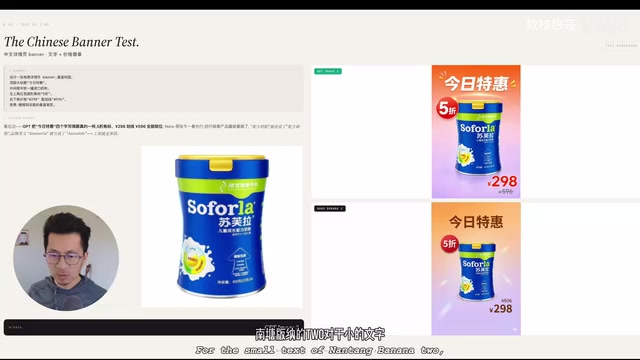
AI image generation models face far greater challenges with Chinese text than English. Chinese is a logographic writing system where each character consists of multiple strokes with complex and varied structures. The model needs to precisely reproduce the position, thickness, and connections of every stroke at the pixel level, rather than simply recognizing a linear arrangement of letters. Furthermore, Chinese characters demand higher legibility at small sizes—a single stroke deviation can transform a character into one with a completely different meaning. Current mainstream image generation models have far more English text than Chinese in their training data, resulting in generally weaker Chinese rendering capabilities. GPT Image 2's breakthrough in this area likely stems from the inclusion of extensive Chinese scene samples in training data, combined with the Thinking Mode's pre-validation mechanism for text content.
In terms of overall poster style, GPT Image 2 produced results that better matched the visual tone of agricultural e-commerce, with color palettes and layouts more suitable for actual use. GPT Image 2 wins this round decisively.
Test 2: Model Character Consistency
E-commerce frequently requires the same model to appear across different images, making character consistency crucial.
Character Consistency is one of the core challenges in AI image generation, academically referred to as Identity Preservation or Subject Consistency. The technical challenge lies in maintaining the same person's facial features (such as facial proportions, skin tone, face shape) across different poses, lighting conditions, backgrounds, and clothing. Earlier solutions relied on LoRA (Low-Rank Adaptation) fine-tuning or DreamBooth personalization techniques, requiring users to provide multiple reference photos for specialized model training. Newer generation models like GPT Image 2 and Nano Banana 2 attempt to achieve character consistency through zero-shot or few-shot approaches—reproducing the same character in entirely new scenes from just a few reference images. This places extremely high demands on the model's facial feature encoding and cross-scene generalization capabilities.
The test required generating photos of a young East Asian woman in different scenarios. Results showed both models interpreted the character reasonably well. AI analysis concluded the generated images weren't technically the same person, but from an average consumer's perspective, the differences were not obvious.
Notably, GPT Image 2 provides two options for users to choose from when generating composite photos, while Nano Banana 2 lacks this selection mechanism. However, in terms of overall character consistency performance, Nano Banana 2 has a slight edge.
Test 3: Nine-Grid Product Display
The nine-grid layout is standard for e-commerce product detail pages, and also the scenario most prone to failure in product consistency.
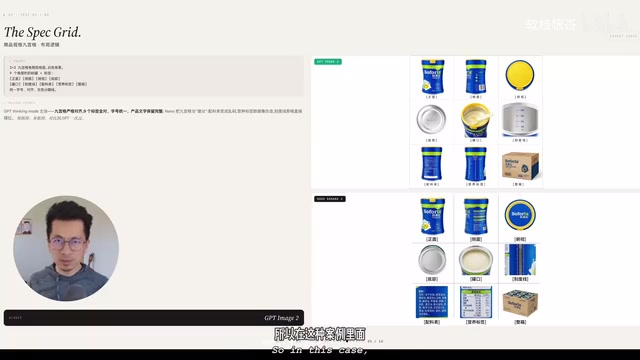
This test exposed a serious problem with Nano Banana 2: over-imagination. It fabricated formula tables, nutrition labels, and other content we never provided, generating large amounts of false text. For products like infant formula, where ingredients and nutritional information are extremely sensitive, this kind of fabrication is absolutely unacceptable.
This "over-imagination" is essentially a manifestation of hallucination—a widespread phenomenon in AI—applied to image generation. In large language models, hallucination manifests as fabricating non-existent facts; in image generation models, it appears as adding visual elements that don't exist in reference images. The root cause lies in the generative model's training mechanism—models learn statistical patterns from massive datasets to "complete" information. When input is insufficient (such as providing only a single low-resolution image), the model fills in gaps based on prior knowledge from training data. For strictly regulated categories like infant formula, pharmaceuticals, and supplements, AI-fabricated ingredient lists or nutrition labels could directly violate advertising laws and food safety regulations, creating serious legal compliance risks.
Admittedly, this test was somewhat unfair to AI models—generating a multi-angle nine-grid display from a single low-resolution product image without any interpolation is nearly impossible. In practice, providing richer prompts, multi-angle product images, or generating images individually and compositing them afterward would yield more reliable results.
GPT Image 2 wins this round, primarily because Nano Banana 2's over-imagination introduces uncontrollable risks.
Test 4: Lifestyle Scene Control
This test required models to place the product within a given scene layout, with accurate focus and natural integration.
Results showed Nano Banana 2 generated scenes with a more authentic lived-in feel, though the overall color tone was darker. GPT Image 2 presented a more "staged" style but with softer, more elegant lighting—potentially more appropriate for products like infant formula.
This round is subjective, but in terms of natural feel for lifestyle scenes, Nano Banana 2 has a slight advantage. The darker tone issue could theoretically be addressed through prompt optimization.
Test 5: Background Replacement & Text Consistency (Ultimate Test)
The final test was the ultimate challenge—product rendering after background replacement, with a focus on text consistency preservation.
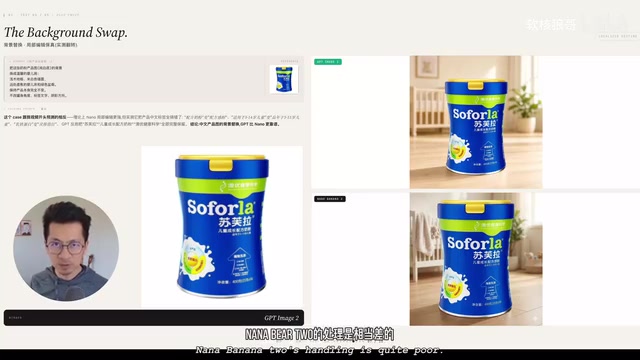
The results this round were abundantly clear—GPT Image 2 wins decisively. Specifically:
- Small text handling: Nano Banana 2 produced numerous strange "sweat stain"-like artifacts after re-rendering
- Numerical accuracy: The original text "suitable for children aged 3 to 14" was altered by Nano Banana 2 to "3 to 15," indicating the model was guessing rather than faithfully reproducing
- Chinese rendering: Most egregiously, the four characters "乳铁蛋白" (lactoferrin) were perfectly reproduced by GPT Image 2, while Nano Banana 2 rendered them as "灵异之味" (something like "supernatural flavor")—completely nonsensical
These issues once again confirm the technical difficulty of Chinese text rendering. When image generation models process text, they are essentially "drawing" text rather than "typesetting" it—the model doesn't truly understand character semantics but attempts to reproduce text patterns from training data in pixel space. When backgrounds change, the model must re-infer the pixel distribution of text regions, a process highly prone to stroke misalignment and character deformation. GPT Image 2's advantage here likely stems from additional semantic understanding and validation steps performed by its Thinking Mode before generation.
Overall Scores & Selection Guide
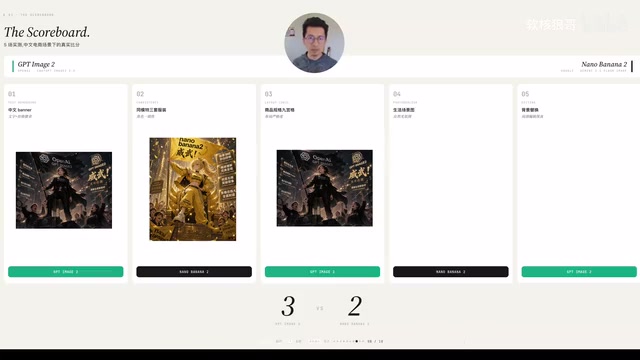
After five rounds of testing, we can draw the following conclusions:
| Test Scenario | Winner | Key Difference |
|---|---|---|
| Poster Generation | GPT Image 2 | More accurate small text rendering |
| Character Consistency | Nano Banana 2 | Slightly better portrait quality |
| Nine-Grid Display | GPT Image 2 | Doesn't over-imagine or fabricate content |
| Scene Control | Nano Banana 2 | More natural lifestyle scenes |
| Background Replacement | GPT Image 2 | Text consistency far surpasses competitor |
Selection Recommendations
Choose GPT Image 2 when: Your e-commerce images demand high fidelity in Chinese text reproduction (ingredient lists, efficacy descriptions, age labels, etc.). GPT Image 2 has a clearly higher success rate. This is especially critical for categories like food, supplements, and baby products where label information accuracy is paramount.
Choose Nano Banana 2 when: You prioritize natural lifestyle scene aesthetics and portrait quality. Nano Banana 2 has a slight edge here. It's well-suited for categories like fashion, home decor, and beauty that emphasize atmosphere.
Limitations to Note
These multimodal models now handle mainstream consumer products quite well, but still encounter various issues with industrial products or niche categories. In actual projects, you'll often need to combine different algorithms and workflows for optimization—relying on a single model rarely delivers perfect results in one shot.
Practical Workflow Recommendations
The "generate separately then composite" strategy mentioned multiple times in this article is actually one of the current best practices in e-commerce AI image generation. A mature e-commerce image generation workflow typically includes the following steps: First, use a segmentation model (such as Meta's SAM 2, RMBG, etc.) to precisely extract the product from the original photo. Then generate background scenes matching brand aesthetics through an AI generation model. Next, use image compositing techniques (such as Inpainting for local redrawing, Outpainting for expansion) to naturally integrate the product into the scene. Finally, enhance the final output's clarity through super-resolution models (such as Real-ESRGAN). This modular pipeline approach involves more steps, but each stage can be independently optimized and quality-checked, offering far greater controllability than end-to-end one-click generation solutions.
Additionally, providing high-resolution reference images, detailed prompt descriptions, and multi-angle product assets can all significantly improve generation quality. AI image generation isn't a "one-click magic" solution—it's a tool that requires carefully designed inputs to produce satisfactory outputs.
Key Takeaways
- GPT Image 2 significantly outperforms Nano Banana 2 in Chinese text rendering and consistency preservation, especially for small text and background replacement scenarios
- Nano Banana 2 has a slight advantage in portrait quality and natural lifestyle scene aesthetics, making it suitable for atmosphere-focused e-commerce categories
- Nano Banana 2 suffers from over-imagination (hallucination) issues, fabricating false ingredient lists and nutrition labels, posing legal compliance risks for sensitive categories like food and baby products
- Both models support 4K resolution output, but GPT Image 2 is slower due to its Thinking Mode mechanism
- For actual e-commerce image generation projects, choose models based on category characteristics and adopt modular workflows (segmentation → scene generation → compositing → super-resolution) to improve overall controllability and output quality
Related articles
 Product Reviews
The Programmer's Desk Setup Guide: Building a Workspace That Feels Like Home
Discover how programmers build productive, comfortable workspaces. From multi-monitor setups to ergonomic design, explore the desk philosophy that drives focus and flow.
 Product Reviews
Qoder vs Cursor Real-World Comparison: Which $20/Month AI IDE Is Better?
Hands-on comparison of Qoder vs Cursor AI IDEs: Agent autonomy, human interaction count, and architecture decisions. Qoder needed only 2 interactions vs Cursor's 8.
 Product Reviews
Cursor Cloud Agent Demo: Eliminating Bottlenecks Across the Entire Software Development Lifecycle
Deep analysis of Cursor's Cloud Agent demo showing how cloud VMs, automated test artifacts, and a full-chain control plane systematically eliminate human bottlenecks across the software development lifecycle.