GPT-Image2 Prompt Engineering: From 470+ Reverse-Engineered Cases to Industrial-Grade Templates

An open-source project engineering GPT-Image2 prompts with 470+ cases, 20+ templates, and composable Skills.
The awesome-gpt-image-2 GitHub project (12K+ stars) treats prompts as code assets, offering 470+ reverse-engineered cases, 20+ industrial-grade parameterized templates, and a composable Skills layer. Its layered methodology—from raw cases to reusable templates to atomic capabilities—brings software engineering best practices like version control, reusability, and collaboration to AI image generation workflows.
Prompting Is Evolving from Dark Art to Engineering Discipline
As image generation models make quantum leaps in capability, writing high-quality prompts has evolved from a dark art into a proper engineering discipline. The recently viral open-source project awesome-gpt-image-2 (by freestylefly) on GitHub embodies this trend perfectly. Built around the core philosophy of "Prompt as Code," it treats prompts as reusable, maintainable, and iterable code assets. In a remarkably short time, the project has amassed over 12,000 Stars, with single-day growth reaching 628 stars—demonstrating the community's strong demand for systematic prompt methodologies.
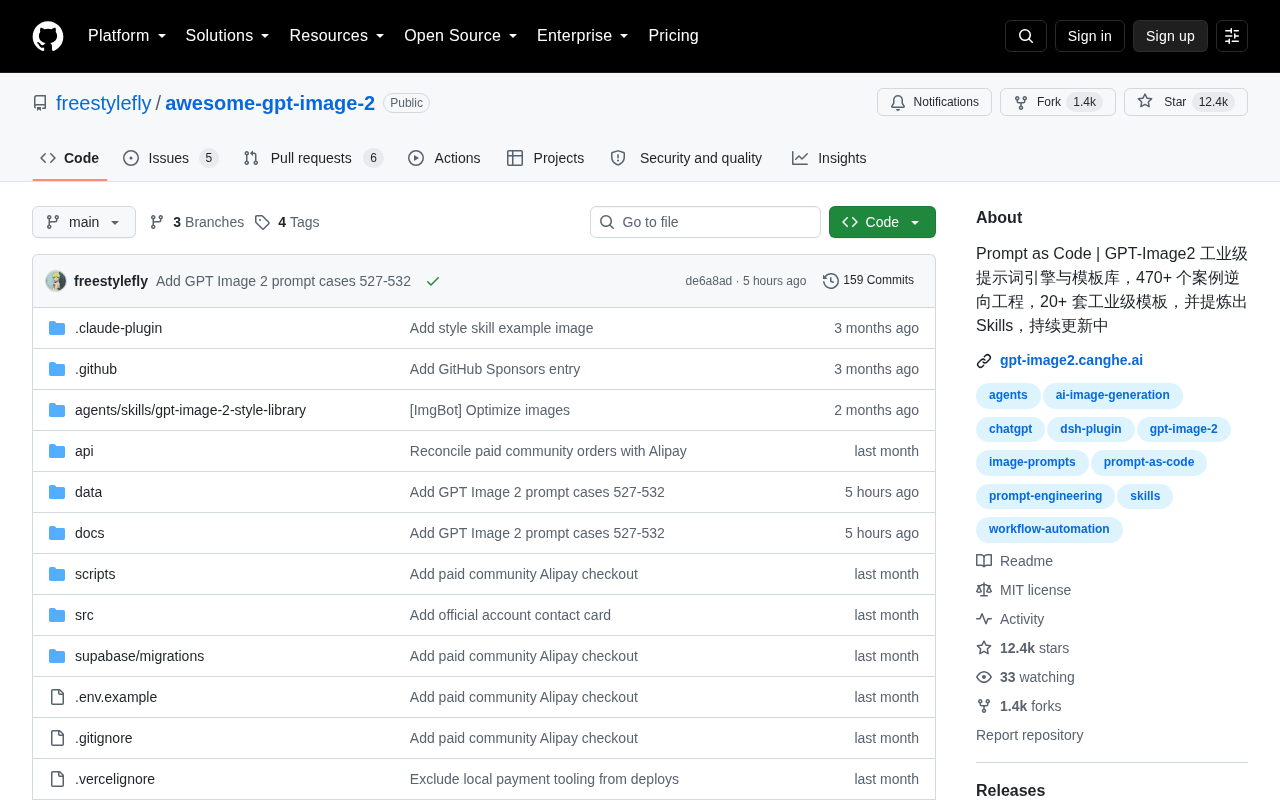
This project is far more than a simple collection of prompts. It builds a complete methodology around GPT-Image2's image generation capabilities: starting from reverse engineering a large number of real-world cases, distilling transferable templates and Skills, and ultimately forming a continuously updated "industrial-grade prompt engine."
It's worth noting that GPT-Image2 represents a significant iteration from OpenAI in image generation. Compared to the earlier DALL·E series, it demonstrates marked improvements in text rendering accuracy, instruction following, and complex scene composition. The core technical advantage of GPT-Image2 lies in its deep integration with large language models—it understands not just visual descriptions but also semantic context and logical relationships. This is precisely why the "Prompt as Code" engineering methodology is particularly effective with GPT-Image2: the model itself possesses the ability to understand structured instructions, which in turn demands more precise and systematic input from users.
Three Core Assets of the Project in Detail
470+ Reverse-Engineered Cases: Deducing Prompt Logic from Results
The most solid component of the project is its systematic reverse engineering of over 470 high-quality image generation cases. Reverse engineering here means working backward from excellent generation results to identify the underlying prompt structure, keyword weights, style descriptions, and parameter configurations. This "results-oriented" methodology is far more practical than writing prompts from scratch—it enables creators to stand on the shoulders of successful cases and understand "what kind of description produces what kind of effect."
Reverse Engineering in traditional software refers to deducing source code or design logic from compiled programs. Transplanting this concept to the prompt domain means starting from a high-quality AI-generated image and analyzing its likely description structure, keyword combinations, weight distributions, and parameter settings. This approach works because image generation models have relatively stable response patterns to different elements in prompts—specific lighting descriptions produce specific visual effects, specific camera language leads to specific compositions. Through systematic analysis of large numbers of cases, one can build a mapping relationship between "input" and "output."
For image generation, details determine success or failure. How to precisely express composition, lighting, materials, camera language, and artistic style in prompts often requires extensive trial and error. The case library accumulated through reverse engineering effectively converts these trial-and-error costs into publicly accessible, reusable knowledge.
20+ Industrial-Grade Templates: Parameterized Encapsulation of High-Frequency Scenarios
Building on the cases, the project further abstracts over 20 industrial-grade templates. Templatization is the key implementation of the "Prompt as Code" philosophy: it encapsulates high-frequency scenarios (such as product posters, portrait photography, illustration styles, UI design mockups, etc.) into parameterized structures where users only need to replace key variables to reuse the entire prompt logic.
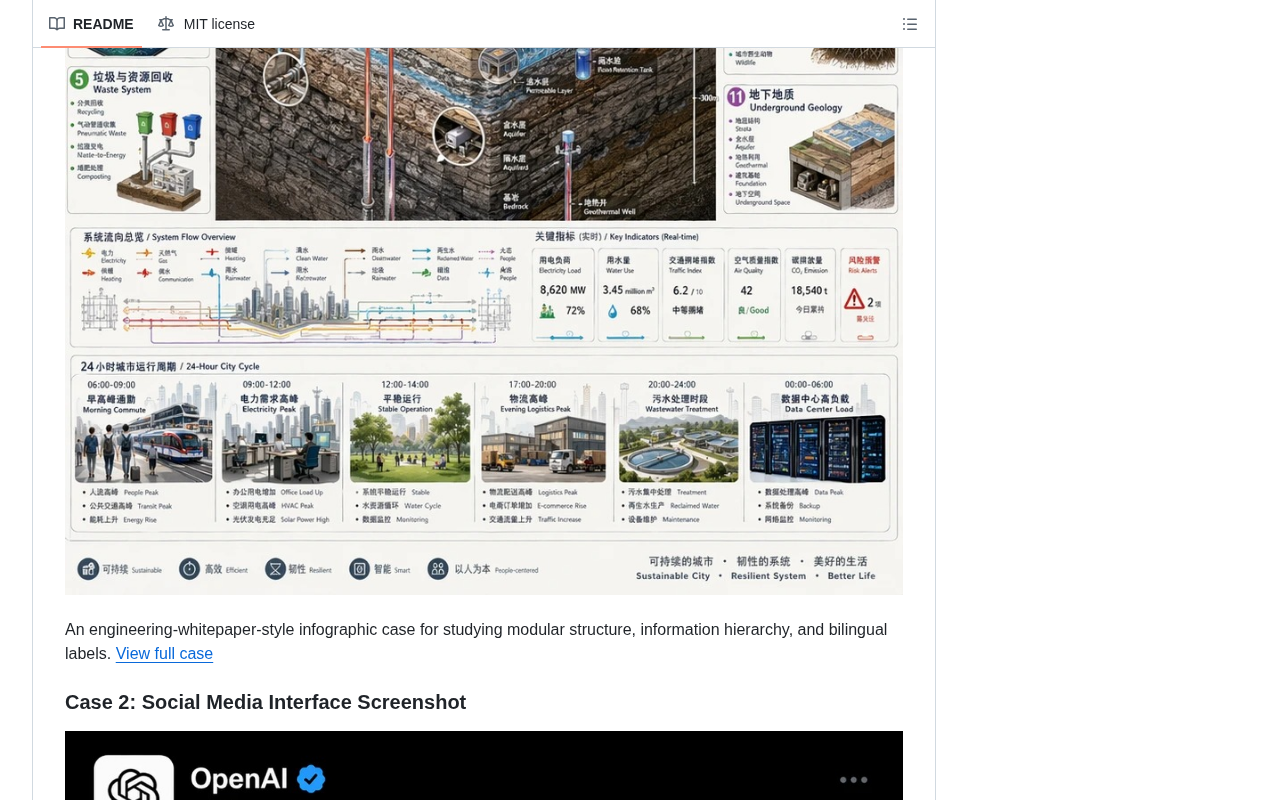
The core idea of parameterized templates derives from the Template Method Pattern and Parametric Design in software engineering. In the context of prompt engineering, parameterization means decomposing a complete prompt into "fixed structure" and "variable parameters." The fixed structure defines the overall style tone, composition logic, and output specifications, while variable parameters are specific details like subject, color, and scene. For example, a product poster template might fix structural descriptions like "minimalist style, centered composition, soft gradient background, professional product photography lighting," while "product type, brand color, copy content" are left as parameters to be filled in. This approach dramatically reduces the cognitive load of writing prompts from scratch.
This practice mirrors "function encapsulation" in software engineering—abstracting repetitive logic to lower the barrier to use while ensuring output quality stability. For teams and individuals who need to generate images at scale, industrial-grade templates offer particularly outstanding value.
Skills Layer: Composable Atomic Capability Units
The project further distills Skills from templates—capability units at a finer granularity than templates. Think of it this way: if templates are complete "solutions," then Skills are the "atomic capabilities" that constitute those solutions—such as how to precisely control lighting, how to describe the texture of specific materials, or how to achieve style transfer.
The Skills layer's design philosophy aligns with the concept of "Ontology" in knowledge engineering. In knowledge engineering, complex knowledge is typically decomposed into atomic-level concepts and relationships, then combined to express more complex semantics. In prompt engineering, a Skill may correspond to an independent visual effect control dimension—such as "cyberpunk neon glow," "macro photography shallow depth of field," or "watercolor bleeding edge treatment." These atomic capabilities can be freely combined like LEGO bricks to create entirely new effects not preset in the template library. This Composability is the key characteristic that distinguishes a simple prompt collection from a truly engineered system.
This layered design (Cases → Templates → Skills) reflects mature knowledge management thinking: the bottom layer is raw data (cases), the middle layer is solutions (templates), and the top layer is composable capabilities (Skills). Users can either directly apply templates for quick results or combine different Skills to address more complex, personalized creative needs.
Prompt as Code: A Paradigm Shift in AI Application Development
"Prompt as Code" is more than a slogan—it reflects a profound paradigm shift in AI application development. When prompts are managed as code, many best practices from software engineering are naturally introduced:
- Reusability: Invest once, use repeatedly, avoiding redundant work;
- Maintainability: When models iterate or requirements change, templates can be updated centrally;
- Collaboration: Team members share the same set of prompt assets, ensuring consistent output;
- Version control: Managing the evolution history of prompts just like managing code.
Treating prompts as code assets means the entire DevOps toolchain can be introduced to manage their lifecycle. Specifically, this includes: using Git for version control to track each prompt modification and its impact on output quality; using CI/CD pipelines for automated testing to ensure templates still produce expected results after updates; using A/B testing frameworks to compare performance of different prompt variants. In enterprise applications, this engineering management also involves governance requirements like access control, audit logs, and cost monitoring for prompts.
As AI generation capabilities grow increasingly powerful, prompt quality is becoming the key variable that differentiates output levels. The project uses JavaScript as its primary language, suggesting it's not merely documentation but likely includes a runnable prompt engine and toolchain—with built-in capabilities for prompt preprocessing, variable substitution, conditional branching, and other programming features. This makes prompts no longer static text but program logic that can be dynamically generated based on context, further reinforcing its "engineering" positioning.
Practical Implications for Creators and Teams
For content creators, designers, and product teams, projects like this offer a clear path to efficiency gains: instead of fumbling from scratch, you can directly leverage methodologies accumulated by the community. Especially in commercial image generation scenarios, output stability and controllability are often more important than a single "wow" moment, and templatization is an effective means of ensuring stability.
At the same time, this project serves as a window into the maturity of the AI application ecosystem. When more and more open-source projects begin systematically organizing, abstracting, and engineering AI usage experience, it signals that the industry is moving from the "novelty phase" to the "utility phase." Prompt engineering as an emerging discipline is seeing its methodologies rapidly crystallize and standardize.
Conclusion: Prompt Engineering Is a Required Course in the AI Era
With its solid case accumulation, clear layered design, and distinct engineering philosophy, awesome-gpt-image-2 has become a highly valuable open-source asset in the GPT-Image2 image generation space. It proves a trend: in the AI era, how to effectively leverage a model's capabilities is itself an engineering practice worth deep investment. For users seeking to improve output quality and efficiency in image generation, continuously updated community projects like this are undoubtedly precious resources worth long-term attention.
Related articles

Python 3.15 New Feature: Is the sentinel Type Better Than None?
Python 3.15 adds the sentinel type, using named unique sentinel objects to replace None and bare object(), resolving confusion among missing values, explicit emptiness, and invalid input while avoiding type hint failures.

Deep Learning's Three Architectures and the Universal Approximation Theorem: A Complete Guide to MLPs, CNNs, and Transformers
Explaining the inductive bias differences among MLP, CNN, and Transformer, the existence meaning of the Universal Approximation Theorem (UAT), and the role of Taylor expansion in approximation analysis, while clearing up common misconceptions.

GitLab Emergency Patch Release: Analysis of Critical Security Fixes
GitLab releases critical patch 19.5.1, sparking 355 points of discussion on Hacker News. This article analyzes the background, upgrade steps for self-hosted instances, and verification points to help DevOps teams respond quickly to security updates.