GPT Live Real-World Test: How Full-Duplex Voice Is Reshaping English Learning and Real-Time Translation

GPT Live's full-duplex voice mode turns AI into a real-time language tutor and interpreter.
GPT Live's full-duplex voice mode transforms AI interaction from walkie-talkie turns into natural phone-like conversation. Real-world tests show it can instantly correct English mistakes, provide real-time simultaneous interpretation, and rehearse business conversations — democratizing access to the kind of immersive language coaching once reserved for paid tutors.
After OpenAI launched GPT Live, a pointed question immediately surfaced: are human simultaneous interpreters actually about to be replaced by AI? With that question in mind, this article draws on hands-on testing by Bilibili creator 陈神 to explore what full-duplex voice mode really changes — and what it means for everyday people learning English.
From Walkie-Talkie to Phone Call: What Full-Duplex Actually Changes
In the past, interacting with an AI voice assistant felt more like using a walkie-talkie: you'd finish speaking, pause, the AI would detect that you'd stopped, and only then begin responding. If you paused mid-sentence for too long, it would assume you were done and jump in. That "half-duplex" rhythm made natural conversation feel awkward.
The core upgrade in GPT Live is its full-duplex voice mode. As the creator put it, it's more like talking on the phone with a real person: you can speak while it keeps listening; you can interrupt it mid-sentence; when you get stuck, it waits quietly; it even uses soft acknowledgments like "mm-hmm" or "got it" to signal "I'm listening — keep going."
Technical Background: The Engineering Challenge of Full-Duplex
Full-Duplex is a foundational concept in communications engineering — both parties can send and receive signals simultaneously, without taking turns. Its counterpart, Half-Duplex, requires one side to stop transmitting before the other can respond; classic examples include walkie-talkies and early HTTP request-response models. Bringing full-duplex to AI voice interaction is an engineering challenge far beyond just "sending and receiving at the same time." The system must distinguish intentional interruptions from unintentional pauses in real time, continuously process the input stream while playing back its own audio, and handle echo cancellation (preventing the AI from treating its own output as user input). GPT Live's breakthrough is integrating all of these engineering problems into a low-latency end-to-end voice model, rather than the traditional three-stage pipeline of speech recognition → language model → speech synthesis. Each stage in the traditional pipeline introduces latency, and the intermediate "text" bottleneck discards paralinguistic information like emotion, intonation, and pauses. An end-to-end model takes audio as both input and output, understanding and generating at the level of "audio tokens" — preserving rich acoustic features like tonal variation, speech rate, sighs, and laughter. This is precisely why GPT Live can produce warm, lightweight vocal responses like "mm-hmm" and "got it."
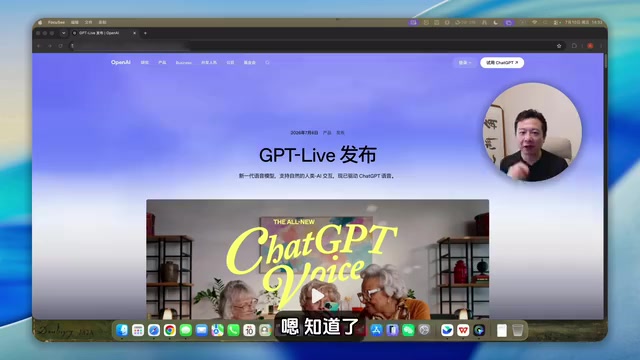
These interaction details may seem minor, but they directly determine whether a conversation feels natural. Real communication has never been a turn-based exchange — it's a continuous process full of interruptions, confirmations, and rhythmic adjustments. Full-duplex gives AI the ability to participate in that kind of continuous dialogue for the first time.
Real-Time Translation: The Language Barrier Is Getting Shorter
For professionals who regularly work with overseas counterparts, translation tools have never been in short supply. The real pain point is cultural context lost in translation — the same sentence can carry entirely different meanings depending on context, and misreading that context can come across as deeply unprofessional.
GPT Live upgrades translation from "text conversion" to "real-time accompaniment." You can open it during a call with an overseas client, tell it where the other person is from, and it will translate what they're saying into Chinese in real time — like having a personal simultaneous interpreter on call.
According to the video, OpenAI demonstrated this capability during the GPT-5.6 launch: a native English-speaking host and a native Japanese-speaking guest held a conversation, with GPT Live interpreting between the two languages in real time, allowing nearly seamless communication. Whether traveling abroad, watching YouTube videos without subtitles, or joining cross-border meetings, the language barrier is clearly being lowered.
Spoken English Practice: One Mistake, One Instant Correction
Beyond real-time translation, GPT Live's most impressive use case may be English speaking practice. The hardest part of learning English has never been memorizing vocabulary — it's not having anyone calibrate you when you make mistakes. Grammar errors go uncorrected, overly blunt phrasing goes unchallenged, wordiness never gets streamlined into something more natural.
Research Support: Why "Immediate Correction" Is So Critical
There's an important concept in language acquisition research called the Comprehensible Input Hypothesis, proposed by linguist Stephen Krashen in the 1980s, which emphasizes that learners need exposure to language slightly above their current level. But more recent research goes further, arguing that "output" and "corrective feedback" are equally critical — learners only truly internalize language rules through the cycle of attempting expression, making errors, and receiving timely correction. In traditional classrooms, teachers can provide only a very limited amount of individualized corrective feedback per student per class period; language exchange apps offer human interaction but no guarantee of professional error correction. The "correct as you go, interrupt as needed" experience GPT Live provides technically realizes what language acquisition researchers have long hoped for: a one-on-one immersive correction environment. In essence, it democratizes scaffolded learning — the kind of support that previously required paying for a private tutor.

The creator's test was illustrative. He first provided a clear prompt: after each English sentence, don't rush to praise — point out grammatical errors and unnatural phrasing, then give a more idiomatic native-speaker version, and "fix one sentence at a time, not like a lecture."
He then deliberately said a sentence with errors: "I want to talk to my wrestlers about the working fee and what they gonna do." GPT Live immediately flagged that "what they gonna do" was too informal and offered the more natural "what they're going to do."
Even more valuable was the controllability: when the creator said "speak slower" or "that's too long to remember, teach me one sentence at a time," GPT Live immediately adjusted its pace and switched to a segmented teaching style.

This is exactly where full-duplex delivers — in traditional practice, a conversation partner might start correcting you before you finish speaking, then over-explain while you struggle to get a word in. GPT Live lets you interrupt at any moment, ask it to slow down, or request a different way of explaining. This fragmented, interruptible, instant-feedback learning experience is precisely what only paid private tutors could previously offer.
From Translation Tool to "Communication Sparring Partner": Extending to the Workplace
Apply this capability to a work context, and the possibilities expand significantly. The creator mentioned having GPT Live roleplay as an overseas athlete, simulating real business conversations about appearance fees and flight arrangements — while flagging expressions he should improve along the way.
This is no longer simple "translate this for me" — it's more like a rehearsal before a high-stakes conversation. You're not doing test-prep-style English exercises; you're pre-running a real business negotiation. For professionals working across borders, GPT Live can even walk you through an entire cross-national meeting flow — a level of value that far exceeds any one-off translation tool.
Will Simultaneous Interpreters Lose Their Jobs? A Tiered Analysis

Back to the original question. The creator's conclusion was measured: high-end simultaneous interpreters won't disappear anytime soon. Large-scale conferences, legal negotiations, and diplomatic settings still demand human judgment, accountability, and on-the-spot improvisation in ways AI cannot fully replicate.
The Career Tiers of Simultaneous Interpretation and AI's Disruption Path
Simultaneous Interpretation (SI) is often called "the crown jewel of language services" — its difficulty far exceeds standard interpreting. Professional simultaneous interpreters must output the target language with a 0.5–3 second delay while still listening to the source language, simultaneously handling grammatical restructuring, cultural transposition, and specialized terminology. UN standards require interpreters to rotate every 30 minutes because sustained high cognitive load rapidly degrades quality. Looking at market structure, translation services have a clear "dumbbell" shape: at the top end are diplomatic, legal, and high-stakes business contexts that depend heavily on human judgment; at the bottom end is a large volume of mechanical work — document translation, subtitle generation, and simple meeting transcription. AI disruption is hitting the bottom end first — machine translation (MT) has already significantly compressed the document translation market, while real-time voice AI is beginning to penetrate lower-complexity interpreting scenarios. The moat protecting high-end simultaneous interpreters comes more from accountability, trust relationships, and real-time adaptability than from raw translation speed.
But low-value "mechanical transcription" translation roles will face mounting pressure. When AI can translate English to Chinese or Japanese to Chinese in real time at near-zero cost and on demand, positions that exist purely to do mechanical transcription will inevitably find themselves in a difficult position. The direction is clear: for ordinary people, the language barrier is shrinking.
Conclusion: The Missing Ingredient Isn't a Teacher — It's the Courage to Speak
The launch of GPT Live can be seen, in some ways, as a milestone marking AI language learning's entry into the era of instant feedback. In the past, what you lacked when learning English was a patient, always-available teacher who could calibrate your mistakes in real time. AI can now largely fill that role — which means what you're really missing is the courage to open your mouth.
Of course, the real-world testing here comes from a single creator's demonstration, and the stability in everyday use and translation accuracy in complex contexts will still need long-term validation from a broader user base. But regardless, this leap in interaction paradigm is worth experiencing firsthand — open GPT Live, have a conversation with it like you're making a phone call, and that might just be where the change begins.
Key Takeaways
Related articles

Workbuddy for Absolute Beginners: How a Desktop AI Agent Fits Into Real Workflows
A beginner's guide to the Workbuddy desktop AI agent: installation, claiming credits, file management, and building automated workflows—compared with CodeX for fit and cost, helping professionals shift from AI question-askers to AI managers.

OpenAI's New Agent Stack: Computer Use, Decisions API, and Ultra-Fast Workflows
OpenAI Dev Day unveiled a new agent stack: Computer Use outperforms humans, Decisions API delivers ultra-low-latency classification via Luna, Agents API opens the same Computer Use capabilities, and GPT-6.1 Sol costs only one-seventh of Astra. Core updates, benchmark data, and developer insights.

Liang Wenfeng Open-Sources DeepInfo Inference Framework, Takes On U.S. Ban
DeepSeek open-sources its DeepInfo inference framework after its models, featuring GPU/CPU cross-pipelining, small-model prediction with large-model verification, and full Huawei Ascend and NVIDIA chip support—facing the U.S. federal ban head-on. This article analyzes its significance for AI deployment and open-source strategy.