GPT-Next Mystery Model Leaked: OpenAI Launches 28-Day Sprint, Gemini 4 Argon Approaches

GPT-Next leaked, OpenAI sprints, Anthropic crushes OpenAI on subscription value, Gemini 4 Argon incoming.
The AI big three are locked in fierce but quiet competition. OpenAI's mysterious GPT-Next model has leaked, and the company has launched a 28-day sprint that already boosted inference speeds by ~50%. SemiAnalysis reports Anthropic subscriptions offer roughly 5× the API-equivalent value of OpenAI's — the direct pressure behind that sprint. Google is rapidly iterating Gemini 4 Argon in its backend, launched image model Nano Banana 2.1, and an RSI-related placeholder has fueled speculation about its accelerated release pace. Open-source lab Reflection AI also dropped Beam, a 501B-parameter MoE model. The competitive focus is clearly shifting from raw capability to efficiency, cost, and real-world usability.
The AI landscape hasn't seen any earth-shattering releases lately, but undercurrents are running strong across OpenAI, Google, and Anthropic — hinting at the direction of the next competitive wave. From the mysterious GPT-Next model leak to OpenAI's 28-day sprint commitment and a reshuffling of subscription value, these scattered signals paint a compelling picture of the industry.
The Mysterious GPT-Next Model Surfaces
OpenAI's biggest enigma right now is a little-known new model called GPT-Next. It's neither the so-called GPT-Minor nor the scrapped GPT-6.1 Astra, but rather something highly similar to GPT-6.1 Sol — perhaps a modest improvement without any major architectural leap.
The model was discovered after generating an impressively crafted voxel-style Pokémon piece. Early outputs suggest it goes a step further than GPT-6.1 Sol on 3D environment building and web development tasks — capable of rendering a 3D kitchen environment complete with lighting, shaders, and functional components, even incorporating animated Pokémon characters. The creative and execution gains are marginal, but the richness of detail is worth noting.

What's truly eye-catching is the pricing speculation. Early estimates suggest roughly 40,000 credits may have generated nearly 5 billion tokens of usage (including cached tokens). If accurate, this new checkpoint would be extraordinarily efficient — possibly hinting at a cost-optimized model. That said, the source cautions against reading too much into a single voxel test and scattered pricing estimates.
OpenAI's 28-Day Sprint Commitment
OpenAI product lead Tibo has kicked off a "28-day shipping challenge": over the next 28 days, the team will either deliver one meaningful improvement per day for Codex and workflow users, or give everyone a full credit reset. It's a win-win for users either way.
The team is currently focused on four things: simplifying the product, improving efficiency (giving users more usage), shipping breakthrough features, and releasing new models. Day one already delivered — the default speed for GPT-6 Astra and GPT-6.1 Sol was boosted by roughly 50%, with targets rising from ~30 tokens/second to ~50 tokens/second. This improvement also extends to services connected via "Sign-in with ChatGPT," including OpenCode, Pi, AMP, and Devin.
The video author speculates that OpenAI will likely drop another significant model during this challenge — most probably a cheaper, more efficient version than Astra — which aligns with the GPT-Next sighting. Tibo had previously hinted vaguely on X that "6.1 is coming," later clarifying he meant "6.1 Sol Ultra Fast" rather than the scrapped 6.1 Astra. The direct pressure behind all this comes from Anthropic, whose new models have clearly outpaced OpenAI in efficiency and usage allowances.
Gemini 4 Argon and Nano Banana 2.1 Progress
On the Google side, Gemini 4 Argon appears to be arriving faster than expected. Its backend logs have quickly filled up with Argon-related internal model slugs, including multiple LSP and barium checkpoints as well as experimental variants. The rapid iteration, bug fixes, and multi-configuration testing suggest Google is actively polishing the model rather than sitting at an early prototype stage. In one SVG simulation test (generating a payment card transaction completion animation), Gemini 4 Argon even outperformed Fable 5.
On the image generation front, Nano Banana 2.1 has launched on both the Gemini web and mobile platforms. Its naming history has been quite chaotic: starting with "instant ramen" in June (believed to be Nano Banana 2 lite), then version 2 in August, renamed to "spicy mayo," offered to partners via Vertex in September as "Nano Banana 2.5," and finally reclassified by Google from "light" to "flash" and officially named 2.1. In a comparison test against Tencent's HY Image 3.5, Nano Banana 2.1 performed better on character consistency, while HY Image 3.5 excelled in lighting, atmosphere, and creative expression — and at a lower price point (~2 cents per 2 2K images). Overall, early performance is solid but not spectacular.
More Questions Around Google's RSI Claims
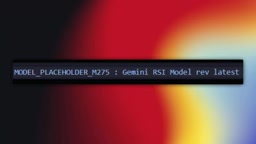
Previously dismissed as unfounded rumors, Google's alleged RSI (Recursive Self-Improvement) work is back in the spotlight after a mysterious internal model placeholder appeared in backend logs — adding fuel to speculation that Google is experimenting with RSI. This could explain how Google has been able to develop so many flash variants so rapidly.
The author remains cautious, however — a single model slug or placeholder isn't enough to conclude that Google has cracked RSI. It could simply be a naming convention or some form of imitation framework. But combined with Google's recent flurry of model activity, it does add an intriguing piece to the puzzle.
Recursive Self-Improvement (RSI) is a core concept in AI safety research. It refers to an AI system's ability to autonomously modify and optimize its own algorithms or weights, continuously improving its performance without human intervention. In theory, once an AI reaches a sufficiently high initial capability threshold, RSI could trigger an "intelligence explosion" — each round of self-improvement making the next round easier, creating a positive feedback loop. This is why some AI researchers view it as a potential existential risk.
At the engineering level, RSI differs fundamentally from RLHF (Reinforcement Learning from Human Feedback) and model distillation, both of which still rely on human feedback signals or teacher models. RSI, by contrast, emphasizes the system autonomously generating its own directions for improvement. If Google is indeed experimenting with some form of RSI framework — even a constrained version, such as having the model participate in designing its own training data or evaluation criteria — it would represent a significant shift in technical direction, and could explain the unusually accelerated pace of its recent model iterations.
Subscription Value Reshuffled: Anthropic Dominates OpenAI
A report from SemiAnalysis tested the usage allowances of nearly all major AI subscriptions, and the findings are striking: in high-load agentic workflows, Anthropic's subscription delivers significantly better value per dollar than OpenAI's — and by a wide margin.
According to the analysis, at the same price point, Opus 5.5 delivers approximately 5× the API-equivalent value of GPT-6.1 Sol; even when comparing mid-tier models, Anthropic's subscription offers more than 5× the API-equivalent value. The report also notes that OpenAI recently cut usage limits on its $200/month ChatGPT plan by roughly half, citing GPT-6.1 Sol's improved efficiency (also widely seen as an IPO-related move). The one exception is at the high end: under Pro and Max 20x plans, OpenAI's GPT-6 Astra allowances are marginally higher than Anthropic's equivalent offering.
In concrete terms, CloudMax provides approximately $12,500 worth of Sonnet or $12,000 of Opus (or 2,500 of Fable) in API-equivalent usage; ChatGPT Pro offers roughly $2,000 of GPT-6.1 Sol or $3,000 of GPT-6 Astra. The author fairly acknowledges that API-equivalent cost only tells half the story — model quality, speed, context length, tool integration, and ecosystem usability all matter equally. "5× the credits" doesn't equal "5× the actual value."
"API-equivalent value" is the comparative framework used in the SemiAnalysis report: it converts the model compute available within a subscription plan into equivalent dollar amounts based on that model's public API pay-as-you-go pricing. For example, if a subscription grants monthly access to $10,000 worth of Sonnet API usage, its API-equivalent value is $10,000. This metric directly reflects how deep a discount a subscription offers versus pay-as-you-go pricing — and is especially relevant for heavy agentic workflow users, where token consumption tends to be extremely high.
However, the metric has clear limitations: it assumes users can fully "max out" their allowances, while in practice, rate limits, context windows, tool call support, and workflow compatibility across platforms all affect actual usable capacity. Additionally, per-token pricing reflects market pricing strategy, not necessarily the actual business value a user derives — which is why the author specifically emphasizes that "5× the credits ≠ 5× the actual value."
Watermarks, Open-Source Models, and Tool Updates
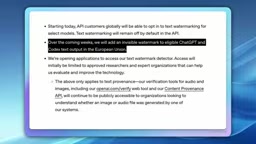
OpenAI is rolling out a text watermarking system called TextScreen to address the EU AI Act. Rather than inserting visible markers, it embeds statistical signals into the model's word choices for later detection. According to OpenAI's testing, TextScreen matches or exceeds Google's SynthID for Text without noticeably degrading output quality — and it's planned to be open-sourced. Global API customers can now opt to enable it on select models. Limitations are acknowledged — text can be paraphrased, translated, or modified.
American AI startup Reflection AI has released an open-source model called Beam, with approximately 501 billion total parameters and only 23 billion active parameters, using a MoE architecture to boost inference efficiency. Beam is designed for reasoning, coding, and agentic workflows, trained end-to-end from scratch rather than built on existing open-source models, with weights set to be released to the public this month.
On the tools front, Google added Opus 5.5 Medium and Sonic 5.5 Medium to Anti-gravity for Pro subscribers (though with very limited quotas); Claude Code gained new mod functionality, including a "cache control" plugin that displays the 5-minute prompt cache window and reminds users to keep the cache "warm" — effectively saving tokens and extending session length; Claude Projects also added the ability to connect directly to local folders. Additionally, a user managed to prompt Fable 5.5 to generate a complete game blending Pokémon and Balatro mechanics in about an hour — complete with mechanics, visuals, music, and a demo video — in a genuinely impressive showcase. The model may be launching in the near term.
MoE (Mixture of Experts) architecture is one of the dominant approaches for scaling large models in recent years. The core idea is to split the model into multiple "expert" sub-networks, with a gating mechanism (Router) dynamically selecting a small subset of experts to handle each input during inference — rather than activating all parameters as a dense model would. With 501 billion total parameters but only 23 billion active, Beam's actual compute per inference is far below what a dense model of equivalent size would require, dramatically reducing inference cost and latency while maintaining high model capacity.
Both GPT-4 and Mixtral are widely believed to use similar architectures. MoE's main challenges include training stability (different experts can easily become load-imbalanced) and communication overhead (data routing between experts is complex in distributed training). Training from scratch end-to-end is therefore a technically demanding feat for Reflection AI — which is precisely why they emphasize it.
Closing Thoughts
This round of updates didn't bring any explosive flagship releases, but from the GPT-Next leak and OpenAI's 28-day commitment to Anthropic's dominance on value-per-dollar, competition among the three giants is shifting from a pure capability race toward a combined contest of efficiency, cost, and user experience. For everyday users, who can deliver the most practically usable compute at a given price point is increasingly becoming the deciding factor.
Related articles

Workbuddy for Absolute Beginners: How a Desktop AI Agent Fits Into Real Workflows
A beginner's guide to the Workbuddy desktop AI agent: installation, claiming credits, file management, and building automated workflows—compared with CodeX for fit and cost, helping professionals shift from AI question-askers to AI managers.

OpenAI's New Agent Stack: Computer Use, Decisions API, and Ultra-Fast Workflows
OpenAI Dev Day unveiled a new agent stack: Computer Use outperforms humans, Decisions API delivers ultra-low-latency classification via Luna, Agents API opens the same Computer Use capabilities, and GPT-6.1 Sol costs only one-seventh of Astra. Core updates, benchmark data, and developer insights.

Liang Wenfeng Open-Sources DeepInfo Inference Framework, Takes On U.S. Ban
DeepSeek open-sources its DeepInfo inference framework after its models, featuring GPU/CPU cross-pipelining, small-model prediction with large-model verification, and full Huawei Ascend and NVIDIA chip support—facing the U.S. federal ban head-on. This article analyzes its significance for AI deployment and open-source strategy.