GPT-OSS 120B Local Deployment Review: Comprehensive Comparison with O4 Mini on Code Generation and Reasoning

OpenAI's GPT-OSS open-weight reasoning model tested locally — performs on par with O4 Mini overall.
OpenAI officially released the GPT-OSS series of open-weight reasoning models in 120B and 20B versions, designed for Agent scenarios and tool calling. Local deployment testing via Ollama shows the 120B version matches or slightly outperforms O4 Mini in code generation and logical reasoning, but web search integration suffers from serious hallucination issues. The model uses open weights rather than true open source, delivering solid but unremarkable results that may serve as a prelude to GPT-5's release.
OpenAI has finally delivered on its open-source promise by officially releasing the GPT-OSS series of open-weight reasoning models. The company claims performance comparable to O4 Mini, with the smaller version even capable of running on mobile phones. But how does it actually perform? This article puts GPT-OSS 120B through its paces with local deployment via Ollama, testing code generation, logical reasoning, and more to reveal its true capabilities.
GPT-OSS Model Overview: Two Sizes, Built for Agent Scenarios
The GPT-OSS series currently comes in two versions: 120B (120 billion parameters) and 20B (20 billion parameters). For reference, GPT-3.5 has approximately 175 billion parameters, so the 120B version is slightly smaller in parameter count than GPT-3.5, though OpenAI claims more advanced training methods have yielded stronger performance.
Notably, OpenAI has adopted an "Open Weights" approach rather than true "open source." True open source requires publishing training data, training code, and complete reproduction workflows. Open weights only releases the trained model parameter files — users can download, deploy, and fine-tune the model but cannot fully reproduce the training process. Meta's LLaMA series and Mistral follow the same approach. The Open Source Initiative (OSI) published a formal definition of "Open Source AI" in 2024 that explicitly requires disclosure of training data and complete methodology. By this standard, the vast majority of so-called "open-source models" are actually just "open-weight models."
The 20B version is designed specifically for mobile devices and reportedly requires only 16GB of RAM to run. This echoes a community poll OpenAI launched in March — where a large number of users voted for an open-source model that could run on mobile devices. GPT-OSS 20B is the direct result of that demand.
One important detail: OpenAI emphasizes that this model is specifically built for Agent scenarios, supporting tool-calling capabilities like web search and code execution. Agents are one of the most central development directions in AI for 2024-2025. Unlike traditional Q&A-style AI, agents can autonomously plan tasks, invoke external tools, and execute multi-step operations. "Tool Calling" (or Function Calling) refers to the model's ability to recognize user intent and generate structured function call instructions to interact with external APIs, search engines, code interpreters, and other tools, then integrate the results before returning them to the user. This requires the model to be specifically optimized for tool-calling formats during training, accurately determining when to call a tool, which tool to call, and how to parse the tool's returned results. Additionally, the model has undergone complete safety training and evaluation — even when deployed locally, it will refuse to answer dangerous requests (such as weapons manufacturing).
Local Deployment of GPT-OSS 120B via Ollama: One-Click Setup with a Catch
The hardware used for this test was a Mac Studio with 96GB of memory and an M2 Max chip. Ollama was chosen as the deployment tool for its convenience.

Ollama is one of the most popular local LLM deployment tools available today. It packages the complex processes of model downloading, quantization, and inference engines into a clean Docker-like command-line experience. Users need only a single command (e.g., ollama run model_name) to automatically download and launch a model. Ollama is built on the llama.cpp inference engine, supports CPU and GPU hybrid inference, and is well-optimized for Apple Silicon (M-series chips), fully leveraging the Unified Memory architecture. The Mac Studio used here has 96GB of unified memory, meaning the CPU and GPU share the same memory pool — the 60.8GB model can be loaded entirely into memory without being limited by discrete GPU VRAM capacity as on traditional PCs. This is why Apple Silicon devices have become a popular choice for local LLM deployment.
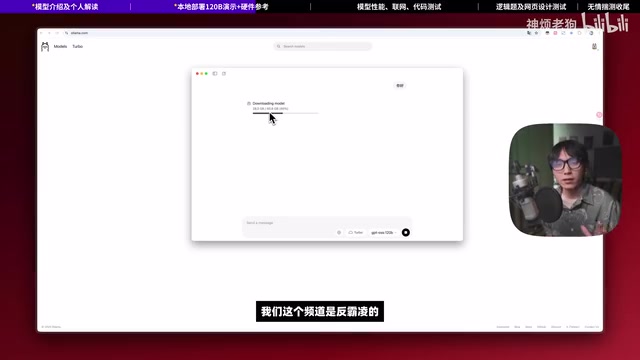
The deployment process is straightforward: after downloading and installing Ollama, select the desired model and send a message to automatically begin downloading and deploying. The GPT-OSS 120B model file is approximately 60.8GB, which takes about 6-7 minutes to download on a gigabit connection.
Regarding the file size, there's a technical detail worth explaining: a 120B parameter model stored at full precision (FP32) would be approximately 480GB; at half precision (FP16/BF16), it would still be around 240GB. The actual 60.8GB download indicates the model has been quantized — likely 4-bit quantization (Q4), compressing each parameter from 16 bits to 4 bits, reducing size by approximately 4x. Quantization is a model compression technique that reduces storage and computational requirements by lowering numerical precision, at the cost of potentially slight performance degradation. For most use cases, the performance loss from 4-bit quantization is within acceptable bounds, making it a key enabling technology for local LLM deployment.
However, there's a catch during deployment: download speed may drop dramatically after reaching 90%+, making it appear stuck. The recommendation is to stop the download, quit Ollama, restart, and try again. In our testing, it took four or five attempts to complete the deployment.
If you'd rather skip the local deployment hassle, you can use OpenAI's cloud-hosted version — just toggle the cloud option and start chatting, though it requires a paid subscription.
Code Generation Testing: GPT-OSS 120B vs O4 Mini
Snake Game Generation Comparison
We used the classic "write a Snake game" prompt to test code generation capabilities. The 120B model's generation speed was fairly smooth, comparable to the ChatGPT experience.
GPT-OSS 120B's Snake game:
- Supports arrow key controls
- No-wall design (wraps around edges)
- Speed increases after eating food
- Game over when hitting the body
- Overall logic is complete with decent playability
O4 Mini's Snake game:
- Supports basic controls
- But the visual effects are "dizzying," actually providing a worse experience than the open-source model
From this test alone, GPT-OSS 120B's code generation quality is on par with O4 Mini, and even performs better in certain details.
Glassmorphism Landing Page UI Generation Test
Next, we tested UI design capabilities by asking the model to generate a glassmorphism-style landing page. Glassmorphism is a UI design trend that emerged around 2020, characterized by semi-transparent frosted glass effects (achieved via CSS backdrop-filter: blur()), multi-layered transparency, prominent border highlights, and colorful backgrounds. This style was first adopted at scale in Apple's macOS Big Sur and Windows 11 design languages. Implementing glassmorphism in code requires combining CSS background transparency, blur filters, border gradients, box-shadow, and other properties, making it a solid comprehensive test of a model's front-end code generation capabilities.

GPT-OSS 20B's performance: The page was very simple and crude, with large portions of code omitted, requiring users to fill in the gaps. Given its smaller parameter count and shorter context window, this result is somewhat understandable.
GPT-OSS 120B's performance: It successfully generated glassmorphism effects, including core feature sections, icons, animations, and even interactive elements like email input fields. However, the text color choices were questionable (white text on a light background) — black would be more appropriate. Overall, the 120B version demonstrated significantly stronger UI understanding and code generation capabilities.
Logical Reasoning Test: The Classic Water Merchant Problem
We used a classic reasoning puzzle to test the model's chain-of-thought capabilities:
A water merchant in the desert has 25 liters of water. One person wants to buy 19 liters, another wants to buy 12 liters. There isn't enough water to sell to both, so the merchant can only choose one. The merchant just wants to get home as quickly as possible, and pouring one kilogram of water takes 10 seconds. Who should he sell to?
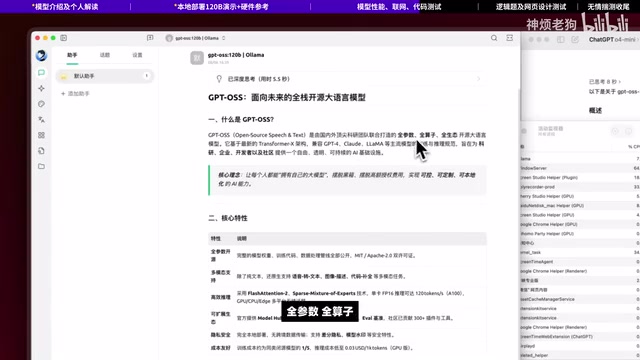
GPT-OSS 120B gave the correct answer: sell to the person wanting 12 liters. Because pouring 12 liters takes only 120 seconds, while pouring 19 liters takes 190 seconds. Since the merchant wants to get home as quickly as possible, he should naturally choose the shorter transaction. The model displayed its complete reasoning process with a clear chain of thought.
As a "Reasoning Model," GPT-OSS is fundamentally different from ordinary language models. Standard language models generate answers directly, while reasoning models first conduct an internal "thinking process" (Chain-of-Thought), breaking complex problems into multiple reasoning steps to progressively derive the final answer. OpenAI's O-series models (O1, O3, O4 Mini, etc.) represent this technical approach. Reasoning models are typically trained through reinforcement learning (particularly process-reward-based reinforcement learning), teaching the model to think deeply before answering. This method is notably effective for tasks requiring multi-step thinking like math, programming, and logical reasoning, but the tradeoff is slower inference speed and higher computational cost, since the model must generate additional thinking tokens.
However, the reasoning process outputs entirely in English, which isn't ideal for Chinese-speaking users. Meanwhile, O4 Mini showed noticeable quality degradation on the same problem, performing below expectations.
Web Search Functionality: A Clear Weakness of GPT-OSS
During testing, we discovered a significant issue: when web search is enabled, the model gets stuck in prolonged search processes without providing a response. More seriously, even when it does find information, the model still "fabricates" content.
For example, when asked about the GPT-OSS model itself, the model fabricated version numbers like "1.3B, 7B, 34B, 70B" that don't exist, and claimed the release date was "late 2024" — which is clearly wrong as of July 2025.
This phenomenon is known as "Hallucination" in the AI field and represents a core deficiency of large language models. Hallucination refers to the model generating information that appears plausible but is actually incorrect. The root cause lies in the fundamental nature of language models as probability-based text generators — they predict "the most likely next token" rather than "the most correct next token." Even when Retrieval-Augmented Generation (RAG) technology introduces external knowledge sources, models may still ignore retrieved correct information in favor of incorrect memories from training data or outright fabrication. This is especially pronounced when models are asked about themselves, since information published after the training data cutoff can only be addressed through retrieval results, and the quality of retrieval result integration heavily depends on the adaptation layer's implementation quality.
It's worth noting that the web search functionality isn't built into the model itself but is provided by the Ollama platform. Therefore, this issue is more of an integration problem and cannot be entirely attributed to GPT-OSS.
Conclusion: Is GPT-OSS 120B Worth Deploying?
GPT-OSS 120B's overall performance can be described as "decent but unremarkable":
| Test Dimension | GPT-OSS 120B Performance | Comparison with O4 Mini |
|---|---|---|
| Code Generation | Good quality, complete logic | Roughly on par |
| Logical Reasoning | Clear chain-of-thought, correct answers | Slightly better |
| UI Design | 120B shows decent capability | Each has strengths |
| Web Search | Many integration issues, prone to hallucination | Clearly inferior |
There's an interesting speculation: could this open-source model be an "appetizer" based on a fusion of GPT-3.5 and GPT-4, building hype for the upcoming GPT-5 release? After all, rumors suggest GPT-5 may launch soon, and OpenAI is unlikely to open-source its truly core technology — GPT-5 is their "ace in the hole," and anything released as open-weight will inevitably be a restrained version.
Deployment recommendations: If you have sufficient hardware (96GB+ memory), you can deploy GPT-OSS 120B locally via Ollama. Users with more modest setups can try the 20B version or use publicly available cloud services. While this model hasn't reached a "revolutionary" level, as OpenAI's first open-weight reasoning model, it's certainly worth trying.
Key Takeaways
- GPT-OSS offers 120B and 20B versions; the 20B can run on phones with just 16GB RAM
- One-click local deployment via Ollama; the 120B model file is ~60.8GB (4-bit quantized), downloadable in 6-7 minutes on gigabit internet
- Code generation capability is roughly on par with O4 Mini, even performing better in the Snake game test
- Logical reasoning performance is solid with clear chain-of-thought, but web search suffers from serious hallucination issues
- The model uses "open weights" rather than true open source, has undergone complete safety training, refuses dangerous requests even when deployed locally, and delivers an overall solid but unexceptional experience
Related articles
 Product Reviews
The Programmer's Desk Setup Guide: Building a Workspace That Feels Like Home
Discover how programmers build productive, comfortable workspaces. From multi-monitor setups to ergonomic design, explore the desk philosophy that drives focus and flow.
 Product Reviews
Qoder vs Cursor Real-World Comparison: Which $20/Month AI IDE Is Better?
Hands-on comparison of Qoder vs Cursor AI IDEs: Agent autonomy, human interaction count, and architecture decisions. Qoder needed only 2 interactions vs Cursor's 8.
 Product Reviews
Cursor Cloud Agent Demo: Eliminating Bottlenecks Across the Entire Software Development Lifecycle
Deep analysis of Cursor's Cloud Agent demo showing how cloud VMs, automated test artifacts, and a full-chain control plane systematically eliminate human bottlenecks across the software development lifecycle.