GPT Plus Subscription in China: Hands-On Guide to Passwordless Session Top-Up

A breakdown of the passwordless Session mechanism behind ChatGPT Plus website top-ups, the operational process, and three types of risk boundaries.
The article compares three ways for users in China to subscribe to ChatGPT Plus: overseas credit cards have high barriers and hidden fees, mobile top-ups are cumbersome and prone to payment risk controls, while website-based top-up wins overall thanks to better pricing, a short process, and no need to hand over a password. In practice, users first choose a plan and enter an email used only for order inquiries, then extract a Session credential from a logged-in browser and give it to the top-up site to complete the subscription, and finally submit the order and refresh to confirm the Plus badge appears. The article emphasizes that a Session is equivalent to login permission, and passwordless does not mean zero risk. It recommends logging back in to refresh the credential after top-up and enabling two-step verification. It also notes that third-party sites have no official endorsement and that the solution's effectiveness depends on platform policy. Those with compliant overseas payment channels should still prioritize direct official subscription.
Title
GPT Plus Subscription in China: Hands-On Guide to Passwordless Session Top-Up
Meta Description
A detailed comparison of three ways to subscribe to GPT Plus in China, with a hands-on walkthrough of the full Session-based top-up process: no password, no account login, pay with Alipay, and refresh to see the top-up take effect. We also break down the privacy risks of Session credentials and what to watch for on third-party sites.
Article Content
For users in China, subscribing to ChatGPT Plus has always been a hassle: no overseas credit card, no support for Alipay or WeChat Pay, and third-party top-up services require handing over your account password. A tutorial video recently circulating on Bilibili offers a third approach—topping up through a site that uses Session information, which requires no account login and no password, and can complete the subscription using only account ID-related information.
In the video, the uploader compares three mainstream top-up methods: website-based top-up, credit card top-up, and mobile app top-up, and explicitly recommends the first. Drawing on the video's content, I'll break down the entire process and the trade-offs behind it.
Side-by-Side Comparison of Three Subscription Methods
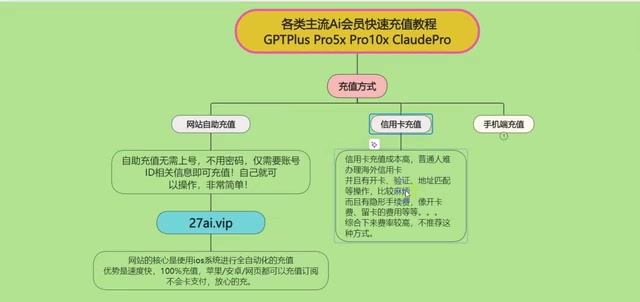
Credit Card Top-Up: High Barrier, Hidden Costs
An overseas credit card is the most direct official channel, but the uploader points out its core drawback: "high cost, and it's hard for ordinary people to get an overseas credit card," plus "hidden fees that make the overall rate very high." For users without overseas payment tools, this route is basically a dead end.
Mobile App Top-Up: Cumbersome and Blocked by Payment Risk Controls
The video is even more direct about mobile subscriptions: "the process is very cumbersome, and beginners find it hard to get it done in one go," and "it doesn't support local payment—you can't use WeChat or Alipay." The worst part is payment risk control—when conditions aren't ideal, you can get stuck at the payment step, and "your money can easily go down the drain."
Website Top-Up: Shortest Process, Lowest Privacy Risk
By comparison, website-based top-up has three advantages: better pricing, simpler operation, and faster speed. More importantly, it does not require handing your account password to a stranger, eliminating the risk of privacy leaks and account theft at the source. This is also the basis for the video's repeated claim that it is "the safest, most stable, and most reliable."
ChatGPT Plus subscription and payment restrictions: ChatGPT Plus is a paid subscription service offered by OpenAI, billed monthly. After subscribing, you can use more powerful models, higher message limits, and some advanced features. Its official payment channel has long relied on the international credit card network (such as Visa and Mastercard), with deductions and risk control checks handled by third-party payment processors. Because OpenAI does not yet operate in mainland China, locally common Alipay and WeChat Pay are not on the supported list. At the same time, the payment step verifies the card issuer's region, billing address, and access environment; when these are inconsistent, declines are easily triggered. This also explains the phenomena mentioned in the article—"mobile top-ups get stuck at payment risk control" and "money easily goes down the drain"—failures often occur at the payment authorization stage, not with the subscription itself. Understanding this restriction is key to seeing why gray channels such as top-up and payment agents have long existed.
Step-by-Step Walkthrough: From Purchase to Successful Top-Up
Step 1: Choose a Plan and Enter Your Email
After entering the top-up site's address in your browser, the page displays a matrix of AI products available for top-up—according to the video, mainstream AI subscriptions such as GPT Plus, GPT Pro 5x, GPT Pro 10x, GPT Go, and Claude Pro can all be handled here. First-time buyers can click on the demo tutorial within the page.
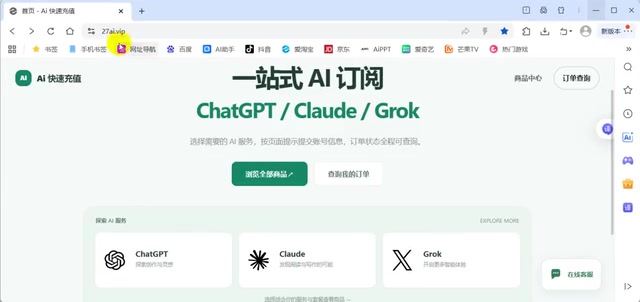
Taking Plus as an example, after selecting a plan, enter your own email. This email is "only used for order inquiries" and does not involve the account itself.
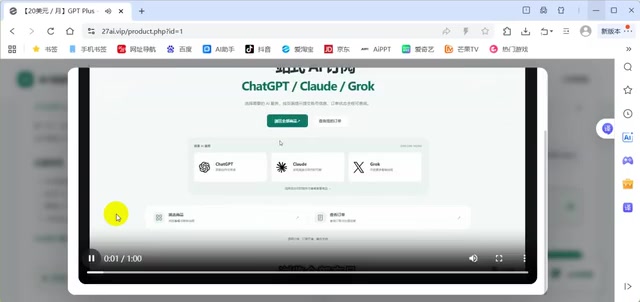
Step 2: Obtain the Session Information
This is the core step of the entire process. In a browser where you are already logged into ChatGPT, extract your login credentials using the Session link provided by the top-up site: if the copied code is very short, it means the account is not logged in; copy the entire content including the brackets, paste it back into the top-up site, and the system will display the account corresponding to that Session so you can double-check whether it is the account you want to top up.
This step is the technical basis for "passwordless" top-up: a Session is a credential for the browser's login state, and the top-up provider uses it to complete the subscription operation without touching your password. But conversely, the Session itself is equivalent to login permission—handing it to any third party carries the theoretical possibility of abuse. The video describes this as "relatively safe" rather than absolutely safe, and that wording is worth noting.
Technical background of the Session mechanism: In web applications, a Session is a state-maintenance mechanism used by the server to identify "which logged-in user the current request comes from." After a user successfully logs in, the server generates a unique Session identifier (usually a long string or Cookie value), and the browser automatically carries it with every subsequent request. The server uses it to determine identity without requiring the user to repeatedly enter a password. Therefore, a Session is essentially a "possession-is-authentication" credential—whoever obtains it can act as that user during its validity period. This is exactly the technical principle that enables website-based top-up to be "passwordless," and also the root of its risk. Common security practices include: setting a shorter Session validity period, binding to a device or IP, immediately invalidating old Sessions when the password is changed or the user actively logs out, and pairing with two-step verification. Understanding this makes it clear why the article suggests actively logging out and logging back in after top-up—this triggers the server to revoke the old credential and generate a new one, thereby invalidating the Session you handed over earlier.
Step 3: Submit the Order and Confirm Receipt
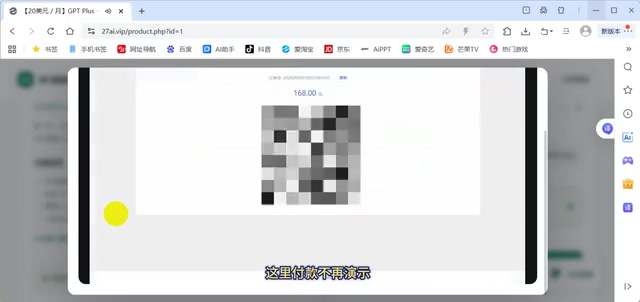
Choose a payment method and submit the order. When the page shows "top-up successful," you're done. Go back to ChatGPT and refresh the page—the Plus badge should now appear; if it doesn't, refresh a couple more times. The video also mentions that the site provides online customer service, which can help with issues such as failed top-ups or invoices.
Three Easily Overlooked Risk Points
Account security always comes first. Passwordless does not mean zero risk. Once a Session leaks, the other party has the same login capability as you for the duration of the credential's validity. It is recommended to actively log out and log back in after top-up to refresh the credential, and to enable two-step verification.
Third-party sites have no official endorsement. The recommendation in the video is essentially a promotional tutorial. The site's stability and after-sales quality depend entirely on the operator and have nothing to do with OpenAI officially. Before topping up, it's basic practice to try a small order first and keep order records.
The solution's effectiveness depends on platform policy. Website-based top-up works on the premise that the subscription process still accepts Session-based operations. Once the official platform tightens login state or payment verification, such channels may fail entirely, and you'll need to reassess.
The role and limits of two-step verification (2FA): Two-step verification adds a second identity confirmation beyond the password. Common forms include SMS/email verification codes, dynamic codes generated by authenticator apps, and hardware security keys. Its core value is that even if the password leaks, an attacker lacking the second factor will still find it difficult to log in. But it's important to be clear: 2FA mainly protects the "login" step. For a valid Session credential already in someone's hands, its protective effect depends on whether the platform performs secondary verification for sensitive operations. Therefore, enabling 2FA can significantly improve overall account security, but it cannot fully offset the risk of actively handing over a Session. For ordinary users, reasonable security habits are: bind a strong, unique password to your account, enable 2FA, regularly check account settings for unfamiliar logged-in devices and kick them out, and avoid entering or pasting any login credentials on unknown sites.
Who This Method Suits
Users who lack overseas payment tools and don't want to bear the risk of account bans from top-up agents are the main beneficiaries of this approach. The video mentions that it supports subscriptions on Apple, Android, and web, giving it broad coverage. But if you already have a compliant overseas payment channel, direct official subscription remains the safest long-term choice—the small savings may not be worth the uncertainty at the account level.
Looking at the whole tutorial, its value lies not in "which website can top up," but in explaining the mechanism of Session-based top-up clearly. Once you understand the mechanism, no matter which service you use, you can judge for yourself where the risk boundaries lie.
One-line Summary
A breakdown of the passwordless Session mechanism behind ChatGPT Plus website top-ups, the operational process, and three types of risk boundaries.
Paragraph Summary
The article compares three ways for users in China to subscribe to ChatGPT Plus: overseas credit cards have high barriers and hidden fees, mobile top-ups are cumbersome and prone to payment risk controls, while website-based top-up wins overall thanks to better pricing, a short process, and no need to hand over a password. In practice, users first choose a plan and enter an email used only for order inquiries, then extract a Session credential from a logged-in browser and give it to the top-up site to complete the subscription, and finally submit the order and refresh to confirm the Plus badge appears. The article emphasizes that a Session is equivalent to login permission, and passwordless does not mean zero risk. It recommends logging back in to refresh the credential after top-up and enabling two-step verification. It also notes that third-party sites have no official endorsement and that the solution's effectiveness depends on platform policy. Those with compliant overseas payment channels should still prioritize direct official subscription.
Related articles

AI Role-Play in a Barbershop: How Veda Builds Immersion Through Dialogue
From a Bilibili Veda barbershop video, explore how AI role-play builds immersion through task dialogue, relationship maintenance, and improvisation.

Why Does Python Endure? A 20-Year Developer's Firsthand Account
A senior developer shares his journey from C, Java, and other languages to Python: convinced by its concise code in 2006, he asks himself every year whether to keep using Python, and the answer is always yes. Python's flexibility and versatility are the key to its enduring popularity.

Conductive Dye Turns Hair into EEG Electrodes, Opening a New Path for Wearable Brain-Computer Interfaces
Can conductive dye turn hair into EEG electrodes? This article explains the principles, potential applications, and deployment challenges of this new wearable brain-computer interface approach.