GPT Researcher Alternative Claims 80% Token Cost Reduction

A developer claims their GPT Researcher alternative cuts Token usage by 80%, but community validation is still needed.
A developer posted on Reddit announcing a drop-in replacement for GPT Researcher that claims to cut Token consumption by roughly 80%, openly inviting community testing and feedback. GPT Researcher is a popular open-source autonomous research agent whose parallel search and multi-round LLM call design can make single-task API costs quite high. The alternative requires minimal code changes to adopt, but the 80% savings claim currently lacks public benchmarks and may vary significantly based on research complexity and retrieval scope. The article recommends small-scale controlled testing with a focus on whether output quality holds up alongside cost savings.
An Open-Source Alternative to GPT Researcher Enters the Scene
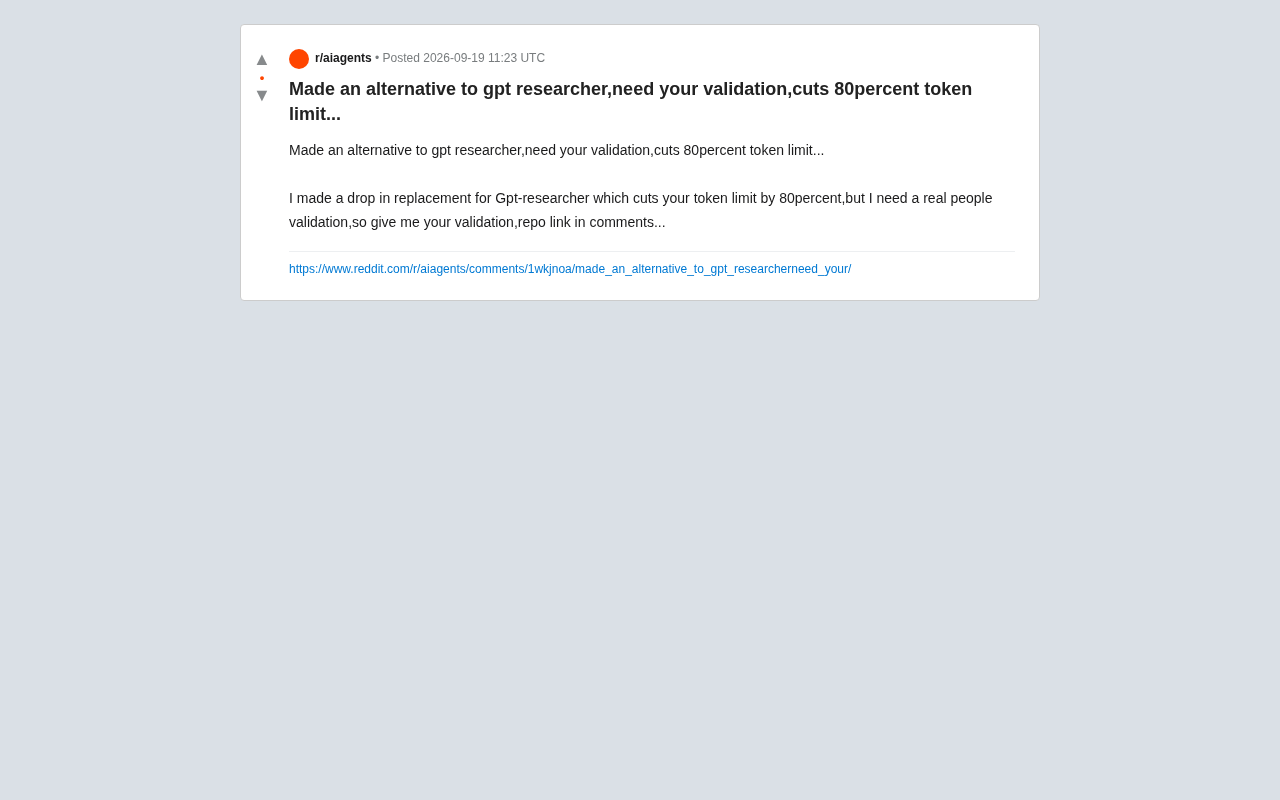
A developer recently posted on Reddit announcing a "drop-in" replacement for GPT Researcher, with the headline claim of reducing Token consumption by approximately 80%. The developer openly acknowledged that the project needs real-world validation, posting the repository link in the comments and inviting community members to test and provide feedback.
For developers who rely on AI for automated research, Token costs have long been a persistent pain point. GPT Researcher is a widely used open-source autonomous research agent that automatically searches, scrapes, and synthesizes web information to generate reports — but handling complex topics often triggers a large volume of Token calls, driving up API expenses considerably. If this alternative tool genuinely delivers an 80% reduction in Token usage, it would be a compelling proposition for cost-conscious users.
GPT Researcher is an autonomous research agent framework developed and open-sourced by Assaf Elovic. It works by taking a user's research question, breaking it down into multiple sub-questions, running parallel search engine queries to scrape multiple web pages, and then using a large language model to filter, synthesize, and produce a structured research report with cited sources. Due to its "parallel search + multi-round summarization" design, a single complete research task can involve dozens or even hundreds of LLM calls. When using high-cost models like GPT-4, the API cost for a single task can sometimes reach several dollars — making Token costs a major barrier for large-scale use cases.
What "Drop-In Replacement" Actually Means
The developer emphasizes that this is a "drop-in replacement" — meaning users can swap out the original GPT Researcher components without significantly restructuring their existing codebase. This design philosophy lowers the migration barrier: in theory, users only need to swap the calling interface to benefit from lower Token overhead, without needing to rebuild their entire workflow.
From a technical standpoint, achieving an 80% Token reduction typically involves several approaches: more granular context management, avoiding redundant information being injected repeatedly, optimizing the filtering and compression of retrieved results, and reducing unnecessary multi-round reasoning calls. However, the post itself does not disclose the specific implementation mechanism — which is one of the key reasons community validation is needed. Whether the Token savings come at the cost of research report quality, completeness, or accuracy remains unsupported by any publicly available data.
What is a Token? A Token is the basic unit large language models use to measure input and output text — roughly equivalent to half a word to one word in English. API services like OpenAI charge based on Token count: the more advanced the model and the longer the context passed in per call, the higher the cost. In automated research scenarios, Token consumption primarily comes from two sources: feeding large amounts of raw web content into the context (input Tokens), and the summaries or reports the model generates (output Tokens). Common compression strategies include pre-filtering retrieved content with a lightweight model or rule-based system before sending it to the LLM, limiting context window size per call, and consolidating multiple small calls into a single structured call. All of these approaches involve a trade-off between information loss and cost savings.
Why "Seeking Validation" Is Worth Paying Attention To
The core appeal of this post is not pure self-promotion — it's an invitation for independent verification from real users. This approach is quite common and relatively healthy in the open-source community: the developer proactively invites external testing rather than drawing conclusions solely from self-reported performance data.
For potential users, healthy skepticism is warranted when facing aggressive performance claims like "80% Token reduction." Eighty percent is a significant number, and real-world results will likely vary considerably depending on the specific use case: the complexity of the research topic, the number of retrieval sources, and the depth requirements of the report could all significantly affect the actual savings achieved. Without benchmarks and reproducible results, this figure is better understood as the developer's preliminary observation rather than a validated conclusion.
Recommendations for Interested Users
If you're currently using GPT Researcher and struggling with Token costs, this tool may be worth exploring — but consider the following evaluation approach:
- Small-scale controlled testing: Run the same research task on both the original and the alternative, then compare actual Token consumption and output quality side by side.
- Focus on output quality, not just cost: The value of saving Tokens lies in "achieving equivalent quality results at lower cost" — if report quality drops significantly, the savings become meaningless.
- Check repository activity: Star count, Issue responsiveness, and documentation completeness are all useful indicators of a project's reliability.
- Review the open-source license and security posture: As a drop-in replacement, confirm that its handling of API keys and data processing is transparent and trustworthy.
Closing Thoughts
Open-source alternative projects driven by individual developers reflect the vitality of the AI tools ecosystem. They often target specific pain points of mainstream tools — such as cost and speed — and offer the community more choices. That said, until this project provides reproducible benchmarks and broader user feedback, the "80% savings" claim remains to be verified. For developers focused on AI research automation and cost optimization, it's worth keeping an eye on this project and participating in validation — letting real data determine whether it lives up to its promises.
Related articles

Chain of Thought Isn't Just for AI: How Humans Can Use CoT to Improve Thinking Quality
Chain of Thought isn't just a prompt trick for large models. Starting from a Hacker News discussion, this article analyzes why CoT works for human thinking too, breaks down actionable ways to transfer it, and highlights the key differences between human CoT and machine CoT.
Cloudflare Teams Up with OpenAI: Closi…
Cloudflare Teams Up with OpenAI: Closing the Loop from Vulnerability Discovery to Defense with AI
Cloudflare uses OpenAI Daybreak to investigate security vulnerabilities and generate reviewable remediation plans, while developers use Codex to boost coding efficiency and quality.

Orca Multi-Agent Orchestration in Practice: A Guide to Parallel Collaboration with Claude and Codex
Orca is Stable AI's free open-source agent workbench supporting 34 agents like Claude Code and Codex in parallel. Learn its Git worktree isolation, multi-model orchestration, and mobile management.