GPU Compute Options Beyond CoreWeave for Small Teams with Steady Inference Loads
A practical framework for small teams to choose GPU compute based on inference load stability, not brand popularity.
Using a Reddit discussion by a GPU infrastructure practitioner as a starting point, this article breaks down four categories of GPU compute options for small teams: hyperscalers (AWS/GCP/Azure), dedicated GPU clouds (Lambda/Crusoe), compute marketplaces (Vast.ai/RunPod), and hosted owned hardware. The central argument is that load stability — not brand recognition — is the decisive variable in infrastructure selection. CoreWeave's pricing and contract structure targets large-scale elastic demand, which means small teams with steady workloads end up paying for flexibility they never use. Sensitive-data scenarios should rule out shared marketplaces entirely. The article recommends quantifying load characteristics, calculating total cost rather than hourly rates, and validating decisions against real-world experience from comparable teams.
Why Small Teams Are Moving Away from CoreWeave
As large model inference becomes a daily reality for more startups and small technical teams, securing stable GPU compute has become an unavoidable cost conversation. CoreWeave has emerged as the industry's go-to GPU cloud provider in recent years — but is it actually the right fit for small teams with stable, modest workloads?
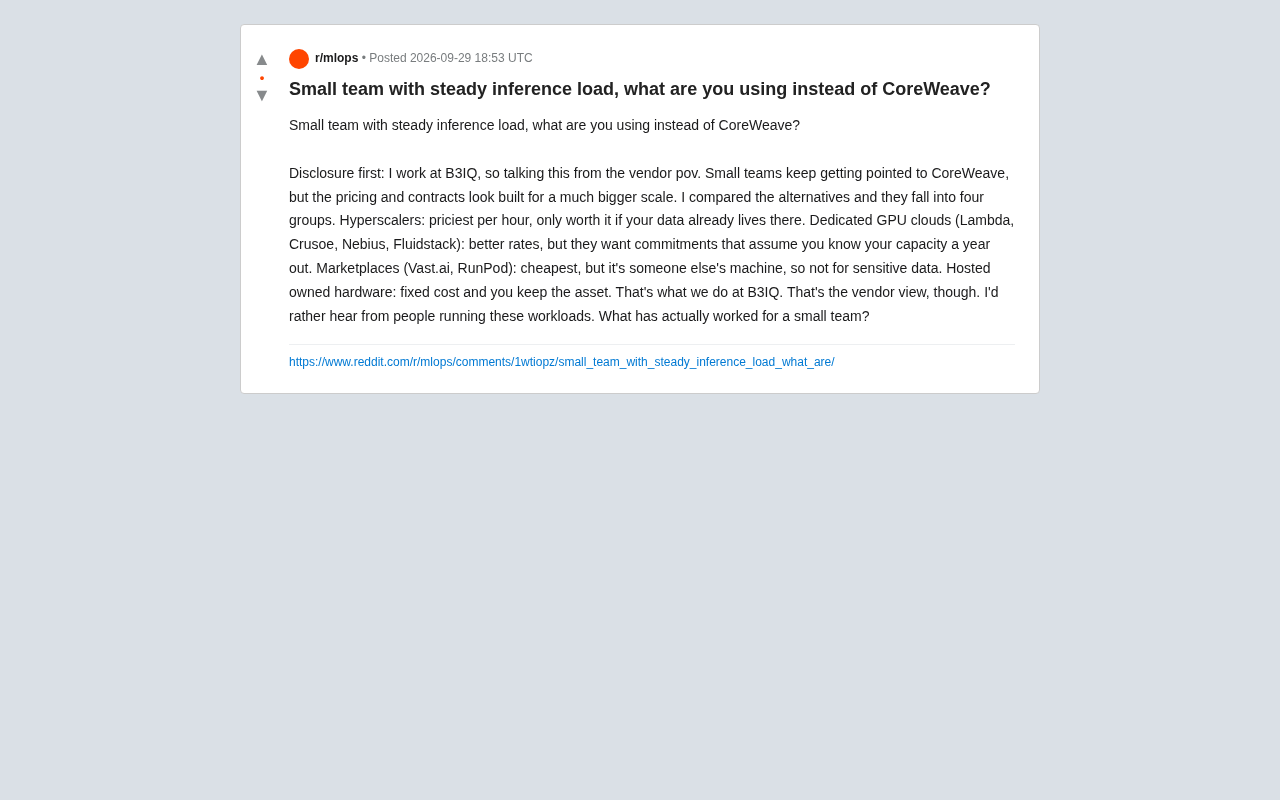
A practitioner from GPU infrastructure company B3IQ raised this question on Reddit. He openly acknowledged his vendor perspective, but the core observation is worth every small team's attention: CoreWeave's pricing structure and contract terms are fundamentally designed for larger-scale customers. For teams with stable monthly inference volumes that don't reach hyperscale, this model often means paying for flexibility and commitments they'll never actually use.
The Real Trade-offs Across Four Categories
The practitioner organized the GPU compute market into four broad categories, each with clear boundaries and trade-offs.
Hyperscalers
Cloud giants like AWS, GCP, and Azure charge the highest on-demand rates of any option in this space. Their value proposition only holds in one specific situation: your data already lives on their platform. Keeping compute within the same ecosystem saves you from the complexity of data migration and cross-platform integration. But if you're just looking for raw GPU capacity, the premium you pay isn't worth it.
The high premium hyperscalers charge for GPU compute is partly because they offer more than bare-metal compute — they provide deep integration with storage (S3, GCS), networking, security, and monitoring as a complete ecosystem. Data gravity is the key concept here: when large volumes of training or business data already reside on a cloud platform, cross-platform transfers not only incur egress fees but also introduce latency and engineering complexity. The principle "keep compute where your data lives" is a pragmatic one. However, in pure inference scenarios, model weights typically need to be loaded only once, and subsequent request payloads are relatively small — the gravitational pull of data is far weaker than during training, which undermines the core argument for staying on a hyperscaler.
Dedicated GPU Clouds
Providers like Lambda, Crusoe, Nebius, and Fluidstack offer significantly better per-unit pricing than the hyperscalers. The catch is that they typically require some form of resource commitment — and that implicitly assumes you can forecast your capacity needs a year in advance. For small teams still exploring product-market fit or whose workloads could shift at any time, that long-term lock-in is itself a risk.
Marketplaces
Compute marketplaces like Vast.ai and RunPod offer the lowest prices, because you're essentially renting someone else's idle machines. The savings are real, but so are the trade-offs: you have limited control over the underlying hardware, and the shared nature of these platforms makes them unsuitable for inference tasks involving sensitive data. Scenarios with strict compliance and data isolation requirements should rule this category out entirely.
Vast.ai, RunPod, and similar platforms operate like a "GPU Airbnb" — aggregating individual mining rigs, small data centers, and idle enterprise GPUs into a rentable resource pool. Beyond data isolation concerns, the core risks include inconsistent hardware reliability (consumer-grade GPUs like the RTX 4090 differ significantly from datacenter-grade A100s in terms of dependability), nodes going offline mid-task, and the absence of SLA guarantees. For offline batch inference, these risks may be tolerable. But for real-time inference serving end users, P99 latency and availability requirements often make shared marketplaces a poor fit. Some platforms offer "secure enclave" or dedicated node options to address compliance concerns, but pricing for those options converges toward dedicated clouds, eroding the cost advantage.
Hosted Owned Hardware
The fourth category is the colocated owned hardware model — fixed costs, clear asset ownership — and it's the path B3IQ itself has taken. The team owns the hardware outright and runs it through a hosting provider. Costs are predictable, and over the long run you avoid the uncertainty of per-hour billing. The trade-off, of course, is upfront capital expenditure and a higher bar for load stability.
Load Stability Is the Critical Variable
The most valuable insight from this discussion is actually embedded in the phrase "steady inference load."
The merits and drawbacks of each option depend heavily on whether your workload is stable and predictable. If your inference volume fluctuates wildly month to month, on-demand marketplaces or cloud providers give you the elasticity you need. But if your load is consistently stable over time, continuously renting elastic compute by the hour is wasteful — you're paying for the ability to scale up at any moment, while almost never actually needing to.
For small teams with steady workloads, fixed-cost hosted hardware or medium-to-long-term dedicated cloud commitments may actually be more economical than seemingly flexible on-demand compute. This is precisely why CoreWeave's model — designed for large-scale elastic demand — feels like a bad fit for smaller teams.
From a cloud economics perspective: on-demand pricing is essentially an insurance premium for uncertainty. Cloud providers must maintain enough idle capacity to handle demand spikes, and that cost gets passed on to users. Reserved Instances or Committed Use Discounts work differently — by having users lock in usage upfront, providers can optimize resource scheduling and offer meaningful discounts. On AWS, one-year reserved instances typically run 30–40% cheaper than on-demand pricing. When load predictability increases further, the amortized cost of owned hardware often beats any cloud option — but at the cost of reduced liquidity. If business contracts during the depreciation period, fixed costs don't contract with it. This is why "load stability" isn't just a technical metric — it's a core input for financial risk management.
Real-World Community Experience Matters Most
To his credit, this practitioner — despite his vendor identity — explicitly handed the conversation back to developers actually running these workloads: "This is just a vendor perspective. I'm more interested in hearing from people actually running these loads. What actually works for small teams?"
This posture is a useful reminder: any vendor's framework and recommendations come with an inherent point of view. For teams making infrastructure decisions, the most reliable signal usually comes from comparable teams sharing real-world experience — the pitfalls they hit, the numbers they ran — rather than any vendor's comparison matrix.
Practical Guidance for Small Teams
Drawing from this discussion, here are a few actionable considerations for small teams with steady inference loads:
- Quantify your load first: Understand whether your inference volume is truly stable and how much it fluctuates month to month — this is the prerequisite for any decision.
- Calculate total cost, not hourly rate: Don't anchor on unit price alone. Factor in commitment periods, idle capacity costs, and data migration costs.
- Data sensitivity takes priority: For inference tasks involving sensitive data, rule out shared compute marketplaces from the start.
- Be skeptical of over-provisioned elasticity: If your load is stable, the premium you pay for elasticity may be your biggest hidden waste.
- Validate across sources: Vendor comparisons are just a starting point — cross-checking with teams running similar workloads is what actually matters.
There's no universal answer for GPU compute selection. But making "load characteristics" — rather than brand recognition — the center of your decision-making is how small teams avoid paying for things they'll never use.
Related articles

Chain of Thought Isn't Just for AI: How Humans Can Use CoT to Improve Thinking Quality
Chain of Thought isn't just a prompt trick for large models. Starting from a Hacker News discussion, this article analyzes why CoT works for human thinking too, breaks down actionable ways to transfer it, and highlights the key differences between human CoT and machine CoT.
Cloudflare Teams Up with OpenAI: Closi…
Cloudflare Teams Up with OpenAI: Closing the Loop from Vulnerability Discovery to Defense with AI
Cloudflare uses OpenAI Daybreak to investigate security vulnerabilities and generate reviewable remediation plans, while developers use Codex to boost coding efficiency and quality.

Orca Multi-Agent Orchestration in Practice: A Guide to Parallel Collaboration with Claude and Codex
Orca is Stable AI's free open-source agent workbench supporting 34 agents like Claude Code and Codex in parallel. Learn its Git worktree isolation, multi-model orchestration, and mobile management.