gpui-kit: A Rust Cross-Platform Desktop GUI Component Library Built on GPUI

Longbridge open-sources gpui-kit, a Rust GUI component library on GPUI, gaining 1K stars in a week.
gpui-kit is an open-source Rust GUI component library from fintech company Longbridge, built on GPUI — the GPU-accelerated UI framework created by the Zed editor team. The project surpassed 15,800 GitHub stars with nearly 1,000 gained in a single week, reflecting strong community demand for native Rust desktop UI components. It wraps common UI elements like buttons, inputs, and lists into reusable Rust components, significantly lowering the barrier to building full desktop apps with GPUI. Key advantages include GPU-accelerated rendering, a native experience without browser engine dependencies, and Rust's memory safety guarantees — all validated through Longbridge's real production use.
gpui-kit: A GUI Component Library for Building Cross-Platform Desktop Apps in Rust
Rust is becoming an increasingly popular choice among desktop application developers. gpui-kit, an open-source project from the Longbridge team, has recently gone viral on GitHub — gaining nearly a thousand stars in a single week, surpassing 15,800 total stars, and approaching 1,000 forks. Built on the GPUI framework, it provides a set of Rust GUI components for cross-platform desktop applications, filling a critical gap in Rust's relatively underdeveloped desktop UI ecosystem.
What Are GPUI and gpui-kit?
GPUI is a GPU-accelerated UI framework built by the team behind the Zed code editor. It emphasizes high-performance rendering through an architecture that combines immediate mode and retained mode paradigms. By offloading rendering to the GPU, it maintains smooth frame rates even with complex interfaces — one of the foundational reasons behind Zed's famously fluid experience.
gpui-kit is a component library built on top of GPUI, analogous to a component framework in the web frontend world. It encapsulates common UI elements — buttons, text inputs, lists, modals, and more — into reusable Rust components, so developers don't have to hand-craft every widget from low-level primitives. This significantly lowers the barrier to building complete desktop applications with GPUI.
Immediate Mode vs. Retained Mode are the two dominant paradigms in GUI framework design. Retained mode frameworks (such as Qt and WPF) maintain a persistent widget tree in memory; the application updates the UI by modifying tree nodes, and the framework decides when to redraw. Immediate mode frameworks (such as Dear ImGui) have the application fully "describe" the entire interface on every frame — the framework retains no widget state. This approach suits games and debugging tools, where logic is simpler but state management falls entirely on the developer. GPUI blends both: it applies immediate mode thinking to rapidly changing parts of the UI, while using retained mode to reduce unnecessary recomputation for stable structures. The result is clean code without sacrificing rendering performance — a key design decision that keeps Zed responsive even under demanding scenarios like opening large files or multi-cursor editing.
Why It Deserves Attention
Rust has built a strong ecosystem in systems programming, CLI tooling, and backend services, but has long lacked a mature, unified solution for graphical interfaces. Existing Rust GUI options each come with trade-offs: some target immediate-mode game tooling, some rely on web technology stacks, and others are still in early stages. gpui-kit's arrival means developers can now access a relatively complete component toolbox built on a native, GPU-accelerated rendering pipeline.
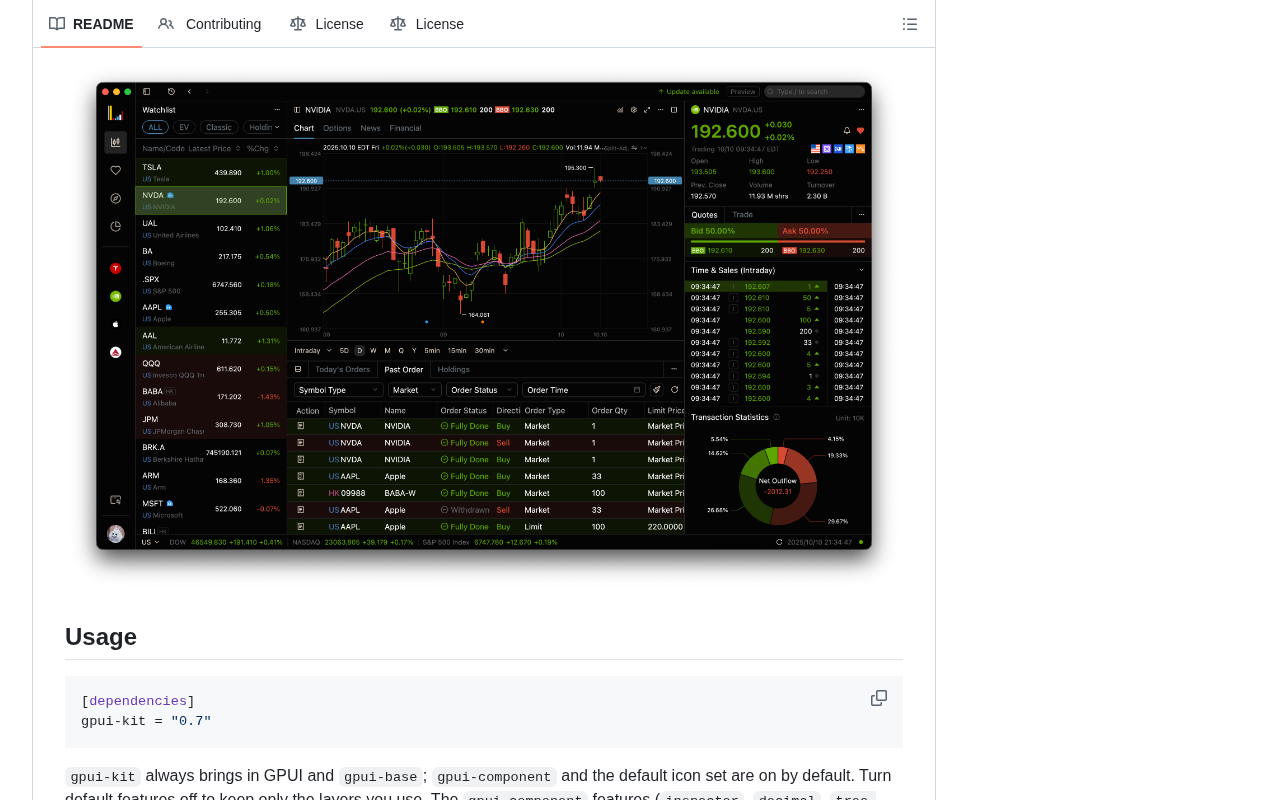
For teams aiming to build high-performance desktop applications, this combination offers several compelling advantages: GPU-accelerated rendering that shines when handling large numbers of UI elements; a native experience that avoids browser engine dependencies, keeping bundle size and memory usage under control; and Rust's guarantees of memory safety and concurrency safety, eliminating a whole class of bugs common in traditional C++ desktop development.
The Rust GUI ecosystem currently includes several frameworks with distinct focuses: egui is a pure immediate-mode framework, popular for game tooling and scientific visualization — lightweight and easy to learn, but limited in style customization. Tauri leverages the system WebView to render UI, letting frontend developers write interfaces in HTML/CSS/JS with a small bundle size, but dependent on the platform's WebView version. Slint uses a declarative DSL to describe interfaces, targeting both embedded and desktop markets. Iced draws inspiration from the Elm architecture, pursuing a functional style. By contrast, GPUI centers on its own GPU rendering pipeline — independent of any system UI components or browser engine — offering unique advantages in rendering consistency and raw performance, albeit with a steeper learning curve and a less mature ecosystem. gpui-kit's value lies precisely in bridging the gap of "GPUI has the capability, but the component library was missing."
Engineering Background: Built by Longbridge
gpui-kit is maintained by the Longbridge team. As a fintech company, Longbridge has real-world business requirements around desktop client performance, stability, and cross-platform consistency. Open-sourcing their internal practices as a component library both reflects the team's serious investment in Rust desktop development and gives the broader community access to components refined through a real production product.
The rapid accumulation of stars is a strong signal of the community's pent-up demand for a "Rust + GPUI component library." Compared to building from scratch, a component library backed by a company and actively maintained tends to inspire much more confidence for production use.
Who Is It For?
gpui-kit isn't a one-size-fits-all solution. It's best suited for the following scenarios:
- Teams already using or planning to use GPUI who want to accelerate UI development;
- Projects demanding a native, high-performance desktop experience, such as editors, financial terminals, and data visualization tools;
- Developers familiar with the Rust ecosystem who are comfortable working with relatively cutting-edge toolchains.
A word of caution: GPUI itself is still evolving rapidly, and its APIs may change. Documentation and community resources are not yet as rich as those for more mature cross-platform frameworks. For projects that only need a simple interface, or teams unfamiliar with Rust, traditional solutions may still be the safer choice.
Summary
gpui-kit represents a positive signal that Rust's desktop GUI ecosystem is maturing. It builds on GPUI's GPU-accelerated rendering capabilities, lowers the development barrier through a set of reusable components, and carries the credibility of real-world validation through Longbridge's engineering practice. As Rust continues to expand at the application layer, the value of projects like this will only grow. For teams looking to explore native, high-performance desktop development, it's well worth adding to the shortlist of candidates during technical evaluation.
Related articles

JobRunner MCP Server: AI Agents Can Now Fix Failed Java Jobs
JobRunner launches an open-source MCP server enabling AI agents to view cluster status, diagnose failures, and recover Java jobs—incident response from any cloud coding environment or existing agent.

MLAI Digital Launches 9 Security Agents: MCP Server Safeguards the Full Lifecycle of Agentic AI
MLAI Digital launches Security MCP Server with nine built-in specialized security agents covering vulnerability discovery, attack simulation, prompt injection detection, API and infrastructure assessment, and accelerated remediation—embedding security validation across the full Agentic AI lifecycle from development to production.

Running Isaac Lab on H100 GPUs: Exploring Better Approaches
Exploring optimization methods for running Isaac Lab on NVIDIA H100 GPUs, including MIG configuration, mixed precision, TensorRT acceleration, and community experience to improve robotics simulation and reinforcement learning efficiency.