Graph Attention Networks + Low-Cost Hardware: A New Approach to Seizure Detection

Researchers use graph attention networks with low-cost hardware to detect seizures, exploring AI healthcare deployment in low-resource regions.
The article discusses a seizure detection study for low-resource regions that uses Graph Attention Networks (GAT) on EEG signals, modeling electrode channels as graph nodes and channel correlations as edges to dynamically learn inter-channel relationships via attention. Its core value is placing hardware availability and algorithmic efficiency on equal footing, not model novelty. Low-cost hardware's low SNR, few channels, and limited sampling rates challenge robustness, while Reddit doubts focus on cross-patient/device generalization and annotation quality. Deployment still requires model compression, local lightweight fine-tuning, and interpretable outputs.
When Deep Learning Meets Scarce Resources: The Real-World Dilemma of Seizure Detection
In low-income and low-resource regions, diagnosing epilepsy has long been a double bind: professional EEG equipment is expensive and requires trained neurologists to interpret, and primary care facilities often lack both. A study that sparked discussion in the Reddit community attempts to detect seizures using Graph Attention Networks (GAT) paired with accessible hardware, offering a new way of thinking about this dilemma.
The value of this research isn't in proposing yet another deep learning model, but in placing "hardware availability" and "algorithmic efficiency" on equal footing. For resource-constrained settings, a model that scores high on top-tier datasets but depends on expensive equipment and massive compute has sharply diminished practical value.
Why Graph Attention Networks
Traditional seizure detection methods mostly treat EEG signals as time series, using CNN or RNN to extract features. Such methods ignore the spatial relationships in EEG signals—the synchrony and functional connectivity between different electrode channels are precisely important biomarkers of seizure onset.
Graph Attention Networks treat each electrode channel as a node in a graph, with inter-channel correlations as edges, and use an attention mechanism to automatically learn which channel connections matter more for the current judgment. Compared with graph convolutional networks that use a fixed topology, GAT's attention weights can adjust dynamically, better matching the rapidly changing brain activity during seizures.
According to the researchers, another motivation for this choice is computational efficiency: attention mechanisms can improve representational capacity without significantly increasing parameter count, which is a key advantage for deployment on low-power hardware.
The Core Mechanism of Graph Attention Networks (GAT)
GAT was proposed by Veličković et al. in 2018, and its key innovation is introducing self-attention into graph neural networks. Specifically, for each node in the graph, GAT computes attention coefficients between it and all neighboring nodes: the feature vectors of two nodes are concatenated or summed, passed through a learnable linear transformation and LeakyReLU activation, then normalized via softmax over the neighbor set to obtain the weight of each edge. A node's new representation is the weighted aggregation of its neighbors' representations. Unlike GCN, which relies on a fixed normalized adjacency matrix, GAT's edge weights are data-driven and can stack multi-head attention to stabilize training. For EEG, this means the model can adaptively adjust inter-channel importance across different patients and different seizure stages, without presupposing a static brain functional connectivity graph.
Spatial Relationships of EEG Channels and Functional Connectivity
Scalp EEG is typically recorded from 19 to 64 electrodes arranged according to the international 10-20 system, with each electrode recording potential changes in the cortical region beneath it. A core electrophysiological feature of seizures is hypersynchronous discharge: multiple channels in the seizure onset zone and its propagation network exhibit highly correlated rhythmic activity. Therefore, inter-channel correlations (such as phase-locking value, coherence, and Pearson correlation coefficient) can serve as features characterizing seizure propagation pathways. Treating electrodes as graph nodes and channel correlations as edges is essentially constructing a functional connectivity network that evolves over time. This kind of graph modeling has been applied in seizure detection, sleep staging, and brain-computer interfaces; its advantage lies in preserving both temporal dynamics and spatial topology, whereas pure CNN/RNN time-series models struggle to explicitly express the latter.
What "Accessible Hardware" Means
The "accessible hardware" in the title is central to understanding this study's positioning. In low-resource environments, the cost, maintenance, and consumables of clinical-grade EEG equipment are unbearable burdens. The research focuses on how to acquire EEG signals of sufficient quality using consumer-grade or open-source hardware, and to keep the algorithm usable under such signal conditions.
The challenge of this approach is that low-cost hardware signals often have lower signal-to-noise ratios, fewer channels, and more limited sampling rates. The model must remain robust under such "imperfect" inputs, rather than performing well only on clean laboratory data.
The State of EEG Acquisition Hardware in Low-Resource Settings
Clinical-grade EEG equipment (such as Nihon Kohden, Natus, etc.) can cost tens of thousands to hundreds of thousands of dollars per unit, requires conductive paste, dedicated amplifiers, and regular calibration, and interpretation depends on trained neuroelectrophysiologists. Alternatives in low-resource settings include consumer-grade devices (such as OpenBCI, Emotiv, Muse, etc.) and open-source hardware, which typically have only 4 to 16 channels, sampling rates of 128 to 256 Hz, use dry electrodes, and can bring costs down to hundreds of dollars. The trade-off is degraded signal quality: dry electrodes have high contact impedance and are susceptible to EMG and motion artifacts, and fewer channels limit spatial resolution, making it impossible to cover the full 10-20 layout. These constraints directly determine the algorithm's input dimensions, computational budget, and robustness requirements, and are also important yardsticks for judging whether a study can truly be deployed.
How Far from the Lab to the Grassroots
Judging from the Reddit community's reactions, the discussion centered on two directions: first, questions about the model's generalization ability under real low-quality signals; second, concerns about data sources and annotation quality. These doubts are reasonable—a common problem with seizure detection models is performance degradation across patients and devices.
For such solutions to truly serve low-resource regions, several engineering-level problems still need to be solved: model compression and quantization to fit edge devices, lightweight fine-tuning on local data, and designing output explanations that doctors can understand. An incidental benefit of graph attention networks is that attention weights can provide a degree of interpretability, helping clinical staff understand which channel relationships the model focused on.
My Take
The direction of this research is commendable: considering algorithmic innovation and hardware constraints within the same framework is closer to real-world needs than merely chasing benchmark scores. But the community's doubts also hit the mark—there is a distribution gap between signals acquired by low-cost hardware and public datasets, and whether the model can bridge this gap requires more validation data from real grassroots settings to answer.
For developers focused on deploying AI in healthcare, the lesson from such work is: in resource-constrained settings, "good enough and it runs" is often more valuable than "optimal but it won't run."
One-line Summary
Researchers use graph attention networks with low-cost hardware to detect seizures, exploring a path for deploying AI healthcare in low-resource regions.
Paragraph Summary
The article discusses a study on seizure detection for low-resource regions that uses Graph Attention Networks (GAT) to process EEG signals, modeling electrode channels as graph nodes and channel correlations as edges, and dynamically learning inter-channel relationships through an attention mechanism. The article emphasizes that the core value of this work lies not in the novelty of the model itself, but in placing hardware availability and algorithmic efficiency on equal footing. The low signal-to-noise ratio, few channels, and limited sampling rates brought by low-cost hardware pose challenges to model robustness, while the Reddit community's doubts center on cross-patient and cross-device generalization ability and data annotation quality. The article argues that for such solutions to truly serve the grassroots, engineering problems such as model compression and quantization, local lightweight fine-tuning, and interpretable outputs still need to be solved.
Related articles
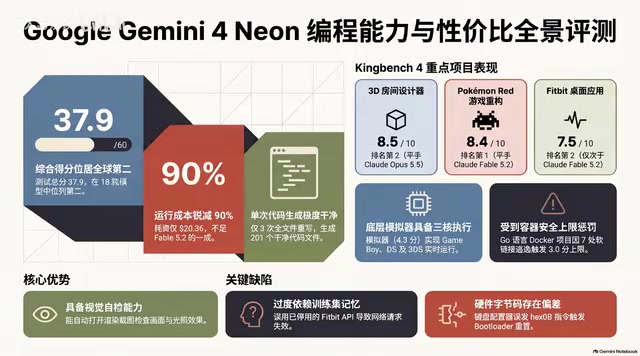
Gemini 4 Neon Hands-On: Value King or Confident Catastrophe?
Gemini 4 Neon review: 1M-token context, four thinking levels, 201 files in one KingBench4 pass at one-tenth Fable 5.2's cost—but it hallucinates fake data, leaves 7 symlink escapes, and bricks keyboards.

Google Gemini 4 Neon Hands-On: 6 3D Works That Impress and Fail
Hands-on with Google Gemini 4 Neon on a 3060 laptop: 6 3D works tested. Sunshower Fishing Harbor and mechanical keyboard impress; soft-body physics and faces fall short.

Gemini 4 Neo Web Novel Writing Test: Faint AI Flavor, Textured Dialogue
Bilibili creator's first-look review of Gemini 4 Neo for Chinese web novel writing: testing a Three Kingdoms transmigration opening with faint AI flavor, emotionally textured dialogue, and strong crisis building, plus comparison of 4A/4H/4C models and full workflow demos.