Graphify: Stop Making AI Agents Read Projects File by File

Graphify builds a local, zero-token knowledge graph of your project so AI agents query the map instead of reading every file.
The article introduces Graphify, a tool for AI coding assistants that unifies project code, documentation, and PDFs into a knowledge graph, with functions as nodes and call/reference relationships as edges. Agents no longer linearly traverse all files but query associations on the graph and then read local content. Its three key features: graph building consumes no AI tokens, runs entirely on a local laptop, and is completely free. The article notes that cloud assistants "reading all files" is a stopgap without project-level indexes, and that longer context means higher token costs; a graph is a compressed representation that significantly reduces retrieval overhead. The tool best suits medium-to-large codebases with complex cross-file dependencies. The author also cautions that public information comes mainly from one video, and that construction algorithms, language support, agent integration, and incremental updates are not detailed, so the 142,000-star figure should be verified independently.
From "reading file by file" to "asking the map directly"
When you ask a cloud-based code assistant a seemingly simple question, it often ends up reading every file in your project from start to finish, one after another. Every file it reads consumes tokens—and consumes your budget. This brute-force traversal approach causes costs to balloon rapidly as projects grow in size.
The YouTube channel introducing Graphify uses a vivid analogy: it's like visiting a strange city and having to ask for directions again every time you go somewhere new. According to the video, this is exactly the pain point Graphify aims to solve—it builds a "map" of your entire project locally, so the AI agent no longer flips through files one by one but queries this map directly.

What Graphify is: turning a project into a knowledge graph
Graphify's core idea is to unify all kinds of materials in a project—code, documentation, PDFs, and more—into a single knowledge graph. In this graph, every function is a node (dot), and every association is an edge (line). Call relationships between code, and correspondences between documentation and code, are all explicitly expressed as connections on the graph.
With this structured mapping, the AI agent no longer needs to linearly scan all files when facing a question. Instead, it can query the graph directly: "What is this thing connected to?" Then it follows the edges to find related nodes and answers with context. This effectively upgrades "retrieval" from text matching to relationship traversal on a graph.
According to the video, Graphify has 142,000 stars on GitHub—a scale that shows it has gained considerable attention in the developer community.
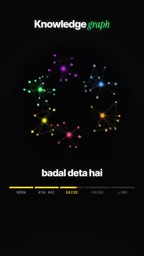
A knowledge graph is a data model that organizes information in a graph structure, composed of nodes and edges: nodes represent entities, and edges represent relationships between entities. In a code context, nodes can be functions, classes, files, or documentation fragments, while edges represent semantic relationships such as calls, references, inheritance, and documentation references. Unlike traditional relational databases, graph structures are naturally suited to expressing multi-hop, networked associations. As a result, queries like "who calls this function" or "which modules does this document describe" only require traversing along edges, without scanning all text.
Programmatically building a code knowledge graph typically relies on abstract syntax tree (AST) parsing, symbol resolution, and cross-file reference analysis to automatically extract deterministic nodes and edges. This is fundamentally different from having a large language model "read" code to generate summaries: the former is static analysis driven by syntax and structure, with reproducible results; the latter relies on model reasoning, is costly, and may produce hallucinations.
Three key features: local, free, and zero-token graph building
The graph-building process consumes no AI tokens
The most noteworthy aspect of Graphify is that the process of generating the code map uses no AI tokens at all. This means graph building itself is a deterministic, repeatable computational process rather than having a large model "understand" each file. For long-maintained projects, this can save considerable invocation costs.
Everything runs locally
The entire graph construction runs on your own laptop, with no need to upload code and documentation to external services. For teams with code confidentiality requirements, this is a substantial advantage—sensitive project materials never have to leave the local environment.
Free to use
The video emphasizes that this capability is completely free. Combined with its local operation, it is more like an infrastructure component in a developer's toolchain than a SaaS product billed by usage.
The real nature of the token cost problem
The behavior of cloud code assistants "reading all files" is essentially a stopgap when there is no project-level index. Without an index, the model can only ensure recall by expanding the context window—and the longer the context, the greater the token consumption and the slower the response.
A knowledge graph provides a compressed representation: the graph is usually much smaller than the total volume of raw text while preserving structural relationships. When an agent needs to locate a function or a piece of documentation, starting from relevant nodes on the graph is more efficient than traversing the entire repository. This strategy of "check the map first, then read locally" also mirrors how human developers understand unfamiliar codebases.
A token is the basic unit of measurement for text processed by large language models, roughly corresponding to a word or subword fragment. A model's context window is capped by the number of tokens, and API calls are billed by the number of input and output tokens. When an agent reads an entire repository file by file, all file contents enter the context as input tokens. The larger the project, the more likely a single request's token count is to approach or even exceed the context window, leading to higher costs, increased latency, and potentially lower answer quality due to "lost in the middle" effects.
Retrieval-augmented generation (RAG) is a common approach to mitigating this problem: first retrieve the fragments most relevant to the question from an external knowledge base, then inject them into the context, avoiding stuffing all materials into the prompt. A knowledge graph can be seen as a structured variant of RAG—the retrieval unit shifts from text chunks to nodes and their neighborhoods on the graph. Recall can leverage both semantic similarity and explicit relationship edges, making it often more precise than pure vector retrieval on problems like cross-file dependencies.
Applicable scenarios and things to note
Tools like Graphify are best suited to medium-to-large codebases: the more files a project has and the more complex its cross-file dependencies, the more obvious the retrieval efficiency gains from a graph become. For projects that mix documentation, PDFs, and code, a unified graph can also help agents establish connections across material types.
It should be noted that public information about Graphify currently comes mainly from the brief introduction in that video. The video does not elaborate on the graph construction algorithm, the range of supported languages, integration with specific agent frameworks, or the mechanism for syncing graph updates with code changes. The 142,000 stars figure also comes from the video's narration, so readers are advised to check the GitHub repository themselves to verify the project's current status and capability boundaries.
From a trends perspective, providing structured project indexes for AI coding assistants is becoming a practical path to reducing token costs and improving answer accuracy. The approach represented by Graphify—"local graph building, free graph building, zero-token graph building"—deserves further attention from developers working on AI coding toolchains.
Related articles

AI Coding Enters the Team Collaboration Era: Interpreting Three Major Moves from Meta, GitHub, and Mistral
Meta acquires Conductor, GitHub Copilot Fusion becomes available, Mistral opens Large 4 weights—three moves show AI coding shifting from code generation to organizing development workflows. This article explains task orchestration, model collaboration, and cost control for developers.

Building a RAG Assistant with Dify: A Practical Guide to Knowledge Bases, Workflows, and Agent Nodes
How should knowledge bases, workflows, and Agent nodes connect in a Dify RAG assistant? We break down the division of labor and wiring logic for a shippable app.
 Tech Frontiers
The AI Industry Doesn't Lack Marketing—It Lacks Good Products
AI faces market selloffs and public skepticism—is marketing really the problem? This analysis of market signals and product experience argues the core困境 is incomplete products and a gap between promises and experience; the only way to change perceptions is to ship better products.