GraphRAG in Practice: Rebuilding Document Q&A Systems with Knowledge Graphs

GraphRAG uses knowledge graphs to enable cross-document reasoning in enterprise document Q&A systems.
This article examines the Agentic GraphRAG Blueprint, an open-source reference architecture that combines knowledge graphs with RAG for large-scale document Q&A. It uses Leiden community detection for graph clustering, offers local and global hybrid search modes, and features incremental ingestion to control token costs. The architecture provides domain-agnostic prompt design and flexible deployment from Docker to Terraform-based cloud setups, bridging the gap between academic GraphRAG research and production-ready implementation.
Introduction: When RAG Meets Knowledge Graphs
Traditional Retrieval-Augmented Generation (RAG) solutions for large-scale document Q&A typically rely on simple text chunking and retrieval. While straightforward to implement, this approach has an obvious weakness: it struggles to connect facts scattered across different documents. When users ask questions that require cross-document reasoning, pure vector retrieval tends to return isolated fragments, producing answers that lack a global perspective.
Retrieval-Augmented Generation (RAG), proposed by Facebook AI in 2020, works by having large language models retrieve relevant information from external knowledge bases before generating answers, thereby mitigating inherent issues like model hallucination and outdated knowledge. The typical RAG workflow involves splitting documents into fixed-length text chunks, converting them into vectors using embedding models (such as OpenAI's text-embedding series or BGE), and storing them in a vector database. At query time, cosine similarity is used to find the chunks most semantically similar to the question. This approach works well for single-document, fact-based Q&A, but falls short when information is spread across multiple documents and requires synthesized reasoning—because vector similarity can only measure semantic proximity, not establish explicit logical connections between entities. This is precisely the bottleneck that GraphRAG aims to break through.
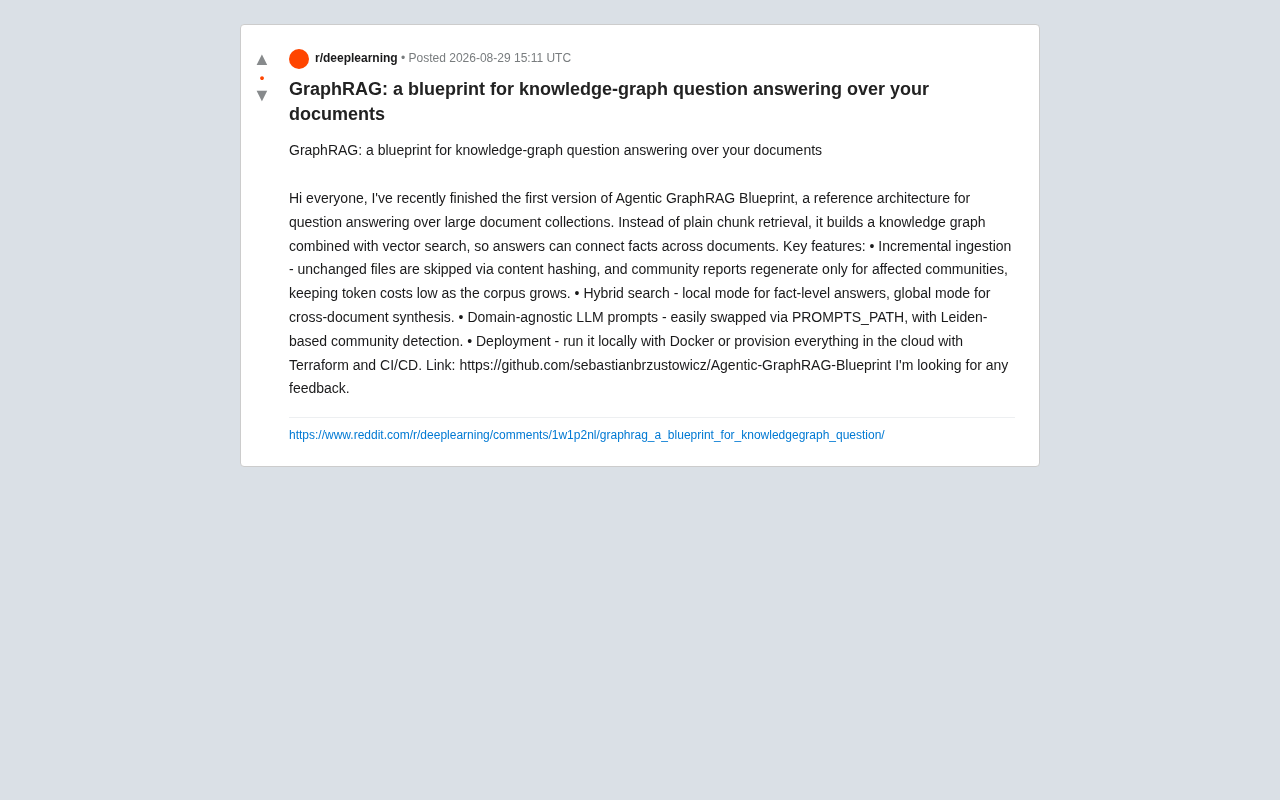
Developer Sebastian Brzustowicz shared his open-source project Agentic GraphRAG Blueprint on Reddit—a reference architecture designed for Q&A over large-scale document collections. Its core idea is to move beyond simple text chunk retrieval by building a knowledge graph combined with vector search, enabling answers that connect facts across multiple documents.
Core Design Principles of GraphRAG
From Isolated Chunks to Connected Graphs
The key differentiator of GraphRAG is that it goes beyond merely "finding relevant passages"—it attempts to understand the semantic relationships between documents. Through entity extraction and relationship construction from document content, the system builds a knowledge graph where nodes represent entities and edges represent the relationships between them.
On top of this, the project employs the Leiden community detection algorithm to cluster the graph. This step groups highly related entities into distinct "communities" and generates summary reports (community reports) for each one. This hierarchical structure enables the system to answer both fine-grained factual questions and perform topic-level synthesis across the entire corpus.
The Leiden algorithm, proposed by researchers at Leiden University in the Netherlands in 2019, is an improved version of the classic Louvain algorithm. It addresses Louvain's flaw of potentially producing "poorly connected communities" by guaranteeing that each community is well-connected internally. It works by optimizing a modularity metric to group tightly connected nodes into the same community while minimizing inter-community connections. In GraphRAG, the Leiden algorithm is crucial because it performs hierarchical clustering on the knowledge graph composed of entities and relationships—highly related entities (such as multiple concepts under the same technical topic) are automatically grouped into the same community, providing the structural foundation for subsequent community summary generation. This hierarchical community structure is the technical cornerstone that enables GraphRAG's "global topic synthesis" capability.
Hybrid Search: Balancing Local and Global Retrieval
The project offers two retrieval modes, which represent the essence of the GraphRAG architecture:
- Local mode: Targets fact-level questions by focusing on specific entities and their neighboring relationships to quickly locate precise answers. Ideal for questions like "What is the definition of a given concept?" or "What are the specific parameters of a particular technology?"
- Global mode: Targets questions requiring cross-document synthesis by leveraging community reports for higher-level information integration. Ideal for questions like "How do multiple projects compare in their technology choices?"
This "local + global" dual-mode design neatly covers the two most common types of document Q&A needs—precise lookup and thematic synthesis.
Engineering Highlights: Built for Production
Incremental Ingestion to Control Token Costs
For any team dealing with a continuously growing document library, cost control is an unavoidable concern. GraphRAG Blueprint addresses this with targeted optimizations:
Through a content hashing mechanism, the system automatically skips files that haven't changed, avoiding redundant processing. Furthermore, when new documents are added, community reports are only regenerated for affected communities rather than rebuilt from scratch. This means that as the corpus scales, token consumption (i.e., LLM API costs) remains manageable.
It's worth noting that in the GraphRAG pipeline, entity extraction and community summary generation during the graph construction phase require extensive LLM calls—often the most expensive part of the entire system. For a knowledge base containing thousands of documents, a full graph rebuild might consume millions or even tens of millions of tokens, costing dozens of dollars or more. The incremental ingestion mechanism precisely identifies "which communities were affected by new documents" and minimizes the scope of recomputation, delivering substantial cost savings over long-term operation.
This design is especially critical for enterprise applications—real-world knowledge bases are continuously updated, and rebuilding the entire graph with every update would cause costs to spiral out of control.
Domain-Agnostic Prompt Design
The project also emphasizes domain-agnostic design. All LLM prompts can be easily swapped by configuring the PROMPTS_PATH path, meaning whether you're working with legal documents, medical records, or technical manuals, users can adapt the system to specific domains by adjusting prompt templates without modifying core code logic.
This pluggable prompt architecture significantly reduces the adaptation cost of deploying GraphRAG across different industries.
Flexible Deployment Options: From Local to Cloud
At the deployment level, the project accommodates both development and production scenarios:
- Local deployment: One-click setup via Docker for quick developer validation and experimentation.
- Cloud deployment: Infrastructure as Code (IaC) via Terraform, coupled with CI/CD pipelines, enables fully automated deployment of the entire system in cloud environments.
Infrastructure as Code (IaC) is a core practice in modern cloud-native engineering, describing and managing server, network, database, and other infrastructure configurations as code. Terraform, a leading IaC tool developed by HashiCorp, uses declarative syntax to orchestrate resources across multiple cloud platforms including AWS, Azure, and GCP, enabling versioned, reproducible, and automated infrastructure deployment. CI/CD (Continuous Integration/Continuous Delivery) ensures that code changes are quickly and reliably pushed to production through automated build, test, and release pipelines. GraphRAG Blueprint's provision of both Docker local deployment and Terraform cloud deployment reflects a dual consideration of development efficiency and production reliability, allowing teams to experiment quickly and transition smoothly to production.
This seamless local-to-cloud transition lowers the barrier for migrating from prototype to production.
Value Analysis: What Problems Does It Solve?
GraphRAG is not an entirely new concept—Microsoft previously released an open-source research project of the same name, validating the effectiveness of combining knowledge graphs with RAG. The value of this Blueprint lies in providing a production-ready reference architecture that engineers academic methods into practical solutions, filling gaps in incremental updates, hybrid search, and flexible deployment.
Microsoft Research officially open-sourced the GraphRAG project in 2024 and published the paper "From Local to Global: A Graph RAG Approach to Query-Focused Summarization," systematically demonstrating the advantages of combining knowledge graphs with RAG for handling "global queries." Their experiments showed that for query tasks requiring understanding of an entire dataset's themes, GraphRAG's answer comprehensiveness and diversity significantly outperformed traditional vector RAG. This research sparked widespread industry interest in graph-enhanced retrieval, giving rise to various implementations including those from LlamaIndex, Neo4j, and others. Sebastian's Blueprint builds on this research foundation, advancing it from experimental code to a production-ready reference architecture that bridges the gap between academic validation and production deployment.
This type of architecture offers clear advantages for the following scenarios:
- Q&A scenarios requiring cross-document reasoning: For questions like "How do Project A and Project B differ in their technology choices?"—where pure vector retrieval falls short—GraphRAG can generate more complete answers by connecting entity information across different documents through the knowledge graph.
- Large-scale, continuously updated knowledge bases: The incremental ingestion mechanism significantly reduces maintenance costs, making it well-suited for enterprise internal knowledge management systems.
- Multi-domain adaptation needs: The pluggable prompt design provides the flexibility to serve different industries with the same architecture.
That said, as a "first version" open-source project, it's still in its early stages, and the author has publicly solicited feedback on Reddit. The quality of knowledge graph construction is highly dependent on the accuracy of entity extraction and relationship identification—a challenge shared by all GraphRAG solutions. Missed or misidentified entities directly lead to missing or erroneous nodes in the graph, which in turn affect community partitioning and final answer accuracy. Moreover, differences in entity recognition capabilities across LLMs mean that solution effectiveness will vary depending on the underlying model chosen. In practice, fine-tuning prompts for specific domains—or even introducing manual verification steps—is often necessary to ensure graph quality.
Conclusion
GraphRAG Blueprint represents an important evolutionary direction in document Q&A: moving from "retrieving fragments" to "understanding relationships." It uses knowledge graphs to compensate for traditional RAG's weakness in cross-document synthesis, while engineering-oriented features like incremental ingestion, hybrid search, and flexible deployment bring the solution closer to production readiness.
For developers building enterprise knowledge bases or intelligent document Q&A systems, this open-source project offers a technical blueprint well worth studying. The project is available on GitHub (Agentic-GraphRAG-Blueprint), and interested readers are encouraged to try it out and share their feedback with the author.
Key Takeaways
Related articles

Chain of Thought Isn't Just for AI: How Humans Can Use CoT to Improve Thinking Quality
Chain of Thought isn't just a prompt trick for large models. Starting from a Hacker News discussion, this article analyzes why CoT works for human thinking too, breaks down actionable ways to transfer it, and highlights the key differences between human CoT and machine CoT.
Cloudflare Teams Up with OpenAI: Closi…
Cloudflare Teams Up with OpenAI: Closing the Loop from Vulnerability Discovery to Defense with AI
Cloudflare uses OpenAI Daybreak to investigate security vulnerabilities and generate reviewable remediation plans, while developers use Codex to boost coding efficiency and quality.

Orca Multi-Agent Orchestration in Practice: A Guide to Parallel Collaboration with Claude and Codex
Orca is Stable AI's free open-source agent workbench supporting 34 agents like Claude Code and Codex in parallel. Learn its Git worktree isolation, multi-model orchestration, and mobile management.