Gravity Appears to Be Holographic: What Does This Mean for Reality?

The holographic principle suggests 3D space's physics is encoded on a 2D boundary, making gravity emergent from quantum entanglement.
The holographic principle grew out of black hole entropy research — a black hole's information capacity scales with the area of its event horizon, not its volume — leading physicists to propose that all physical information in any spatial region can be encoded on its 2D boundary. Maldacena's AdS/CFT duality provided the most rigorous mathematical framework yet, establishing a precise equivalence between a 5D bulk spacetime with gravity and a 4D boundary quantum field theory without gravity. In this holographic view, gravity and curved spacetime are not fundamental building blocks but emerge from boundary quantum entanglement — captured in the phrase "spacetime is stitched together by entanglement." However, AdS/CFT is validated in Anti-de Sitter space, not our actual accelerating universe, so the popular claim that "the universe is a hologram" remains an inspiring analogy rather than a proven fact.
A Physics Conjecture That Defies Intuition
Gravity might be "holographic" — this is one of the most puzzling and provocative ideas in contemporary theoretical physics. A recent article in Quanta Magazine revisited this question: if gravity is fundamentally a holographic phenomenon, then our understanding of three-dimensional space, time, and even "reality" itself may need to be completely redefined.
The "holographic" referred to here isn't the 3D projection of science fiction films, but rather the Holographic Principle that emerged from string theory and quantum gravity research. Its central claim sounds almost absurd: the degrees of freedom needed to describe all physical information within a region of space may be entirely encoded on the boundary surface of that region — not in its volume. In other words, everything that happens in three-dimensional space might be completely describable by data on a two-dimensional "screen."
Where the Holographic Principle Comes From
This idea can be traced back to the study of black hole entropy. Physicists discovered that the amount of information a black hole can contain is not proportional to its volume, but to the area of its event horizon. This counterintuitive conclusion was established through the work of Bekenstein and Hawking, and later elevated into a more general principle by 't Hooft and Susskind.
If information truly "lives" on the boundary, it implies that our universe may have been dramatically overestimated in terms of dimensions — the upper limit on the information capacity of physical content in a three-dimensional volume is actually determined by a two-dimensional surface. This is the most striking aspect of the holographic principle.
What gave this conjecture genuine computational power was the AdS/CFT duality proposed by Maldacena. It establishes a precise mathematical correspondence: the physics inside an Anti-de Sitter (AdS) space with gravity is equivalent to a gravity-free quantum field theory (CFT) on its boundary. This provides the most robust theoretical support to date for the idea that "gravity is holographic."
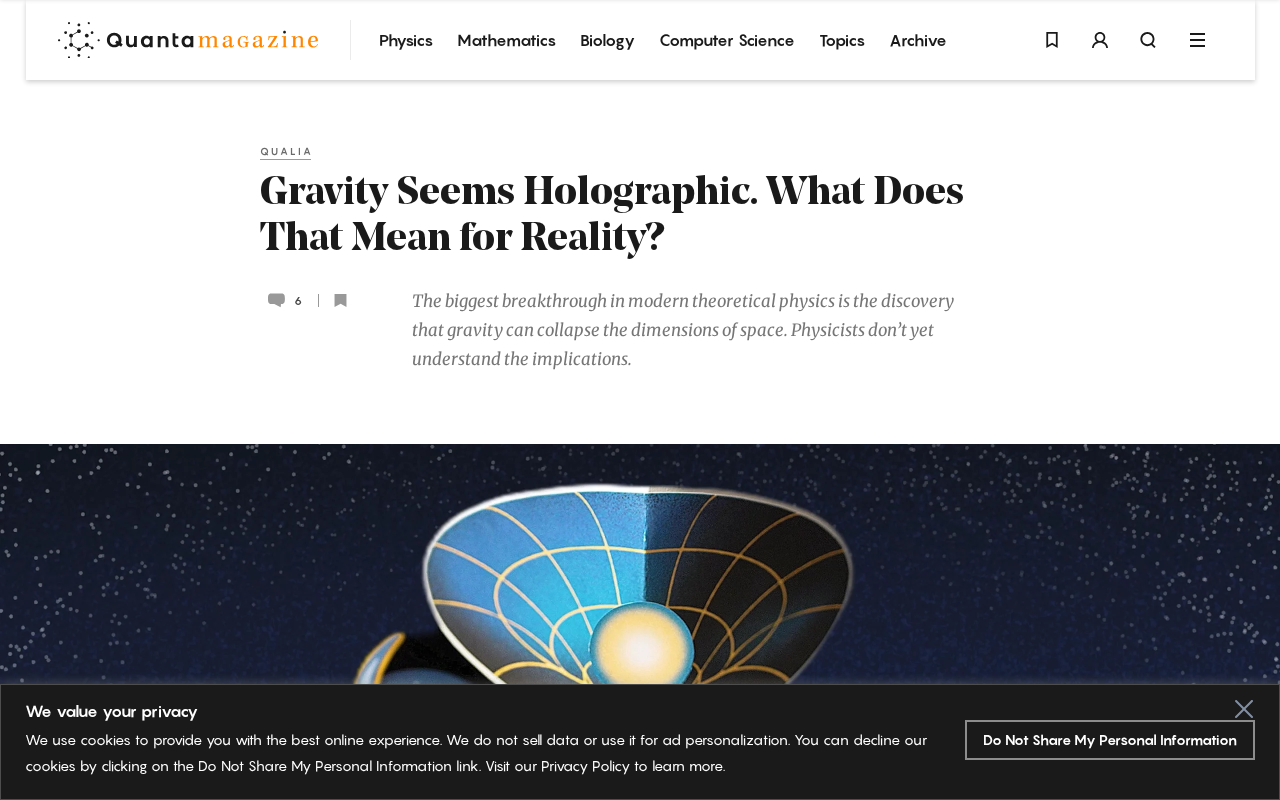
Two key terms in AdS/CFT duality deserve further explanation. Anti-de Sitter space (AdS) is a spacetime with a negative cosmological constant — intuitively, it can be imagined as a "bowl"-shaped space that curves infinitely toward its boundary. This special geometric structure enables a precise mathematical mapping between the gravitational theory "inside" and the quantum field theory "on the boundary." Conformal Field Theory (CFT) is a class of quantum field theories that remain symmetric under arbitrary scale transformations. It contains no gravity and lives on the boundary, which has one fewer dimension than the bulk space. Maldacena's 1997 paper was so influential precisely because it provided the first exactly calculable example: five-dimensional AdS supergravity is mathematically equivalent to a supersymmetric quantum field theory on its four-dimensional boundary. This means both theories describe "the same thing," and researchers can switch to the dual side when calculations become difficult — a "dictionary"-style translation tool that fundamentally transformed how theoretical physics is done.
What It Means for Gravity to Be "Emergent"
The most profound shift brought by the holographic perspective is the demotion of gravity from a fundamental force to an emergent phenomenon. In this picture, gravity and curved spacetime are not the foundational building blocks of the universe, but rather "emerge" from the more fundamental quantum information and quantum entanglement structure on the boundary.
In recent years, the physics community has paid increasing attention to the relationship between quantum entanglement and spacetime geometry. A growing body of research suggests that the entanglement patterns between quantum bits in the boundary theory may correspond directly to the geometric connections in the bulk space. To borrow a widely cited phrase: spacetime may be "stitched together by entanglement." If this direction holds, then the nature of gravity is no longer a force in the Newtonian or Einsteinian sense, but rather the macroscopic expression of how information is organized.
"Emergence" has a specific meaning in physics: new properties appear at the macroscopic level that are not explicitly present in the microscopic fundamental laws. The classic example is temperature — a single particle has no temperature; temperature is a statistical expression of the collective motion of large numbers of particles. The emergence of gravity in the holographic framework is analogous: the geometric structure of curved spacetime may not be an input written into the universe's most fundamental equations, but rather the collective output of entanglement patterns among vast numbers of quantum bits in the boundary quantum system. A 2010 thought-experiment paper by theoretical physicist Mark Van Raamsdonk provided a concrete picture: if you progressively cut the quantum entanglement between two subsystems in the boundary CFT, the corresponding bulk geometry splits topologically into two disconnected regions. This hints that entanglement is not merely correlated with geometry — it may actually be the "glue" holding spacetime together. This direction later evolved into the ER=EPR conjecture — the claim that Einstein-Rosen bridges (wormholes) and Einstein-Podolsky-Rosen entangled pairs share a deep equivalence — further deepening the connection between quantum information and spacetime geometry.
The Philosophical Impact on "Reality"
Behind these physical developments lurks an unavoidable philosophical question: if three-dimensional reality can be completely encoded by a two-dimensional boundary, which layer is actually "real"? Is it the bulk space we inhabit, or the mathematically equivalent boundary description?
It is worth noting that holographic duality has so far been rigorously verified primarily in specific, non-realistic spacetime backgrounds (such as AdS space). The universe we live in is an accelerating, de Sitter (dS)-type space, and extending the holographic principle to the real universe remains one of the core unsolved problems. The popular claim that "the universe is a hologram" is therefore better understood as a richly suggestive analogy than a confirmed conclusion.
This discussion also sparked a lively debate on Hacker News (217 points, 179 comments), with some expressing excitement about progress in quantum gravity research and others urging caution against over-interpreting highly theoretical conjectures. This tension accurately reflects the true state of frontier physics: there remains a considerable gap between mathematically elegant and self-consistent frameworks and physically testable facts.
The key difference between de Sitter space (dS) and Anti-de Sitter space lies in the sign of the cosmological constant: AdS corresponds to a negative value, where spacetime curves inward; dS corresponds to a positive value, where spacetime accelerates in its expansion — which is precisely the state of our universe as confirmed by astronomical observations. This sign difference creates a fundamental mathematical obstacle: AdS space has a timelike boundary where a quantum field theory can naturally "live," while dS space has boundaries located at the infinitely remote future or past in time, and how to define a well-behaved dual theory there remains without a consensus answer. Therefore, despite the intuitive appeal of the proposition that "our universe is holographic," in the strict technical sense, the success of AdS/CFT cannot be directly transplanted to the real universe. Constructing a dS/CFT duality is one of the most active and most challenging frontiers in quantum gravity, and any claim to have extended the holographic principle to the real universe should be met with careful scrutiny.
Why This Matters
The holographic principle matters not only because it may reveal the nature of gravity, but because it unifies three seemingly unrelated domains — gravity, quantum information, and spacetime geometry — under the same narrative. It suggests that the key to understanding quantum gravity may not lie in finding smaller particles, but in understanding how information is encoded and entangled.
For readers who follow frontier science, this line of research is a reminder that physics is undergoing a deep reassessment of "what is fundamental and what is emergent." Whether gravity is truly holographic remains unanswered, but the act of asking the question is already reshaping how we imagine the structure of reality.
Related articles

Chain of Thought Isn't Just for AI: How Humans Can Use CoT to Improve Thinking Quality
Chain of Thought isn't just a prompt trick for large models. Starting from a Hacker News discussion, this article analyzes why CoT works for human thinking too, breaks down actionable ways to transfer it, and highlights the key differences between human CoT and machine CoT.
Cloudflare Teams Up with OpenAI: Closi…
Cloudflare Teams Up with OpenAI: Closing the Loop from Vulnerability Discovery to Defense with AI
Cloudflare uses OpenAI Daybreak to investigate security vulnerabilities and generate reviewable remediation plans, while developers use Codex to boost coding efficiency and quality.

Orca Multi-Agent Orchestration in Practice: A Guide to Parallel Collaboration with Claude and Codex
Orca is Stable AI's free open-source agent workbench supporting 34 agents like Claude Code and Codex in parallel. Learn its Git worktree isolation, multi-model orchestration, and mobile management.