GrayPass: Using Behavioral Biometrics to Lock Down High-Risk Actions by AI Agents

GrayPass uses behavioral biometrics to verify before sensitive actions whether an AI agent is still controlled by a legitimate user.
GrayPass is a security product that received 85 upvotes and ranked 7th on Product Hunt, positioned as a "control verification layer before sensitive actions." It highlights the blind spot of traditional login verification: authentication happens at login, but risk often occurs at specific actions after login, especially when AI agents perform transfers, modify payee accounts, grant admin privileges, and other operations on behalf of humans—login tools cannot answer "is the person controlling it now still the authorized one." Its core technology Brainprint identifies users through typing rhythm, mouse trajectories, and scrolling habits, claiming not to collect input content to reduce privacy concerns. Before sensitive operations, the system provides four tiered dispositions: allow, re-verify, hold, and deny, using intermediate paths to reduce collateral damage. The article believes its direction is clear, but the reliability of behavioral signals, as well as false positive rates and integration costs in real enterprise environments, remain to be verified.
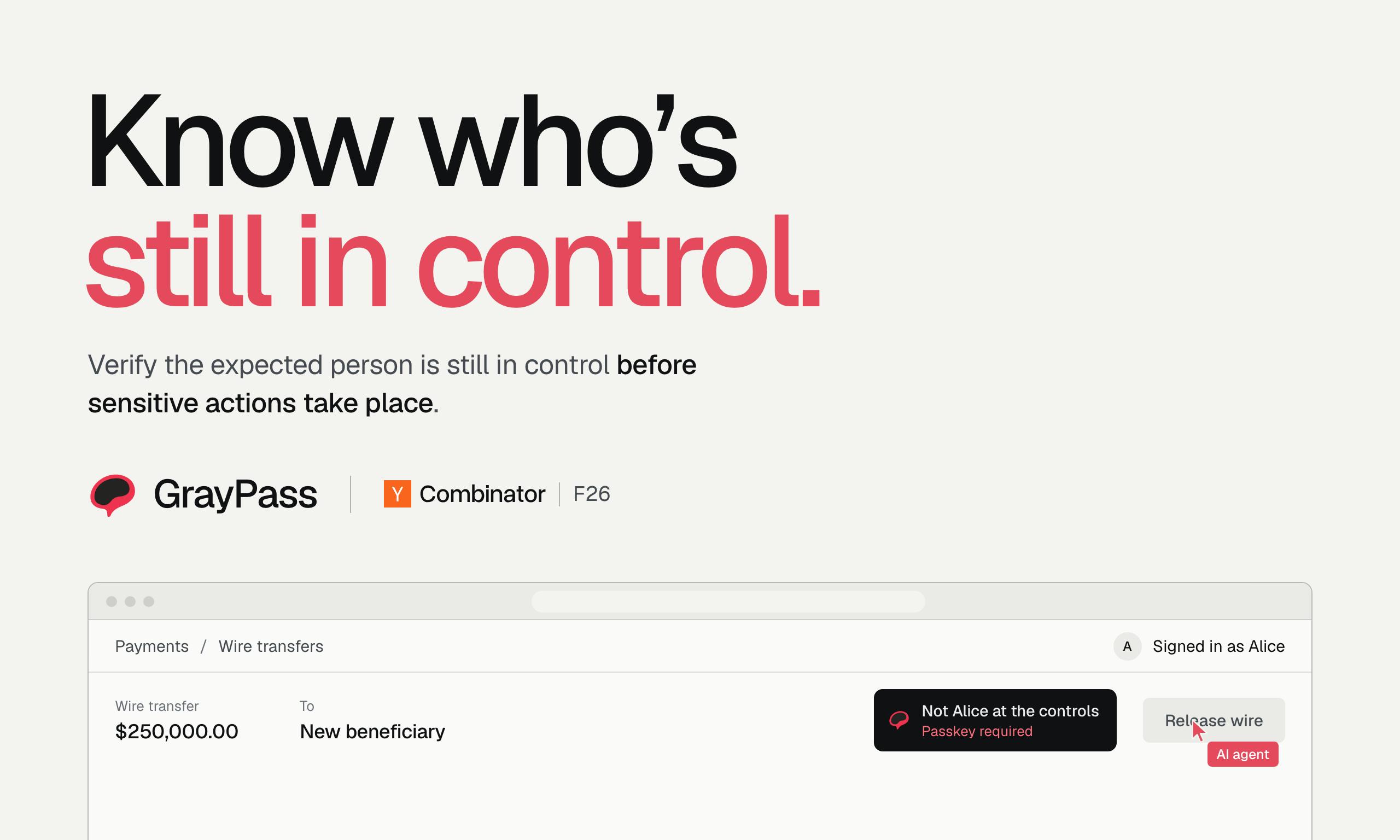
Login tools only tell you who came in, but GrayPass wants to answer a more critical question: when an AI agent is about to perform a sensitive action, is the person controlling it still the one who was authorized?
This product, which received 85 upvotes and ranked 7th on Product Hunt, positions itself as a "control verification layer before sensitive actions." As AI agents increasingly act on behalf of humans to execute transfers, modify payee accounts, grant admin privileges, and similar actions, GrayPass attempts to fill a neglected security gap: identity verification happens at login, but risk often occurs at a specific action after login.
Why Login Verification Is No Longer Enough
Traditional identity authentication models are built on an implicit assumption: the moment login succeeds, the person sitting at the keyboard is the account owner, and this remains unchanged throughout the session. This assumption barely holds in the era of human operation, but quickly fails once AI agents are involved.
An agent may be authorized to access the system, but whether the specific actions it performs remain under the control of a legitimate user is not answered by login tools. More troublesome is that attackers do not necessarily need to steal passwords—they may hijack an already authenticated session or induce an authorized agent to perform unauthorized actions. GrayPass's entry point is precisely this window between "after authentication, before execution."
Its approach is not simply to require multi-factor authentication (MFA) again for every sensitive operation, but to use behavioral signals to judge whether the current controller is trustworthy, and then decide whether to allow, re-verify, hold, or outright deny.
Session Hijacking refers to an attacker stealing or forging session credentials (such as cookies or tokens) after a user has completed identity authentication, thereby impersonating a legitimate user to continue operations without knowing the password. Because session credentials are typically treated as equivalent to an authenticated identity during their validity period, traditional login verification has almost no ability to perceive this type of attack. Unlike credential theft, session hijacking occurs after authentication; the attacker inherits an already established trusted channel. Therefore, "continuous verification" mechanisms are needed to reconfirm the controller's identity before critical operations—precisely the window GrayPass targets.
Brainprint: Recording Rhythm, Not Content
GrayPass's core technology is called Brainprint, which learns each person's typing style, mouse movement trajectories, and scrolling habits. The key point is that it claims not to collect the specific content users input—that is, it does not read what you type, only how you type.
This design is intentional on the privacy front. For a product aimed at enterprise security scenarios, if it itself needed to record keystroke content, deployment resistance would be very high. By collecting only behavioral rhythm features, GrayPass attempts to find a practical balance between "continuous verification" and "non-invasion of privacy."
From the product description, Brainprint's positioning is to "add a fresh layer of trustworthiness" rather than replace MFA. It aims to let most normal-operation users pass verification seamlessly, triggering additional verification steps only when behavioral signals are anomalous. This approach aligns with the "continuous evaluation" concept in zero trust architecture, but pushes the evaluation granularity down to individual sensitive actions.
Behavioral Biometrics is a class of technologies that identify individuals by analyzing their interaction patterns with devices. Common features include keystroke dynamics (key intervals, press durations), mouse trajectory acceleration and jitter, scrolling speed and pause distribution, etc. Unlike physiological features such as fingerprints and faces, behavioral features are continuous and can be passively collected during a session, making them suitable for continuous identity verification. Their inherent limitation is that the features are probabilistic: user fatigue, emotional fluctuations, changing keyboards, or using assistive devices all cause feature drift. In actual deployment, threshold adjustment and tiered handling must balance false positives and false negatives.
The Risk Control Logic Behind Four Disposition Actions
Before a sensitive operation executes, GrayPass provides four outcomes: allow, re-verify, hold, and deny. These four options correspond to risk control strategies at different confidence levels, rather than a simple binary pass/block.
The value of this tiered handling lies in reducing collateral damage. If the system had only two buttons—"allow" and "block"—any misjudgment would directly interrupt business flow; with "re-verify" and "hold," the system can choose a lower-cost intermediate path when uncertain. For irreversible or high-impact operations such as transfers, modifying payee accounts, and granting admin privileges, this layered design is especially important.
Interestingly, GrayPass uses "sensitive actions" as verification trigger points rather than continuously monitoring the entire process. This is a pragmatic trade-off: full monitoring incurs too high performance and privacy costs, while making a single judgment before critical actions covers the main risks without making the user experience unbearable.
Zero Trust Architecture's core principle is "never trust, always verify"—that is, not assuming a request is trustworthy because it comes from the internal network or because login has been completed, but continuously evaluating each access request based on context. NIST SP 800-207 summarizes it into principles such as identity-centric, least privilege, and dynamic authorization. GrayPass pushes the evaluation granularity from "session level" down to "individual sensitive action level" and replaces binary allow/block with tiered handling, which can be seen as one concrete implementation of zero trust principles in the AI agent scenario.
Identity Verification in the Agent Era Needs New Answers
GrayPass appears at a point in time when AI agents are moving from "answering questions" to "executing actions." When agents can initiate payments, change configurations, and call internal APIs, security models must answer a new question—authorization is granted to a person, execution is done by an agent, so who guarantees that the agent still represents the person's will at the moment of execution?
The answer this product gives is to use behavioral biometrics for "control verification" rather than reinventing an agent permission system. Its limitations are also obvious: behavioral signals themselves are not 100% reliable, and changes in user state (fatigue, device changes, use of assistive tools) may all affect judgment; meanwhile, the information disclosed so far is insufficient to judge its false positive rate and integration costs in real enterprise environments.
But the direction is clear. Login verification solves "who you are"; GrayPass wants to solve "are you still in control now." As agents increasingly do things on behalf of people, the latter question will become harder and harder to avoid.
AI Agent refers to an intelligent entity capable of autonomously planning and invoking tools, APIs, or external systems to complete multi-step tasks. Its key characteristic is "executing actions" rather than merely "generating content." This creates a mismatch with traditional security models: the authorizing entity is a human account, while the actual executor is an agent program, and the consistency of intent between the two cannot be guaranteed by login credentials. Industry discussion of countermeasures includes agent-specific identities, fine-grained permission delegation (such as OAuth delegated authorization), and runtime verification before execution. GrayPass chooses the runtime behavioral verification path rather than restructuring the permission system, and its effectiveness depends heavily on the reliability of behavioral signals.
One-line Summary
GrayPass uses behavioral biometrics to verify before sensitive actions whether an AI agent is still controlled by a legitimate user.
Paragraph Summary
GrayPass is a security product that received 85 upvotes and ranked 7th on Product Hunt, positioned as a "control verification layer before sensitive actions." It highlights the blind spot of traditional login verification: authentication happens at login, but risk often occurs at specific actions after login, especially when AI agents perform transfers, modify payee accounts, grant admin privileges, and other operations on behalf of humans—login tools cannot answer "is the person controlling it now still the authorized one." Its core technology Brainprint identifies users through typing rhythm, mouse trajectories, and scrolling habits, claiming not to collect input content to reduce privacy concerns. Before sensitive operations, the system provides four tiered dispositions: allow, re-verify, hold, and deny, using intermediate paths to reduce collateral damage. The article believes its direction is clear, but the reliability of behavioral signals, as well as false positive rates and integration costs in real enterprise environments, remain to be verified.
Related articles

Nightmare Mode: Engineering Practices for Simulating Disk Failures
Starting from the Hacker News Nightmare mode discussion, this article analyzes typical forms of simulated disk failures, fault injection implementation approaches, and how to integrate fault drills into the development process to improve distributed system fault tolerance.

Datasette-charts-pie Plugin Released: New Options for Pie and Sunburst Charts
Datasette-charts-pie 0.1a0 is released, adding pie, donut, sunburst, and rose charts to Datasette. The author dislikes pie charts but built the plugin to test the plugin architecture.

Diablo II: A Classic Retrospective That Changed Gaming History
From game history writing and tech community discussion, a retrospective on Diablo II's random drops, numerical systems, and multiplayer design—analyzing why this classic ARPG is still discussed by developers today.