Grok 4.5 Hands-On Review: Code Generation and Research Visualization Capabilities

Grok 4.5 impresses in code generation and research visualization — here's what you need to know.
xAI's Grok 4.5 delivers flagship-level performance in code generation, logical reasoning, and multimodal processing, directly rivaling Claude Opus. Hands-on tests show it can produce near-production-ready web pages and journal-quality research figures in a single pass. The article also covers how AI aggregation platforms work and what to watch out for.
Grok 4.5 Arrives: The LLM Race Enters a New Phase
Since xAI released Grok 4.5, competition in the large language model space has intensified once again. Based on hands-on reports from multiple developers, Grok 4.5 directly targets Anthropic's Claude Opus series in terms of overall capability, demonstrating flagship-level performance in code generation, logical reasoning, and multimodal processing.
Technical background on xAI and Grok: xAI was founded by Elon Musk in 2023, with the Grok model series as its flagship product line. Unlike competitors such as OpenAI and Anthropic, xAI's training data includes real-time information from X (formerly Twitter), giving Grok a natural advantage in processing time-sensitive information. Architecturally, Grok 4.5 continues the Mixture-of-Experts (MoE) design philosophy — an architecture that dynamically activates different "expert" sub-networks to handle different types of input. This significantly improves parameter utilization efficiency while maintaining inference speed, and is one of the core technical approaches mainstream LLMs use to improve cost-effectiveness.
The multimodal processing mentioned in this article refers to a model's ability to simultaneously understand and generate multiple data types — including text, images, and code. This capability relies on the deep integration of a Vision Encoder with the language model backbone. The vision encoder (typically based on ViT, or Vision Transformer architecture) converts images into vector representations the model can understand, which are then fed into the Transformer backbone alongside text tokens for joint modeling. The competitive frontier for top multimodal models has shifted from "can it recognize images" to "can it maintain consistency in complex cross-modal reasoning tasks" — which is also the core evaluation dimension when comparing Grok 4.5 against Claude Opus 4, Gemini 1.5 Pro, and similar models.
For users in China, directly accessing Grok often involves some friction. Recently emerged AI aggregation platforms now allow developers and researchers to access Grok 4.5, the full Gemini lineup, and the latest GPT models from a single interface, significantly lowering the barrier to experiencing cutting-edge AI.
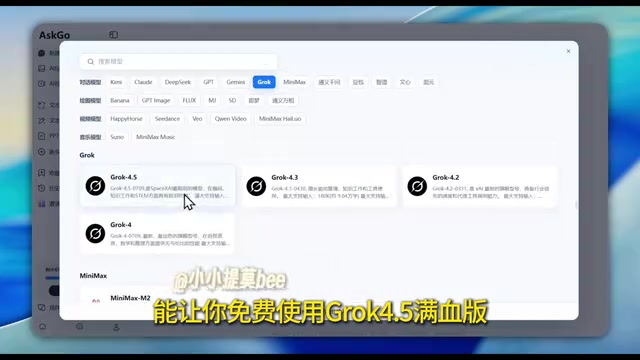
How AI aggregation platforms work technically: The technical core of these platforms is a Unified API Gateway architecture. The platform maintains backend connections to each major model's official API and exposes a unified call interface to users. Requests are routed through the platform to the respective model provider's endpoint. These platforms typically also implement load balancing, request caching, and unified Streaming Response packaging to improve the user experience. However, this architecture means user input data passes through third-party servers — a fundamental difference from calling official APIs directly, and a key technical consideration when assessing data security risks. The core value of these aggregation platforms is their "one-stop" convenience: no need to register separate overseas accounts or maintain multiple subscriptions, with seamless switching between web, browser extension, mobile, and desktop. While convenient, data security and compliance should not be overlooked — choose service providers with higher credibility.
Test 1: Web Development and Code Generation
In testing, after entering a web development prompt into Grok 4.5, the model produced structurally complete, clearly commented code after a brief wait.
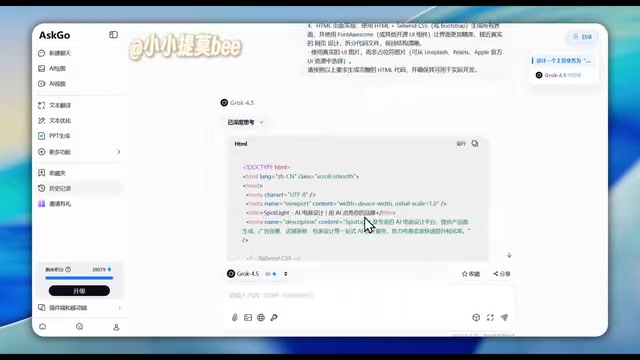
After running the code, the generated page delivered impressive visual aesthetics and interaction quality. Based on the demo output, Grok 4.5 demonstrates a mature understanding of modern frontend design standards — including layout hierarchy, color coordination, and interaction details — and can produce near-production-ready pages in a single pass.
How LLM code generation works: This capability stems from pre-training on massive code corpora (including GitHub open-source repositories, technical documentation, Stack Overflow Q&A, etc.), combined with Instruction Fine-tuning and RLHF (Reinforcement Learning from Human Feedback) to optimize output quality. Frontend code generation has become an important model evaluation dimension because it simultaneously tests three capabilities: natural language understanding, structured logic generation, and visual aesthetic expression. That said, it's worth noting that LLM-generated code carries the risk of "hallucinated vulnerabilities" — code that is syntactically correct but may contain outdated API calls, potential XSS injection vulnerabilities, or logic errors in edge cases. These issues are difficult to catch through visual code review alone and must be verified through comprehensive test coverage.
Practical Implications for Frontend Workflows
For frontend developers, Grok 4.5's practical value is mainly reflected in three areas: rapid prototyping, boilerplate code generation, and design inspiration. It can significantly compress the time from requirements to an initial page. However, deploying to production still requires manual review for code quality, maintainability, and security. Grok 4.5 is best positioned as an "efficiency multiplier" rather than a replacement for developer judgment.
Test 2: Literature Comprehension and Research Visualization
The second test was more specialized: upload an academic paper, have Grok 4.5 generate image prompts based on the content, then feed those prompts into an image generation model, select an appropriate aspect ratio, and submit.
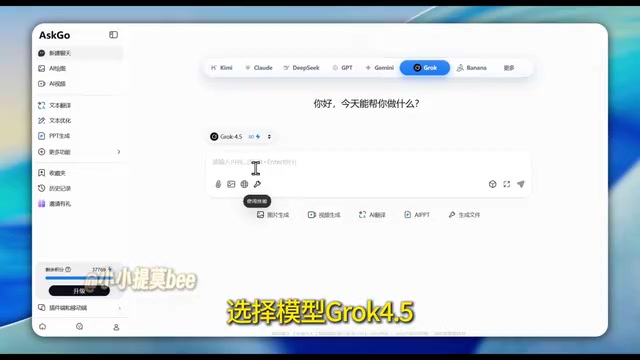
The results were surprisingly impressive — the generated images achieved a quality close to figures in top-tier journals. This workflow clearly demonstrates the potential of LLMs in research pipelines: the language model handles understanding the literature context and generating precise visualization descriptions, while the image model handles rendering output, forming an efficient "text understanding + visual generation" collaborative pipeline.
Technical breakdown of research image generation: This workflow — "language model interprets the paper → generates image prompts → image model renders output" — is essentially a classic AI Agent workflow that chains multiple specialized models into a task pipeline through Tool Use. Prompt Engineering is the critical link connecting the two models: the language model must accurately translate data relationships and visualization intent from the literature into visual description language that the image generation model can understand. Current mainstream research image generation typically uses Stable Diffusion series or DALL·E diffusion models as the rendering backend. These models excel at generating visually appealing conceptual figures, but have inherent limitations in precise data visualization (such as axis tick marks and error bar representation) — which is precisely why human verification remains essential.
Limitations to Keep in Mind
Despite the impressive demo results, research figures have extremely high standards for accuracy and rigor. AI-generated diagrams may perform well aesthetically but can introduce errors in data accuracy, unit labeling, and logical relationships. In formal publication contexts, researchers should treat these outputs as drafts or sources of inspiration rather than finished products ready for direct use — the manual verification step cannot be skipped.
AI Aggregation Platforms: Opportunity and Clear-Eyed Perspective
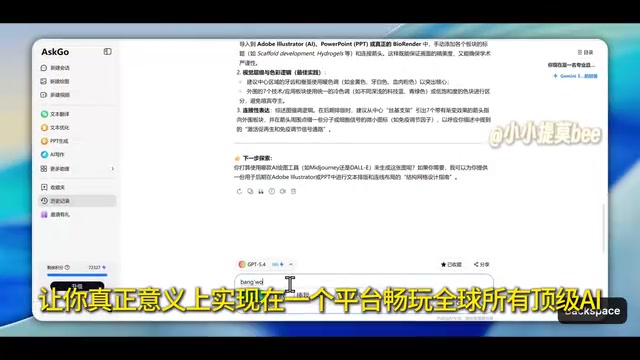
This hands-on review demonstrates that aggregation platforms do genuinely lower the barrier for everyday users to experience the full capabilities of top models like Grok 4.5, Gemini, and GPT. For developer productivity and research assistance, the appeal of these tools is evident.
That said, a few points are worth keeping in mind:
- Compliance and data security: Third-party aggregation platforms involve data forwarding. Exercise extra caution when handling sensitive information, and avoid uploading confidential or private content.
- Service reliability: Some platforms' low-cost offerings rely on unofficial channels, carrying risks of service interruption or sudden shutdown.
- Capability authenticity: Different platforms define "full-version" access inconsistently, and the actual experience may differ from the official version. Cross-verification is recommended before committing to a platform.
Conclusion: Use the Tools Wisely, Keep Your Judgment Sharp
The release of Grok 4.5 once again confirms the rapid iteration of LLM capabilities — the gap between top models continues to narrow, and the multi-model aggregation trend gives users the freedom to compare options. For developers and researchers, making good use of these tools can deliver real productivity gains. But alongside embracing the convenience, maintaining clear judgment about compliance, data security, and result reliability remains equally important. Truly sustainable productivity comes from a collaborative model of "AI assistance + human oversight" — not blind dependence on any tool.
Key Takeaways
Related articles

Disaster and Glory of the Apollo Program: The History We Must Revisit Before Returning to the Moon
From the fatal Apollo 1 fire to Apollo 8's daring lunar orbit to Apollo 11's successful landing—revisiting the disasters, fears, and compromises of the Apollo program and their lessons for today's return to the Moon.

Netflix Trust Exercise Turns Into Firing Trap: Where Are the Boundaries of Corporate Trust?
A Netflix employee was fired after sharing private info in a trust exercise. We analyze the risks of corporate trust exercises and how employees can protect themselves.

AMD CDNA5 Architecture Deep Dive: Technical Evolution and the AI Computing Competition Landscape
Deep analysis of AMD's CDNA5 architecture covering Chiplet packaging upgrades, HBM memory evolution, and low-precision compute optimization, examining how AMD challenges NVIDIA's AI chip dominance.