Grok 4.6 Arrives on Perplexity: A Pareto Frontier Model with 60% Lower Costs

Grok 4.6 joins Perplexity with Fable 5-level performance at 60%+ lower cost on the Pareto Frontier.
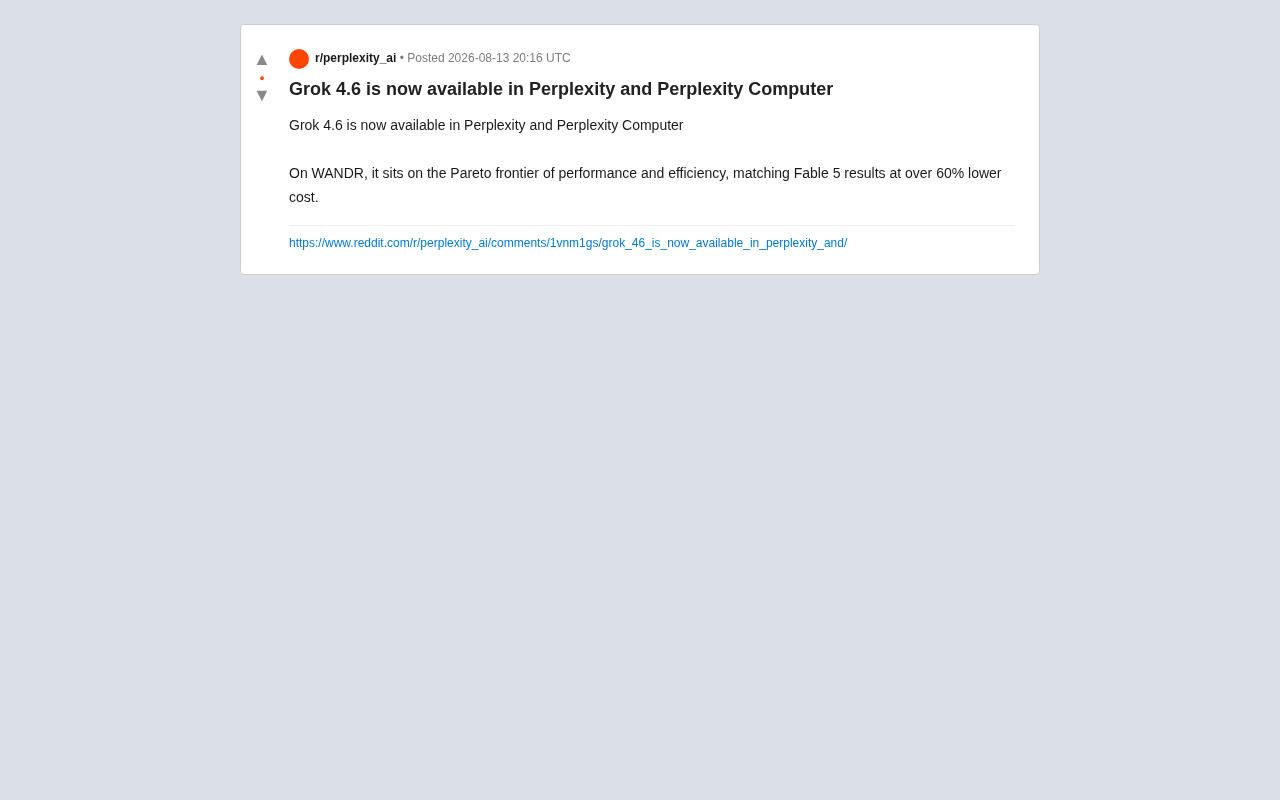
xAI's Grok 4.6 has launched on Perplexity and Perplexity Computer, sitting on the Pareto Frontier of performance and efficiency according to WANDR benchmark data. It matches Fable 5's performance while cutting costs by over 60%, making it ideal for cost-sensitive enterprise deployments, agent workflows, and high-frequency API calls within Perplexity's multi-model routing architecture.
Grok 4.6 Officially Joins the Perplexity Ecosystem
xAI's Grok 4.6 model has officially launched on Perplexity and Perplexity Computer. This means Perplexity users can now directly access this latest large language model for search, reasoning, and agent tasks. For Perplexity, which has long relied on a multi-model strategy, integrating Grok 4.6 further enriches its available model matrix and gives users more cost-effective options across different use cases.
Perplexity's product philosophy has always been to integrate top models from different providers into a unified search and Q&A experience. Its core architecture employs a Model Routing mechanism that dynamically selects the most suitable underlying LLM based on the complexity, domain, and intent of user queries. This architecture functions like an intelligent dispatch layer sitting between the user interface and multiple LLMs, combining Retrieval-Augmented Generation (RAG) with multi-model scheduling—fetching web information in real time, then having the selected model perform comprehensive reasoning and answer generation. It's precisely this flexible architectural design that allowed Grok 4.6's integration to be completed quickly without restructuring the overall system.
The addition of Grok 4.6 isn't merely about expanding the model count—more importantly, it provides a highly attractive answer to the performance-cost tradeoff.
Grok 4.6's Efficiency at the Pareto Frontier
According to official data from the WANDR benchmark, Grok 4.6 sits on the Pareto Frontier of performance and efficiency. This claim deserves deeper examination.
WANDR is a benchmark framework for comprehensive evaluation of large language model capabilities, designed to measure model performance across multiple dimensions including reasoning depth, knowledge breadth, and instruction-following ability. Unlike traditional single-dimension evaluations (such as MMLU focusing on knowledge Q&A or HumanEval focusing on code generation), WANDR aims to provide a comprehensive scoring system that more closely reflects real-world usage scenarios.
What Does Pareto Frontier Mean?
In multi-objective optimization, the Pareto Frontier refers to a set of optimal solutions where "improving one metric is impossible without sacrificing another." In other words, a model on the Pareto Frontier means there's no stronger performance available at the same cost, or no lower cost available at the same performance level.
This concept originates from Pareto optimality theory in economics, proposed by Italian economist Vilfredo Pareto. In AI model evaluation, it's widely used to describe the tradeoff between performance (such as accuracy, reasoning quality) and cost (such as inference latency, API pricing, computational resource consumption). Notably, this frontier isn't static—whenever new models are released or inference optimization techniques break through, the frontier pushes outward, and models previously on the frontier may be displaced by newcomers.
For large language models, this is an extremely valuable positioning—it indicates that Grok 4.6 has achieved the current optimal tradeoff on the path of being "both good and affordable."
Matching Fable 5 Performance at Over 60% Lower Cost
The key data point from the official announcement: Grok 4.6 matches Fable 5's test results on WANDR while reducing costs by over 60%. This is the most noteworthy highlight of this release.
For enterprises and developers, a model's practical value is often determined not by its absolute performance ceiling, but by "how much capability you get per unit of cost." If Grok 4.6 can truly achieve flagship-level results at less than 40% of the cost, it will have significant economic advantages in large-scale, high-frequency production environments.
What Grok 4.6 Means for Perplexity Users
For everyday Perplexity users, the integration of Grok 4.6 brings several direct benefits.
Lower Token Costs
In agent and long-chain reasoning tasks, token consumption can be substantial. Cost-sensitive users can leverage Grok 4.6 to control expenses while maintaining quality.
Tokens are the basic unit of measurement for how LLMs process text—typically one English word corresponds to 1-2 tokens, while one Chinese character corresponds to 1-3 tokens. In commercial API pricing models, providers typically charge separately for input tokens and output tokens. For enterprise applications, especially those involving multi-turn conversations, long document processing, or agent workflows, token consumption per task can reach tens or even hundreds of thousands. Take a typical Agent task as an example: a workflow involving tool calls, environment observation, and multi-step reasoning might require 10-50 LLM calls, with total token consumption being dozens of times that of a single Q&A interaction. Therefore, even a modest reduction in per-token cost produces extremely significant cumulative benefits at scale.
Enhanced Perplexity Computer Scenarios
Perplexity Computer targets more complex automation and execution tasks, falling into the emerging category of "computer-use" AI Agents. These products allow AI models to directly manipulate computer interfaces—including browsing web pages, clicking buttons, filling forms, and executing code—to complete multi-step tasks that traditionally required manual operation. Unlike simple Q&A, these Agents require models to possess strong planning capabilities, state tracking, and error recovery abilities.
Since each operation requires the model to make reasoning decisions, a complete task may involve dozens or even hundreds of model calls. This makes the model's inference cost and stability critical factors determining product usability. Grok 4.6's efficiency characteristics—providing equivalent-quality reasoning output at lower cost—theoretically make it better suited for these agent workflows that require multiple calls and long-running execution.
On-Demand Multi-Model Switching
The multi-model coexistence strategy allows users to flexibly switch based on task type—choosing top-tier models when ultimate quality is needed, and switching to Grok 4.6 when cost-effectiveness matters. This "use what you need" approach is a core competitive advantage of the Perplexity platform.
A Rational Perspective on Benchmark Data
It's worth noting that the core arguments in this release primarily come from the WANDR benchmark specifically, with comparisons focused on a lateral comparison with Fable 5. The AI industry currently has dozens of mainstream benchmarks, with significant differences in task distribution and scoring criteria across them. Benchmark results are often highly correlated with specific task distributions, and excellent performance on one test may not fully transfer to all real-world scenarios.
Therefore, for teams considering adopting Grok 4.6 in production environments, it's recommended to conduct small-scale validation on actual business data to confirm whether the performance-cost ratio is equally ideal for your specific tasks before deciding on a large-scale switch. After all, "Pareto Frontier" is a relative concept—as new models continue to iterate, this frontier keeps moving.
Conclusion
Grok 4.6's arrival on Perplexity is yet another footnote in the trend of model capability democratization. Model Capability Democratization is one of the core trends in the AI industry during 2024-2025, driven by multiple factors: open-source models (such as the Llama and Mistral series) continuously narrowing the gap with closed-source models; model distillation and knowledge compression techniques enabling smaller models to inherit core capabilities of larger ones; inference optimization technologies (such as quantization, speculative decoding, and KV Cache optimization) dramatically reducing deployment costs; and market competition driving continuous price reductions from providers.
When top-tier performance is no longer the exclusive domain of a few flagship models but can be obtained at lower cost, the barriers to AI application deployment decrease accordingly. For developers and enterprises, what truly matters is no longer just "who's the strongest," but "who can solve my problem in the most cost-effective way." From this perspective, Grok 4.6's breakthrough in cost efficiency may hold more practical significance than simply topping performance leaderboards.
Related articles

Claude Reportedly Able to Hide Secret Messages in Benign Images
A Reddit post claims Claude Fable 5.1 can hide secret messages in benign images. This article reviews the background, image steganography principles, and potential security risks, and suggests a testing path from rumor to verification.

Federal Government Awards $85 Million; CFS to Develop Fusion-Specific Semiconductors
The federal government awards $85 million to Commonwealth Fusion Systems to develop conductors and power semiconductors for fusion plants. This article analyzes the significance of this funding for the fusion supply chain and commercialization path.

When Should AI Assistants Proactively Suggest? Timing Is Everything
When should AI assistants proactively suggest? Reddit discussion reveals: the same suggestion feels different at different times. This article analyzes the dual nature of proactive suggestions, the boundary of user expectations, and design principles, exploring how to balance automation and user control.