Grok 4.7 Lands on Amazon Bedrock: A Hands-On Evaluation of Long-Horizon Agents

Grok 4.7 hits Bedrock; tests show agent reasoning effort needs task-tiered tuning.
Grok 4.7 is now available on Amazon Bedrock, offering per-request tunable reasoning effort for long-horizon agents. Tests across three reasoning tasks and four effort levels show a non-linear accuracy–cost relationship—no universal optimal setting exists. Production should tier by task type and monitor accuracy vs. cost in two dimensions.
Grok 4.7 is now officially available on Amazon Bedrock, giving developers a new model option for building long-horizon agents. Based on the official technical blog, this article builds a tool-calling agent and runs hands-on tests across three types of reasoning tasks and four levels of reasoning effort, while recording both accuracy and per-task token cost.
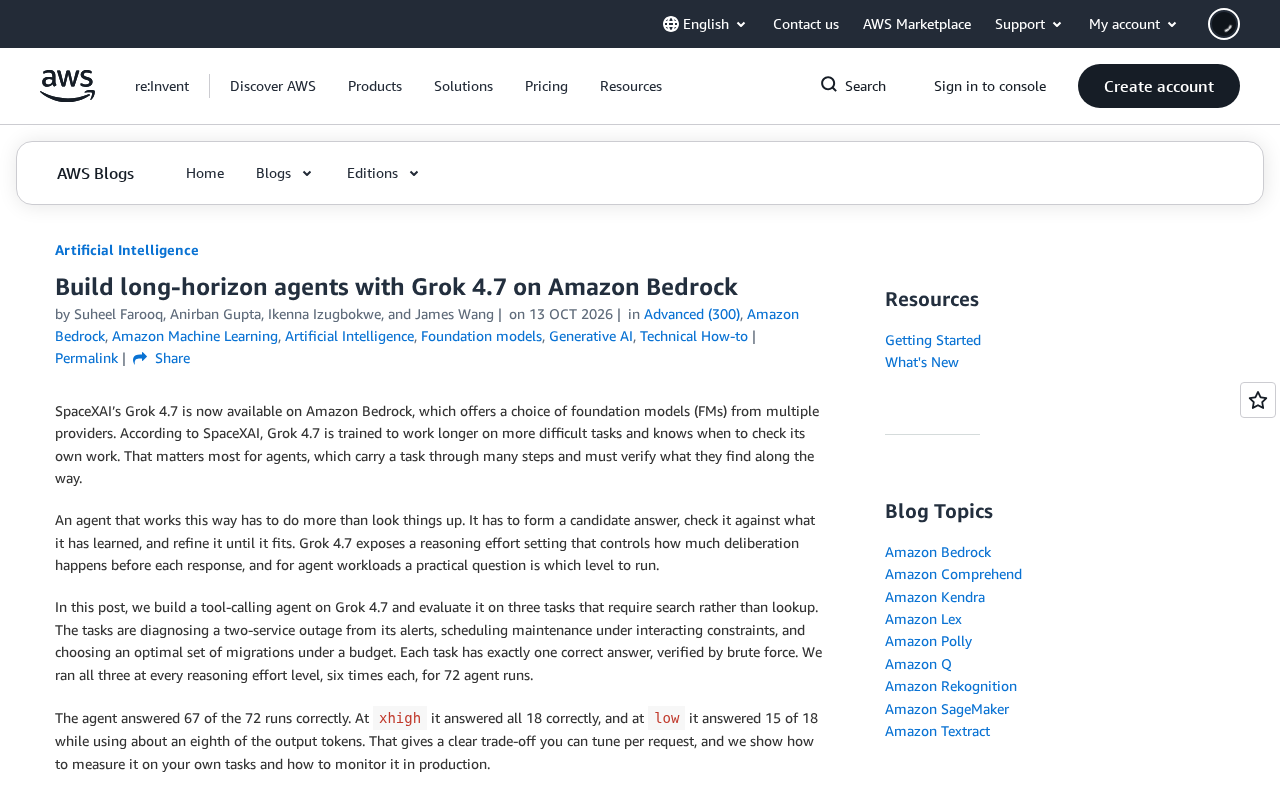
Why Long-Horizon Agents Need "Tunable" Reasoning Effort
The core challenge of long-horizon tasks is this: a single task often requires multiple steps of tool calls and reasoning chains, where model outputs are short but environment interactions are dense. The traditional approach is to fix reasoning effort—either over-reasoning drives costs up, or under-reasoning causes task failure.
Grok 4.7 on Bedrock introduces the ability to adjust reasoning effort on a per-request basis, letting developers dynamically balance accuracy against token cost within the same model for different tasks. This has clear significance for production cost control—high-value tasks can be dialed up to higher reasoning levels, while low-risk tasks can be pushed down to save budget.
Long-horizon agents refer to agents that need to continuously complete multiple steps of decision-making and environment interaction over an extended time span, typically manifesting as a "plan → call tools → observe results → re-plan" loop, where a single task may trigger dozens of model calls. In contrast, short-horizon tasks (such as single-turn Q&A or one-shot classification) need only one inference pass to produce an answer.
Both the cost and failure modes of long-horizon tasks differ from short tasks: a single model output may be very short, but the accumulated context, tool return results, and intermediate reasoning chains cause total token counts to balloon rapidly. At the same time, insufficient reasoning at any single step can throw the entire chain off target, and errors often only surface many steps later. As a result, long-horizon agents are far more sensitive to "how the reasoning budget is allocated" than short tasks.
Reasoning effort / reasoning budget is a class of parameters that has emerged in LLM APIs over the past two years, used to control how much "thinking" a model is allowed to consume before giving a final answer. Common implementations include capping the token limit for internal chain-of-thought, controlling the number of samples, or controlling whether extended thinking mode is enabled.
Raising reasoning effort gives the model more room for decomposition, verification, and self-correction, typically yielding accuracy gains on math, code, and multi-hop reasoning tasks; the cost is increased latency and higher token consumption. Lowering reasoning effort does the opposite: faster and cheaper, but more prone to "reasoning breaks" on tasks requiring multi-step derivation—that is, skipping key intermediate steps and jumping straight to a conclusion. Grok 4.7 exposing this parameter at per-request granularity on Bedrock is one of its main selling points for agent scenarios.
Evaluation Design: Three Task Types × Four Effort Levels
The experiment built a tool-calling agent on Amazon Bedrock and evaluated it across three types of reasoning tasks, with each task type run at four reasoning effort levels, recording two core metrics:
- Accuracy: whether the task was solved completely and correctly
- Per-task token cost: the total tokens consumed to complete one task
This two-dimensional evaluation approach is closer to engineering reality than looking at accuracy alone. Long-horizon agent failures are often not because the model "can't do it," but because the reasoning budget doesn't match task complexity.
Tool-calling agents refer to agent forms where the model invokes external tools—search engines, code executors, database queries, HTTP APIs, etc.—through structured output (such as JSON-formatted function calls), and feeds the returned results back into context.
Evaluating such agents can't just look at whether the final answer is correct—it also needs to examine whether the call path is reasonable: whether the right tool was chosen, whether parameters were valid, and whether retries were handled correctly after failures. Therefore, in tool-calling scenarios, "per-task token cost" includes not only model-generated text but also the input token overhead from tool return content being re-injected into context. This makes cost accounting more complex than pure text Q&A, and makes it all the more necessary to measure by task dimension rather than by request dimension.
Key Finding: The Non-Linear Relationship Between Accuracy and Cost
The evaluation results reveal a pattern worth paying attention to: the relationship between reasoning effort and accuracy is not linear. At low effort levels, some tasks show obvious reasoning breaks; and the accuracy gains from high effort levels are often accompanied by significant increases in token cost.
This means there is no "one universal optimal setting" in production. The truly viable strategy is to tier by task type: use high reasoning effort for tasks that are accuracy-sensitive with high cost tolerance; use low-fidelity reasoning for high-frequency, low-risk tasks to control total cost.
Production Deployment: Per-Request Tuning and Monitoring
One of the article's focal points is "how to do this well in production." Core practices include:
- Per-request tuning: specify reasoning effort at the call level, rather than fixing it globally
- Cost monitoring: track by per-task token cost as the unit, rather than only looking at totals
- Accuracy regression: continuously sample-verify whether low-effort reasoning introduces hidden errors
The practical value of this approach is that it transforms the "model selection" problem into a "reasoning budget allocation" problem—the same model covers the full spectrum of tasks from lightweight to heavy-duty through different effort levels.
Takeaways for Developers
Grok 4.7's availability on Bedrock, combined with the tunability of reasoning effort, adds a controllable dimension to the engineering of long-horizon agents. For teams building multi-step tool-calling systems, we recommend establishing an "accuracy–cost" two-dimensional monitoring dashboard as early as possible, treating reasoning effort as a tunable parameter rather than a fixed configuration.
Competition in long-horizon agents will ultimately come down to who can reliably complete more complex tasks with fewer tokens.
One-line Summary
Grok 4.7 hits Bedrock; tests show agent reasoning effort needs task-tiered tuning.
Paragraph Summary
Grok 4.7 is now officially available on Amazon Bedrock, offering a new model option for long-horizon agent development with per-request tunable reasoning effort. Based on the official technical blog, this article builds a tool-calling agent on Bedrock and runs hands-on tests across three types of reasoning tasks and four reasoning effort levels, recording both accuracy and per-task token cost. The core finding: the relationship between reasoning effort and accuracy is not linear, and there is no universal optimal setting—low effort levels cause reasoning breaks, while high effort levels improve accuracy but significantly drive up costs. Production environments should therefore adopt a task-type-tiered strategy and establish "accuracy–cost" two-dimensional monitoring. The article also offers practical approaches including per-request tuning, cost monitoring measured in per-task token cost, and accuracy regression sampling for low-effort reasoning, transforming the model selection problem into a reasoning budget allocation problem.
Related articles

@ai-sdk/vue 3.0.306 Patch Release Syncs with [email protected] Update
@ai-sdk/vue 3.0.306 released, synced with [email protected]. A routine patch release for the Vercel AI SDK ecosystem with no public API changes; the Vue adapter layer stays version-aligned with the core package.

Gemini 4 Argon API Launches: The Era of Million-Token Output Begins
Google launches Gemini 4 Argon with sparse MoE architecture, up to 1M output tokens, and a 68.90% Vals Index score, available across API, AI Studio, and the Gemini app.

DukaanAI: Turning Product Photos into Inventory Lists with Open-Source AI
DukaanAI is an AI inventory tool for small retailers that turns product photos into inventory entries using the open-source Gemma 3 model, with local inference, editable fields, and CSV export.