Grok, Cursor, and X Premium Merge Into a Unified Subscription: Four Tiers From $8 to $200 Explained

Grok, Cursor, and X Premium merge subscriptions, while Meta and DigitalOcean double down on the Agent race.
The AI tool subscription market is consolidating: Grok, Cursor, and X Premium merge into a unified X-Subscription with four tiers from $8 to $200 per month and a cross-tool usage pool that refreshes weekly. Meta releases Agent-focused models MuseWonder and WonderFull, and DigitalOcean opens previews of Signals and Simulations for Agent observability and testing. The trend: AI Agents are moving from "can they work" to "can they be managed well."
The AI tool subscription market is undergoing a round of structural consolidation. According to the iStarSoft AI Daily Briefing (YouTube), Grok, Cursor, and X Premium have been merged into a unified "X-Subscription" system divided into four paid tiers. This change not only affects existing users' billing structure but may also redefine the bundling logic between AI coding tools and general-purpose AI assistants.
Four Tiers and the Usage Pool Mechanism
The new subscription system is divided into four tiers: Plus at $8/month, Premium at $30/month, Super at $100/month, and Ultra at $200/month. The core selling point is a usage pool shared across Cursor and Grok, refreshed weekly.

This means users no longer need to manage quotas separately for each tool—coding assistance and conversational AI credits can be reallocated between them. Existing Cursor subscribers can choose to keep their original plan or migrate to the new system. The new plans offer roughly twice the coding usage for Grok models—a direct incentive for heavy coding users.
However, there's an easily overlooked clause: third-party models are billed at API list prices. This means that if users call models that aren't native to Grok or Cursor, the costs won't be included in the plan, and they'll need to set their own spending caps to avoid unexpected bills. From a product design perspective, this is using price leverage to steer users toward the in-house model ecosystem.
Meta Releases MuseWonder and WonderFull: New Models Built for Agent Scenarios
Meta has launched its most capable model series to date—MuseWonder and WonderFull—both designed for Agent scenarios. Wonder is now available on the Meta model API, while WonderFull is used for MuseCoding. Meta says a full safety report will be released soon.

According to Artificial Analysis benchmarks, WonderFull scores 56 on the intelligence index, a significant improvement over the previous 48. Its coding Agent score is 68, on par with ClawedCode (running Sonnet 5.5). On API pricing, MuseWonder is $4 per million tokens for input and $20 for output.
The implications of these numbers deserve unpacking. The jump from 48 to 56 on the intelligence index is substantial, but the coding Agent score of 68 only "catches up" rather than "leads" the current top competitors, suggesting Meta is still in a catch-up position in the Agent coding race. For developers, having one more competitive option is always good, but migration costs and learning curves need to be factored in.
Agent scenarios refer to application forms where models don't just passively answer questions but can autonomously call tools, execute multi-step tasks, and adjust strategies based on feedback—such as automated programming, web operations, and data analysis pipelines. Compared to single-turn conversations, Agent tasks place higher demands on models' instruction following, error recovery, and long-context consistency, which is why evaluation systems typically set up separate sub-items like "coding Agent" rather than only looking at general intelligence indices. The Intelligence Index is generally a weighted score combining multiple benchmarks, used for horizontal comparison of model capabilities, but different organizations use significantly different methodologies, so caution is needed when comparing across leaderboards.
DigitalOcean Launches Signals and Simulations: Observability Tools for Agents
DigitalOcean has opened public previews of Signals and Simulations for AI Agents.

Signals flags failed tool calls and user frustration signals in live traffic, essentially equipping Agents with a "symptom monitoring" system. Simulations allows developers to test fixes in simulated conversations before real users encounter them.
The positioning of these two tools is clear: when Agents move from experimentation to production environments, the biggest pain point is "when something goes wrong, you don't know where it went wrong." Signals solves the observability problem, while Simulations solves the change validation problem. For teams deploying Agents to production, this combination is worth watching.
Observability originates from the distributed systems operations field and refers to the ability to reconstruct a system's internal state through three types of data: logs, metrics, and traces. When an Agent fails to call an external tool, gets stuck in a loop, or misunderstands user intent, traditional logs often only show "what was called" but not "why it failed." The value of tools like Signals lies in correlating failed calls with user sentiment signals to form a traceable problem chain. Simulation testing moves change validation earlier: first verifying fixes in synthetic conversations or replayed traffic, then gradually rolling out to real users, reducing the risk of production incidents. These two capabilities are typically essential components for Agents moving from demo to production.
XRadar: Quota Fixes, Version Changes, and Market Share
At the daily news level, there are several items worth noting. According to Alexandra Wang, Meta fixed a Muse quota-related bug and reset MuseCode usage limits.
A viral post claims that "anti-gravity" will remove third-party model support on November 2 (this is from a single source and has not been officially confirmed). Google documents show that paid plans will continue to retain Clawed 5.5.
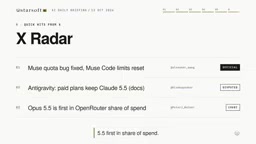
On OpenRouter's share chart, Opus 5.5 ranks first. This ranking reflects the actual call distribution on the API aggregation platform and can serve as a reference indicator for model market heat. You may not have noticed that leading in share doesn't equal leading in capability—price, latency, ecosystem lock-in, and other factors all influence developers' choices.
OpenRouter is a third-party platform that aggregates model APIs from multiple vendors, allowing developers to call models from different providers through a unified interface. Its share chart reflects the actual call volume distribution on that platform, not the entire market. This type of data has sample bias: developers who prefer trying new things and are price-sensitive are more likely to use aggregation platforms, while large enterprises often connect directly to vendor APIs. Therefore, share rankings can be viewed as a cross-section of "developers voting with their feet," more reliable for observing heat trends than for judging absolute market position.
The Industry Logic Behind Subscription Consolidation
Bundling a coding tool (Cursor), conversational AI (Grok), and social platform subscription (X Premium) into a single subscription system essentially does two things: raising the revenue ceiling per user and reducing churn across multiple products.
The weekly refresh design of the usage pool is also worth pondering—it creates a sense of urgency that "if you don't use it, you lose it," pushing users to call services more frequently and thereby deepening their dependence on the platform. For users, the key decision point is: does your usage pattern actually benefit from the cross-tool usage pool, or are you just paying for a bunch of credits you'll never use?
On the competitive landscape side, Meta entering the Agent race with its Muse series, DigitalOcean filling in Agent operations infrastructure, and OpenRouter's share data revealing real call preferences—these signals stacked together point to the same trend: AI Agents are moving from "can they work" to "can they be managed well."
Usage Pool mechanisms are a common design approach for subscription-based AI services, with a core logic similar to "shared quotas" in cloud computing or "data pools" in telecom plans. The traditional approach bills each product separately (each tool has an independent quota), while usage pools allow multiple tools under the same account to share a total quota. Weekly refresh is a pacing control method: monthly quotas tend to lead users to concentrate consumption at the beginning of the month and leave them idle at the end, while weekly refresh distributes load more evenly and shortens users' "psychological billing cycle," making the sense of loss from idle credits more frequently perceived. For platforms, this design both smooths computing resource scheduling pressure and increases users' daily active usage.
One-line Summary
Grok, Cursor, and X Premium merge subscriptions, while Meta and DigitalOcean double down on the Agent race.
Paragraph Summary
The AI tool subscription market is seeing structural consolidation: Grok, Cursor, and X Premium have been merged into a unified X-Subscription with four tiers—Plus, Premium, Super, and Ultra—priced from $8 to $200 per month, with a cross-tool usage pool that refreshes weekly, roughly double coding usage for Grok models, but third-party models billed separately at API list prices. Meanwhile, Meta released MuseWonder and WonderFull for Agent scenarios, with WonderFull scoring 56 on the intelligence index and 68 on coding Agent, on par with Sonnet 5.5; DigitalOcean opened previews of Signals and Simulations, providing fault flagging and simulation testing for Agents. OpenRouter share data shows Opus 5.5 in first place, but share leadership doesn't equal capability leadership. The overall trend is that AI Agents are shifting from "can they work" to "can they be managed well."
Related articles

@ai-sdk/vue 3.0.306 Patch Release Syncs with [email protected] Update
@ai-sdk/vue 3.0.306 released, synced with [email protected]. A routine patch release for the Vercel AI SDK ecosystem with no public API changes; the Vue adapter layer stays version-aligned with the core package.

Gemini 4 Argon API Launches: The Era of Million-Token Output Begins
Google launches Gemini 4 Argon with sparse MoE architecture, up to 1M output tokens, and a 68.90% Vals Index score, available across API, AI Studio, and the Gemini app.

DukaanAI: Turning Product Photos into Inventory Lists with Open-Source AI
DukaanAI is an AI inventory tool for small retailers that turns product photos into inventory entries using the open-source Gemma 3 model, with local inference, editable fields, and CSV export.