Grokbot Bioinformatics AI Agents: 11 Specialist Agents for Sequence Analysis

Grokbot deploys 11 specialist AI agents for bioinformatics researchers via MCP protocol in five minutes.
Grokbot is a professional-domain AI agent tool centered on templated deployment for building expert teams in five minutes. Users simply state their professional background in natural language, and the system automatically installs 11 specialist agents plus a coordinator bot via an MCP server, covering core bioinformatics tasks like sequence analysis and data processing. Its multi-agent architecture fits bioinformatics multi-step pipelines well, and the template library extends beyond bioinformatics to other professions. However, only a promotional demo exists so far, leaving key questions about analysis quality, database integration, underlying models, data security, and reproducibility unanswered.
The Time Problem for Bioinformatics Researchers
Genomic sequence analysis, high-throughput data interpretation, biological database management — these tasks consume the bulk of a bioinformatics researcher's working hours. Repetitive data processing pipelines, tedious format conversions, and batch alignments make it difficult for scientists to focus on the analysis and discoveries that actually matter.
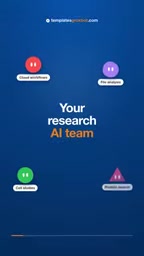
This is precisely the pain point that AI Agent tools aim to solve. Unlike general-purpose chatbots, a team of agents configured for a specific professional domain can understand the bioinformatics work context and directly address concrete task scenarios.
Grokbot's Core Approach: Templated Agent Teams
Based on a demonstration from YouTube, Grokbot's main pitch is the idea of "building an expert team in five minutes." It pre-packages the various specialist agents needed for bioinformatics work through a templated approach, so users don't have to configure anything from scratch.
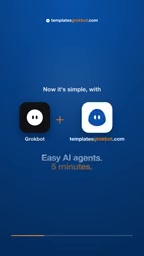
The entire process is described as remarkably simple: install Grokbot, add a template creator bot, and connect it to the template's Grokbot MCP server. Then just type a single natural language prompt — "I'm a bioinformatician" — and the system automatically finds and installs all relevant agents.
Worth highlighting here is the use of MCP (Model Context Protocol). As a standard protocol for connecting AI models with external tools and data sources, MCP makes collaboration between agents and calls to external resources more standardized. Grokbot uses MCP servers to distribute and organize templates, reflecting the current trend in the agent ecosystem toward standardized interfaces.
MCP (Model Context Protocol) is an open-source standard protocol proposed by Anthropic in late 2024 to address interoperability between AI models and external tools and data sources. Previously, each AI application needed to develop separate integrations for different data sources (databases, APIs, file systems, etc.), making maintenance extremely costly. MCP is built on a client-server architecture that defines unified message formats and calling interfaces: the AI model acts as a client and communicates with various "MCP servers" through the protocol, where each server encapsulates specific tool capabilities or data access logic. This design is analogous to the USB standard — once a device conforms to the specification, any compatible host can recognize and use it. By packaging its template distribution functionality as an MCP server, Grokbot means that theoretically any MCP-compatible AI client can call this template system without depending on Grokbot's proprietary interface.
11 Specialist Agents Plus 1 Coordinator
A defining feature of the Grokbot solution is "multi-agent collaboration." Once installed, users get 11 specialist agents covering different sub-tasks such as sequence analysis and data processing.
Beyond these task-specific expert agents, the solution also emphasizes adding a coordinator bot to enable the entire team to work in concert. This "specialist division of labor + central coordination" architecture is a typical design pattern in recent Multi-Agent Systems (MAS): individual agents handle deep tasks in specific domains, while the coordinator manages task assignment, process orchestration, and result integration to prevent agents from working in silos.

For bioinformatics work, which involves multi-step pipelines (e.g., sequence QC, alignment, variant calling, annotation, visualization), having multiple specialist agents collaborate in a coordinated division of labor is theoretically a much better fit for real workflows than a single general-purpose model.
The "coordinator" role in Multi-Agent Systems (MAS) has several mainstream implementation approaches in engineering practice: rule-based task routing, where the coordinator statically dispatches tasks to the corresponding specialist agent based on input type; LLM-based dynamic planning, where the coordinator is itself a language model capable of understanding task intent, decomposing subtasks, and dynamically scheduling; and a reflection-revision loop, where the coordinator collects outputs from all agents and performs consistency checks or merging. For bioinformatics pipelines, there are strict data dependencies between steps (for example, alignment results must first pass quality control before being used for variant calling), so whether the coordinator can perceive these upstream-downstream dependencies directly determines the reliability of the overall workflow. The demo does not clarify which mechanism Grokbot's coordinator uses — this is a critical aspect to examine when evaluating its practical usability.
The Template Ecosystem: Beyond Bioinformatics
Based on the demonstration, Grokbot doesn't only serve bioinformatics. The company mentions that "there's a template for any job," and users can find agent combinations suited to their profession at templatesgrokbot.com. Bioinformatics is just one vertical use case in its template library, used to showcase the solution's ability to land in specialized scenarios.
This "profession as template" product philosophy lowers the barrier to entry for AI agents. For professionals unfamiliar with agent configuration and prompt engineering, using a preset template is far more approachable than building from scratch.
A Measured Take: Questions Beyond the Demo
It's worth noting that the source material for this article is a promotional demo video focused primarily on "how to set things up quickly," leaving the following critical questions unanswered:
- What specific bioinformatics tasks do the 11 agents correspond to? How is the analysis quality?
- What are the actual capabilities for connecting to real genomic data and professional databases like NCBI and Ensembl?
- What is the underlying model? How is data privacy and security handled (research data is typically sensitive)?
- Can the actual processing performance deliver accuracy alongside the advertised "five-minute" convenience?
For bioinformatics researchers, ease of use matters, but the reliability and reproducibility of analysis results — as well as support for professional data formats — are the factors that truly determine whether a tool can become part of a real research workflow. We recommend that interested users validate the tool on a small scale in actual projects before making a full commitment.
Bioinformatics places particularly strict demands on tool reproducibility. Mainstream research communities (such as the Bioconductor, Nextflow, and Snakemake ecosystems) have long relied on version-locked pipelines and containerized environments (Docker/Singularity) to ensure consistency of analysis results across different machines and time points. AI agents introduce randomness (language model outputs with temperature > 0) and opaque intermediate steps, which are inherently in tension with the "exact reproducibility" paradigm of scientific research. Furthermore, core biological databases such as NCBI, Ensembl, and UniProt each have their own API specifications and data formats (FASTQ, BAM/CRAM, VCF, GFF3, etc.). For an agent to truly integrate into existing workflows, it needs deep adaptation to these formats and interfaces — not merely natural language-level task descriptions. These are the core issues that promotional demos typically don't address, but that researchers must verify before actual adoption.
Summary
Grokbot represents one attempt to move AI agent tools toward "vertical specialization" and "templated deployment." Using the MCP protocol to organize agents, a coordinator to oversee multi-agent collaboration, and natural language for one-click professional team configuration — these design choices all address real pain points in getting agents deployed in practice. However, as a tool intended for rigorous research contexts, its true capabilities still need more detailed empirical testing to be substantiated.
Related articles

JobRunner MCP Server: AI Agents Can Now Fix Failed Java Jobs
JobRunner launches an open-source MCP server enabling AI agents to view cluster status, diagnose failures, and recover Java jobs—incident response from any cloud coding environment or existing agent.

MLAI Digital Launches 9 Security Agents: MCP Server Safeguards the Full Lifecycle of Agentic AI
MLAI Digital launches Security MCP Server with nine built-in specialized security agents covering vulnerability discovery, attack simulation, prompt injection detection, API and infrastructure assessment, and accelerated remediation—embedding security validation across the full Agentic AI lifecycle from development to production.

Running Isaac Lab on H100 GPUs: Exploring Better Approaches
Exploring optimization methods for running Isaac Lab on NVIDIA H100 GPUs, including MIG configuration, mixed precision, TensorRT acceleration, and community experience to improve robotics simulation and reinforcement learning efficiency.