Grokbot: Build 8 AI Agents in 5 Minutes to Lighten the Load for Writers

Grokbot deploys 8 specialized AI writing agents in under 5 minutes using templates and the MCP protocol.
Grokbot is an AI agent platform built for creative professionals like writers, centered on rapid five-minute deployment. It connects to a template server via the MCP protocol and uses a single natural language command to automatically discover and install job-relevant bot modules — giving writers 8 specialized agents covering research, style, and promotion, plus a coordinator to orchestrate them all. This multi-agent architecture is more stable and controllable than relying on a single large model. Grokbot also extends the same framework to other professions through its template system. Current information is based on the official demo; real-world effectiveness should be evaluated before deep adoption.
Where Does a Writer's Time Actually Go?
Writing has never been just about putting words on a page. Research, outlining, style editing, revisions, promotion — every step demands constant switching between different tools. For many independent authors, the time actually spent creating is largely consumed by tool-switching and workflow coordination.
That's exactly the pain point Grokbot aims to solve. According to its official demo, it's an AI agent system that anyone can configure in under five minutes, designed specifically for creators like writers who require multi-step collaboration.

What Is Grokbot?
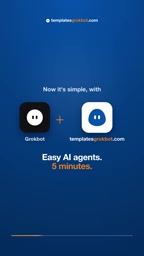
Grokbot's core philosophy is turning AI agents into tools that anyone can deploy quickly. According to the demo, the setup process is straightforward:
- Install Grokbot
- Add a template creator bot
- Connect it to the template's Grokbot MCP server
- Enter the command: "I'm a writer, find and install all relevant bots"
- Add a coordinator bot to get the whole team working together
After these steps, users end up with 8 specialized agents covering different tasks, plus 1 coordinator to orchestrate them all. The official claim is the entire process takes under five minutes.
The Role of the MCP Protocol
The MCP server mentioned here is worth noting. MCP (Model Context Protocol) is a standardization protocol that has been gaining traction in the AI tooling ecosystem, designed to establish contextual connections between different models and tools. Grokbot uses the template's MCP server to discover and install relevant bots in bulk — meaning users don't need to configure each one manually. Instead, a single natural language command lets the system handle the matching automatically.

MCP (Model Context Protocol) was proposed and open-sourced by Anthropic in late 2024, with the goal of establishing a unified standard for communication between AI models and external tools or data sources. Think of it as the "USB port" of the AI tool ecosystem. Previously, every AI application had to develop its own custom integration for each external tool — costly and hard to reuse. MCP defines a common specification for context passing, allowing models to interact with file systems, databases, search engines, and third-party APIs in a consistent way. For a multi-agent platform like Grokbot, the MCP server acts as a "directory hub," enabling coordinators or template creators to automatically discover available bot modules and load them on demand — without users needing to understand the underlying interface details. This is why a single natural language command can trigger a batch installation: the system handles the entire service discovery and registration process in the background via the MCP protocol.
How 8 Agents + 1 Coordinator Work Together
The most interesting design choice in this system is the "team-based" approach. Rather than providing one all-powerful assistant, Grokbot breaks the writing workflow into multiple specialized roles — covering research, style, book promotion, and other distinct stages — then uses a coordinator to orchestrate them all, letting the agents collaborate like a real team.
This "multi-agent" architecture is one of the key directions AI applications are evolving toward. Compared to a single large model handling everything, a team of agents with clearly defined responsibilities tends to be more stable and controllable in complex, multi-step workflows. The coordinator exists specifically to handle task allocation and result integration across multiple agents.

In a Multi-Agent System, the "coordinator" typically plays the role of an Orchestrator — breaking down the user's high-level goals into subtasks, dispatching them to specialized agents, collecting their outputs, and deciding on next steps. The key advantage of this pattern is that each individual agent only needs to handle a focused subtask within a limited context window, reducing the likelihood of errors and making it easier to optimize or replace specific components. By contrast, if a single model handles the entire writing workflow, earlier information tends to get "forgotten" as conversation turns accumulate, and maintaining logical continuity between tasks becomes harder to guarantee. That said, multi-agent architectures do introduce new complexity: message-passing latency between agents, the decision quality of the coordinator itself, and error propagation can all affect overall system stability — which is why real-world performance still needs independent validation.
Beyond Writing: The Extensibility of Template-Based Design
The demo also hints at a broader ambition: Grokbot isn't just for writers. The team states that "every job has a corresponding template," and users can find solutions suited to their profession at templatesgrokbot.com/for-my-job.
In other words, "writer" is just one example scenario. This template-plus-multi-agent framework can theoretically be applied to any profession that involves multi-step collaboration — whether that's marketing, design, or data analysis. The purpose of a template is to pre-package the typical workflow of a given profession into a ready-made set of agents, lowering the barrier for everyday users.
Quick Take
Based on the demo, Grokbot's main selling points are "low barrier to entry" and "rapid deployment." Five-minute setup, natural language installation commands, and template-based professional solutions all reduce the difficulty for everyday users getting started with multi-agent systems.
That said, it's worth noting that the information available so far comes only from product promotional materials. The real-world collaboration quality of the agents, their output quality, and the actual effectiveness of the promotional features still need further validation. For writers considering giving it a try, it's worth starting with a free or trial plan to assess whether it genuinely fits your creative workflow before committing to deep reliance on it.
Related articles

Workbuddy for Absolute Beginners: How a Desktop AI Agent Fits Into Real Workflows
A beginner's guide to the Workbuddy desktop AI agent: installation, claiming credits, file management, and building automated workflows—compared with CodeX for fit and cost, helping professionals shift from AI question-askers to AI managers.

OpenAI's New Agent Stack: Computer Use, Decisions API, and Ultra-Fast Workflows
OpenAI Dev Day unveiled a new agent stack: Computer Use outperforms humans, Decisions API delivers ultra-low-latency classification via Luna, Agents API opens the same Computer Use capabilities, and GPT-6.1 Sol costs only one-seventh of Astra. Core updates, benchmark data, and developer insights.

Liang Wenfeng Open-Sources DeepInfo Inference Framework, Takes On U.S. Ban
DeepSeek open-sources its DeepInfo inference framework after its models, featuring GPU/CPU cross-pipelining, small-model prediction with large-model verification, and full Huawei Ascend and NVIDIA chip support—facing the U.S. federal ban head-on. This article analyzes its significance for AI deployment and open-source strategy.