GrokBot: Deploy 11 AI Agents in 5 Minutes and Free Biomedical Engineers from Documentation Hell

GrokBot deploys 11 AI agents in 5 minutes to automate biomedical engineering documentation via MCP — but verify before using in compliance workflows.
GrokBot is an AI agent deployment tool aimed at biomedical engineers, promising a 5-minute setup. Users describe their role in natural language, and the system automatically installs 11 specialist agents plus a coordinator bot that collaborate via an MCP server. Target use cases include clinical requirement organization, engineering documentation, and regulatory paperwork. The platform also offers cross-industry templates via templatesgrokbot.com. However, all claims are based on official promotional demos — real-world performance and reliability in high-stakes compliance scenarios like medical device documentation require independent validation.
Biomedical engineers spend a staggering amount of their workday on clinical requirements, engineering documentation, and regulatory paperwork. GrokBot proposes a new approach: deploy AI agents quickly to handle these repetitive documentation tasks through dedicated intelligent assistants. This article breaks down GrokBot's core functionality and positioning based on its official demo, helping you decide whether it's worth trying.
The Documentation Burden Facing Biomedical Engineers
For biomedical engineers, the start of a new week is often buried under paperwork. Clinical requirements need constant organization, engineering documents must remain consistent and traceable, and regulatory paperwork leaves zero room for error. These tasks are necessary, yet they consume enormous amounts of time and attention.
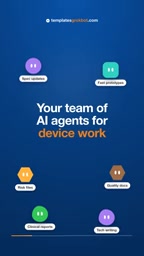
GrokBot's pitch zeroes in on exactly this pain point — it claims to ensure that "clinical requirements, engineering documents, and regulatory paperwork no longer eat up your Monday." Its core argument is that structured, rule-based documentation tasks are precisely what AI agents do best.
What Is GrokBot: An AI Agent Tool Anyone Can Set Up in 5 Minutes
GrokBot positions itself as an AI agent tool that "anyone can configure in 5 minutes." The barrier to entry is deliberately kept as low as possible, with an emphasis on enabling professionals without a technical background to quickly assemble their own intelligent assistant team.
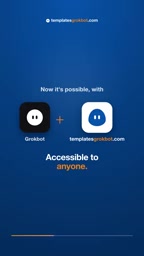
According to the official demo, the deployment process involves a few steps: install GrokBot, add a template creator bot, and connect it to the GrokBot MCP server corresponding to the template. The MCP (Model Context Protocol) mechanism here allows agents to share context and work collaboratively — it's the critical underlying layer that makes the entire system function.
Mobilize Your Entire Team with a Single Sentence
GrokBot's interaction style is notably streamlined — you simply describe who you are and what you need in natural language. The demo command shown is: "I'm a biomedical engineer. Find and install all relevant bots."

The system then automatically matches and installs professional agents relevant to that role, eliminating the tedious process of selecting and configuring each one individually. This "describe your role → auto-assemble your team" model reduces the cognitive burden of understanding what each tool does.
What Is MCP? MCP (Model Context Protocol) is an open standard protocol proposed and open-sourced by Anthropic in late 2024, designed to solve the interoperability problem between AI models and external tools and data sources. The core idea is similar to a universal USB standard — any application, database, or service that implements the MCP interface can be accessed by AI agents in a consistent way, without needing custom integration code for each tool. In multi-agent scenarios, the MCP server acts as a central hub for context, allowing agents to share task state, document content, and action history, preventing information silos. This is the technical foundation for GrokBot's claim that multiple specialized agents can "work together rather than in isolation." MCP is already supported by major AI tools including Claude and Cursor, and is becoming a key piece of infrastructure in the AI agent ecosystem.
11 Specialist Agents + 1 Coordinator
The centerpiece of GrokBot's offering is team-based operation. After completing the initial setup, users also need to add a coordinator bot so the entire team can work in sync rather than independently.

GrokBot claims the entire process can be completed in under 5 minutes, leaving you with 11 specialist agents plus one coordinator. This "specialized roles + central coordination" architecture essentially simulates a real working team: each agent handles a specific document type, while the coordinator manages task assignment and integration, avoiding output conflicts and duplicated effort.
Multi-agent collaboration is a significant evolution in current AI applications. Compared to a single general-purpose chatbot, a team of purpose-built agents with clearly defined responsibilities theoretically delivers greater accuracy and consistency when handling complex, process-driven professional tasks.
Templates: An Expansion Strategy for Any Industry
GrokBot isn't limited to biomedical engineering. Its companion site, templatesgrokbot.com, offers a template library for "any job," where users can find agent configurations suited to their profession.
This template-based strategy signals that GrokBot isn't targeting a single vertical market — it's aiming to become a cross-industry AI agent deployment platform. For roles that involve large volumes of standardized document workflows — whether in engineering, legal, or compliance — this kind of out-of-the-box agent team has real potential value.
A Sober Look: The Gap Between Marketing and Reality
It's worth noting that all information in this article comes directly from GrokBot's official demo, which is inherently promotional in nature. Claims like "deploy 11 agents in 5 minutes" and "free up your Monday" are largely marketing language. The actual performance, accuracy, and reliability in strictly regulated environments (such as medical device compliance documentation) still require independent verification.
For fields like biomedical engineering — where document accuracy standards are exceptionally high — key questions must be evaluated before adoption: Can AI agent-generated content meet regulatory review standards? Does it require human review? Tools can improve efficiency, but when it comes to compliance documentation, the ultimate responsibility still rests with the engineer.
Interested readers can try the official demo themselves to assess whether it fits their actual workflow.
A Note on Regulatory Documentation in Biomedical Engineering Regulatory documentation in the biomedical engineering field typically must comply with rigorous standards such as FDA 21 CFR Part 820 (Quality System Regulation), ISO 13485 (Medical Devices Quality Management Systems), or the EU MDR. The wording, traceability, and version control of these documents are all subject to clear constraints. The core risks of AI-generated content in these contexts go beyond factual accuracy — they include whether terminology aligns with regulatory conventions, whether cited standards are current and in effect, and whether the document generation process itself produces an auditable trail. Some regulatory bodies have already begun scrutinizing validation requirements for AI-assisted compliance documentation. As a result, before integrating any AI agent tool into a formal compliance workflow, organizations typically need to complete Tool Validation and retain the associated records — a step that may itself offset some of the efficiency gains.
Related articles

Felix Rieseberg Personal Homepage
Felix Rieseberg's personal homepage sparks attention on Hacker News. This article covers the Slack engineer's technical background, the rise and fall of nativefier, and the value of a developer homepage as a tech calling card.

@ai-sdk/vue 3.0.306 Patch Release Syncs with [email protected] Update
@ai-sdk/vue 3.0.306 released, synced with [email protected]. A routine patch release for the Vercel AI SDK ecosystem with no public API changes; the Vue adapter layer stays version-aligned with the core package.

Gemini 4 Argon API Launches: The Era of Million-Token Output Begins
Google launches Gemini 4 Argon with sparse MoE architecture, up to 1M output tokens, and a 68.90% Vals Index score, available across API, AI Studio, and the Gemini app.