GrokBot in Action: How Business Coaches Can Use an AI Agent Team to Manage the Details

GrokBot uses MCP and templates to spin up a multi-agent team for business coaches in minutes — but real-world results are unverified.
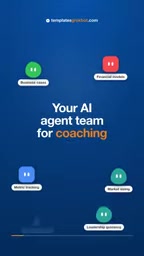
GrokBot is a ready-to-use AI agent tool built on MCP, with a core pitch of minimal setup: users install the app, connect to a template server, declare their professional role, and the system auto-installs matching specialist bots. Add a coordinator agent and you have a multi-agent team. The business coach demo generates 11 agents — covering financial analysis, goal-setting, and more — coordinated by a single orchestrator. This "specialists + coordinator" architecture is mainstream in AI agent design, and template-based packaging removes the prompt engineering learning curve. However, the source is a single product demo video, with no third-party validation of output quality, data compliance, or template reliability. Treat it as a promising direction, not a proven solution.
Business coaches juggle a lot at once — evaluating business performance, setting growth targets, and reviewing financial metrics often happen in parallel, and details can easily fall through the cracks. A YouTube demo introduces GrokBot, an AI agent tool built for specific professional roles that claims to be up and running in five minutes. This article breaks down how it works and where its limits lie, based on that demo.
What Is GrokBot?
According to the demo, GrokBot is a set of "ready-to-use" AI agents. Its core pitch is a low setup barrier: users don't need to write complex code. Just install GrokBot, add a "Template Creator" bot, and connect it to the MCP server at templates.grokbot.com — that's the basic environment up and running.
Worth noting here is the role of MCP (Model Context Protocol). As a connectivity protocol between models and external tools and data sources, MCP is becoming a universal interface in the AI agent ecosystem. GrokBot's use of an MCP server to pull templates means it treats "capabilities" as pluggable modules rather than hard-coded features.
MCP (Model Context Protocol) is an open-source standardized protocol proposed by Anthropic in late 2024, designed to solve the fragmented integration problem between AI models and external data sources or tools. Before MCP, every AI application that needed to connect to a database, API, or local file had to build a separate adapter for each data source — an extremely costly maintenance burden. MCP standardizes this process: as long as a tool provider implements an MCP server, any MCP-compatible AI client can call it directly, much like how USB standardized peripheral connections. For tools like GrokBot, pulling templates via MCP means the template library can iterate independently without modifying the agent itself — this is the technical foundation behind its claimed "pluggable" capabilities. Major AI tools including Cursor and Claude Desktop already support MCP, and the protocol is quickly becoming the de facto standard in the AI agent ecosystem.
Building an Agent Team in Five Minutes
The workflow shown in the demo is refreshingly simple. After installing GrokBot and connecting to the template server, users just type a single natural-language prompt — something like "I'm a business coach" — and the system automatically finds and installs all relevant bots.
From there, you add a "Coordinator" bot to get these specialized agents working together. According to the demo, the entire process takes under five minutes and results in 11 specialized agents plus one coordinator — a complete working "team."
This "specialists + coordinator" multi-agent architecture is a classic design pattern in today's AI agent landscape. Individual agents handle specific subtasks (such as financial analysis or goal-setting), while the coordinator handles task routing and result aggregation, breaking a complex workflow into a manageable collaborative network. For a business coach, this means financial metric reviews, growth target tracking, and performance assessments can each be handled by a dedicated agent, with the coordinator consolidating everything.

Prompt Engineering refers to the craft of designing input instructions for AI models to guide them toward a desired output. Without a templated tool, building a reliable business analysis agent typically requires practitioners to repeatedly fine-tune system prompts — defining the agent's role, task boundaries, output format, and error-handling logic — a process that can take hours or even days. GrokBot's template approach essentially front-loads and packages this work: the platform handles the standardized prompt crafting, and users skip the learning curve by simply stating their professional role. This has genuine practical value for non-technical consultants, though it also means users hand over full control of prompt quality to the platform and lose the ability to make fine-grained customizations for their specific business context.
Template-Driven Generality
GrokBot emphasizes that "every job has a matching template," and users can browse templates suited to their profession at templates.grokbot.com. Business coaching is just one example scenario in the demo — the underlying logic is templating: packaging a profession's typical workflow into a pre-configured set of agents that users access simply by declaring their role.
The advantage of this model is that it dramatically lowers the barrier to using AI agents — users don't need to understand prompt engineering or agent orchestration. That said, from the demo materials alone, this reads more like a product pitch than a proof of concept: there are no details on actual runtime performance, output quality, or data security.

A Sober Look: The Questions Left Unanswered
To be clear, this article is based on a single product demo video. The claim of "11 agents in five minutes" is a vendor assertion with no third-party verification. Several key questions remain unanswered: How accurate are these agents when handling financial metrics? Is template quality consistent? How well does the coordinator actually perform on complex tasks? And how is data privacy and compliance handled?
For business coaches or consultants considering this kind of tool, treat it as "a direction worth exploring" rather than a proven solution. Multi-agent collaboration does represent where AI tooling is heading, and template-driven low-code deployment does reduce adoption costs for professionals — but real-world value still needs to be validated in your own business context.
Summary
GrokBot lays out a clear product direction: use MCP as the connectivity layer, encapsulate professional workflows in templates, and handle complex tasks through multi-agent collaboration. For business coaches who need to manage information across multiple dimensions simultaneously, the "expert team" metaphor is genuinely compelling. But behind the simplicity of the demo, actual effectiveness and reliability still need independent evaluation to answer.
Related articles

Workbuddy for Absolute Beginners: How a Desktop AI Agent Fits Into Real Workflows
A beginner's guide to the Workbuddy desktop AI agent: installation, claiming credits, file management, and building automated workflows—compared with CodeX for fit and cost, helping professionals shift from AI question-askers to AI managers.

OpenAI's New Agent Stack: Computer Use, Decisions API, and Ultra-Fast Workflows
OpenAI Dev Day unveiled a new agent stack: Computer Use outperforms humans, Decisions API delivers ultra-low-latency classification via Luna, Agents API opens the same Computer Use capabilities, and GPT-6.1 Sol costs only one-seventh of Astra. Core updates, benchmark data, and developer insights.

Liang Wenfeng Open-Sources DeepInfo Inference Framework, Takes On U.S. Ban
DeepSeek open-sources its DeepInfo inference framework after its models, featuring GPU/CPU cross-pipelining, small-model prediction with large-model verification, and full Huawei Ascend and NVIDIA chip support—facing the U.S. federal ban head-on. This article analyzes its significance for AI deployment and open-source strategy.